Gemini 4 Hydrogen vs Claude Sonnet 5.5, GPT-6.1 Terra and Gemini 4 Argon
Gemini 4 Hydrogen scores within a point of Claude Sonnet 5.5 for a third of the cost per task. We compare it with Sonnet 5.5, GPT-6.1 Terra and Gemini 4 Argon.
WidelAI Research
Evidence-led analysis for practical multi-model AI decisions
Gemini 4 Hydrogen is Google's new fast, low-cost Gemini 4 model. It shipped on November 12, 2026 as gemini-4-hydrogen, two weeks after Gemini 4 Argon reached general availability, and it is aimed at the work most people actually send to a model all day: coding agents, spreadsheets, research and documents, at a price low enough to leave running. Input is $1.50 per million tokens and output is $7.50, flat across the whole 1M-token context window.
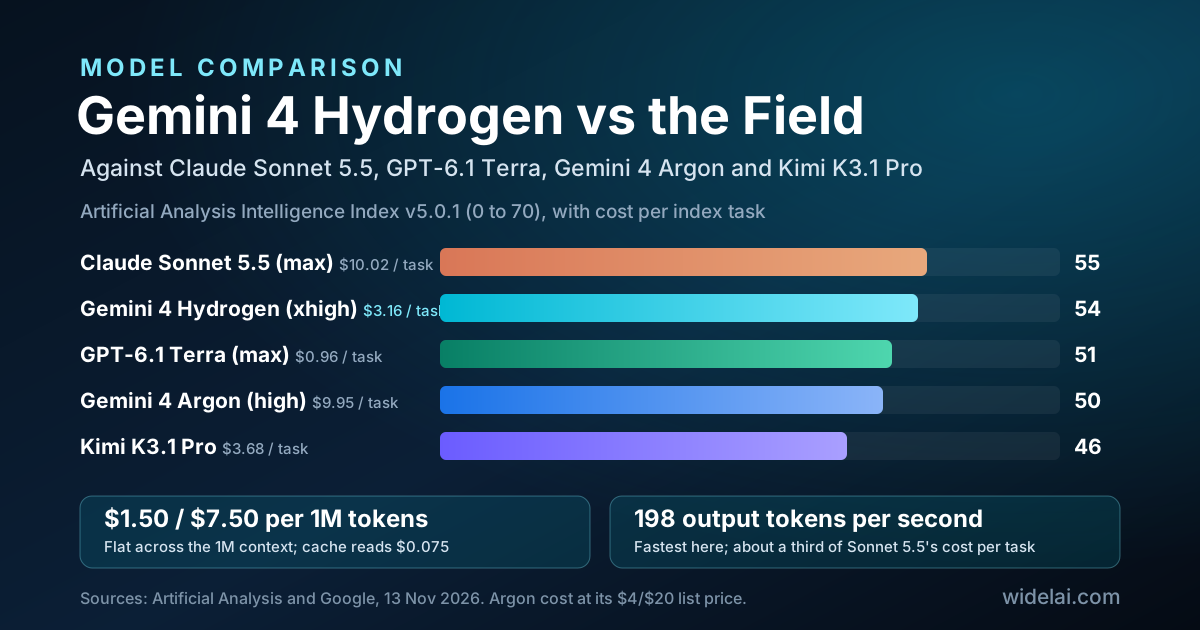
The short version: one day in, Hydrogen scores 54 on the Artificial Analysis Intelligence Index at its new xhigh setting, one point behind Claude Sonnet 5.5 at max and three points ahead of GPT-6.1 Terra, for about a third of Sonnet's cost per task. It is the fastest model in this comparison at 198 output tokens per second. It is not the strongest coder here: Sonnet 5.5 still leads Terminal-Bench and computer use, and GPT-6.1 Terra is cheaper per task again.
This guide compares Hydrogen with the models you would weigh it against: Claude Sonnet 5.5, OpenAI's GPT-6.1 Terra and Google's own Gemini 4 Argon, with Kimi K3.1 Pro and Claude Haiku 5.5 where the independent numbers help. It covers specifications and price, Google's benchmarks, the independent results, cost and speed per task, a routing table by task, and how to try Hydrogen on WidelAI and in WidelCode today.
Sources: Google's Gemini 4 Hydrogen announcement, developer post, what's new, model page, API pricing and model card; OpenAI's GPT-6.1 Terra model page; Artificial Analysis model pages for each model, Intelligence Index v5.0.1; Vals AI model pages and the Vals Index. All independent figures were checked on November 13, 2026. Benchmark tables are Google-reported unless marked otherwise.
The Short Answer
- Best value for everyday agentic work: Gemini 4 Hydrogen. 54 on the Artificial Analysis index at xhigh for $3.16 per task, against Sonnet 5.5's 55 for $10.02, and the fastest output of any model here.
- Strongest model in this group: Claude Sonnet 5.5. Second of 37 on the Vals Index (70.85%), first on Terminal-Bench 4.1 and OSWorld-2.1 in Google's own table, and still the safer pick for hard coding and desktop agents.
- Cheapest per task: GPT-6.1 Terra. 51 on the Artificial Analysis index for $0.96 per task at $1 / $5 per million tokens. It is slow (70 tokens per second) and weak on Vals' legal and tax tests.
- Gemini 4 Argon is now the expensive Gemini. Hydrogen beats it on the Artificial Analysis index (51 to 50 at the same high setting) at 75% of its introductory price and 37.5% of its December price. Argon still leads Vals' legal boards.
- Biggest surprise: tax and finance. Hydrogen is first of 85 on Vals Tax Agent Bench (52.30%) and second of 40 on the Vals Finance Index.
- Biggest caveat: it is one day old. Google's comparison table covers only Sonnet 5.5 and Terra, and independent runs are still landing.
The Models at a Glance
| Released | Context | Max output | Direct price (in / out per 1M) | Cache read per 1M | WidelAI credits per 1K (in / out) | |
|---|---|---|---|---|---|---|
| Gemini 4 Hydrogen | Nov 12, 2026 | 1M | 64K (1M with long decode) | $1.50 / $7.50 | $0.075 | 0.30 / 1.50 |
| Claude Sonnet 5.5 | Sep 28, 2026 | 1M | 128K | $2 / $10 | $0.20 | 0.40 / 2.00 |
| GPT-6.1 Terra | Oct 26, 2026 | 1.05M | 128K | $1 / $5 (2x input, 1.5x output above 272K) | $0.05 | Not on WidelAI |
| Gemini 4 Argon | Oct 13, 2026 | 1M | 64K | $2 / $10 to Nov 30, then $4 / $20 | $0.10, then $0.20 | 0.40 / 2.00 until Nov 30 |
Prices from Google's, Anthropic's and OpenAI's API pricing pages. WidelAI bills 1 credit per $0.005 of provider API cost. GPT-6.1 Terra bills a whole request at the higher rate once the prompt passes 272K tokens.
Four things stand out before any benchmark:
- Hydrogen has no long-context surcharge and no introductory clock. Google prices it flat across the 1M window. Argon's $2 / $10 ends on November 30; Terra doubles its input price above 272K tokens.
- Its output ceiling is the lowest by default. A synchronous call returns up to 65,536 tokens, half of Sonnet 5.5 and Terra. Google's Interactions API can run a long decode up to 1M output tokens in the background, but that is a separate mode.
- It accepts the most input types. Text, images, video, audio and PDF all go in. Sonnet 5.5 and Terra take text and images.
- It adds a thinking level. Hydrogen offers low, medium, high (the default) and a new xhigh. The older minimal level is rejected with an error, and temperature, top-p and top-k are ignored, as on Argon.
What Google's Benchmarks Show
Google's model card compares Hydrogen with exactly the two models this guide is about: Claude Sonnet 5.5 and GPT-6.1 Terra. Hydrogen is best on 7 of the 10 rows. Sonnet 5.5 takes the other three, and they are the three that matter most for coding agents.
| Benchmark | Gemini 4 Hydrogen | Claude Sonnet 5.5 | GPT-6.1 Terra |
|---|---|---|---|
| SWE-sweep (agentic coding) | 13.5% | 3.1% | 5.8% |
| Terminal-Bench 4.1 (cheating-adjusted) | 57.0% | 63.9% | Not reported |
| Agents' Last Exam v1.1 | 71.6% | 60.4% | 69.8% |
| AutomationBench-AA | 76.1% | 71.8% | 60.2% |
| Vending-Bench 2 (final bank balance) | $14,549 | $11,165 | $9,107 |
| OSWorld-2.1 (offline subset) | 77.6% | 83.9% | 74.2% |
| MKA (multimodal) | 53.4% | 52.0% | 43.8% |
| Chartography | 66.6% | 61.6% | 63.2% |
| Terminal-Bench-Science 0.1 | 51.4% | 59.9% | 58.3% |
| HLE-Diamond (reasoning) | 58.8% | 53.3% | 47.3% |
Google-reported, from the Gemini 4 Hydrogen model card, "as of November 2026". Bold is best in row.
Where Hydrogen wins
The rows Hydrogen wins are about finishing long, practical tasks. Agents' Last Exam and AutomationBench-AA measure multistep knowledge work and business automation; Vending-Bench 2 runs a simulated business for months and scores the final balance. Hydrogen leads all three, and by a wide margin on AutomationBench (16 points over Terra). It also leads both multimodal rows and HLE-Diamond, a hard reasoning set where it is 5.5 points clear of Sonnet 5.5.
Google's launch post adds a comparison with its own previous fast model. On Terminal-Bench 4.1, Hydrogen scores 57% against 18.2% for Gemini 3.8 Flash, and Google says it finishes tasks 2.5 times faster at its default high setting. Partners reported 2x to 2.8x speedups with 12% to 23% fewer tokens.
Where Sonnet 5.5 wins
Sonnet 5.5 leads the terminal and computer-use rows: Terminal-Bench 4.1 by 6.9 points, OSWorld-2.1 by 6.3 and Terminal-Bench-Science by 8.5. Those are the benchmarks closest to what a coding agent like WidelCode does: run commands, read output, edit files and try again. If your work is mostly that, Google's own table says Sonnet 5.5 is still ahead.
SWE-sweep, the one coding row Hydrogen wins, is a new and very hard benchmark where every model scores below 15%. Treat a 13.5% against 3.1% result as interesting rather than decisive.
What the table leaves out
Google did not put Gemini 4 Argon in Hydrogen's table, and OpenAI's Terra launch compared Terra with GPT-5.6 Terra and GPT-6 Astra, not with Gemini. For the cross-vendor picture, the independent results below are the better guide.
What the Independent Results Show
Artificial Analysis
| Model (setting) | Intelligence Index | Cost per index task | Output speed | Time to first answer token |
|---|---|---|---|---|
| Claude Sonnet 5.5 (max) | 55 | $10.02 | 144 tok/s | 260.4 s |
| Gemini 4 Hydrogen (xhigh) | 54 | $3.16 | 198 tok/s | 41.1 s |
| Gemini 4 Hydrogen (high) | 51 | Not yet published | Not yet published | Not yet published |
| GPT-6.1 Terra (max) | 51 | $0.96 | 70 tok/s | 163.9 s |
| Gemini 4 Argon (high) | 50 | $9.95 | 64 tok/s | 39.9 s |
| Kimi K3.1 Pro (reasoning) | 46 | $3.68 | 32 tok/s | 169.5 s |
| Claude Haiku 5.5 (max) | 36 | $0.41 | 256 tok/s | 182.9 s |
Artificial Analysis Intelligence Index v5.0.1, checked November 13, 2026. The Hydrogen (high) score of 51 is from Google's launch post, citing Artificial Analysis. Argon's cost is at Google's $4 / $20 standard rate; at the introductory rate it is about half.
Three readings:
- Hydrogen at xhigh is within a point of Sonnet 5.5 at max for 32% of the cost. It also spends far less time per task: 13.0 minutes against 33.0 for Sonnet 5.5, on Artificial Analysis' measurements.
- GPT-6.1 Terra is the value outlier. It spent 99.4M output tokens on the index against Hydrogen's 304M and Sonnet's 335M, which, with the lowest token price, makes it a third of Hydrogen's cost per task. The trade is speed: 70 tokens per second and almost three minutes to the first answer token.
- Hydrogen replaces Argon on most axes. Higher index score, three times the output speed, a third of the cost per task at list price, and the same 1M context.
Vals AI
| Model (setting) | Vals Index | Rank of 37 | Cost per test | Terminal-Bench 4.0 | Tax Agent Bench | Legal Index | Finance Index |
|---|---|---|---|---|---|---|---|
| Claude Sonnet 5.5 (max) | 70.85% | 2 | $16.18 | 64.14% | 41.96% | 68.02% | 64.53% |
| Gemini 4 Argon (high) | 69.39% | 5 | $13.37 | 57.58% | 49.22% | 76.78% | 66.00% |
| Gemini 4 Hydrogen (xhigh) | 68.49% | 6 | $9.84 | 54.04% | 52.30% | 73.63% | 66.14% |
| GPT-6.1 Terra (max) | 60.54% | 13 | $2.94 | 49.49% | 17.08% | 58.76% | 53.32% |
Vals AI, checked November 13, 2026. Vals prices Argon at its $4 / $20 standard rate.
Vals tells a similar story with sharper edges. Sonnet 5.5 is the strongest of the four overall and on Terminal-Bench 4.0, where it is third of 64 models; Hydrogen is eleventh. Hydrogen is first of 85 on Tax Agent Bench and second of 40 on the Finance Index, ahead of every model in this comparison. Argon keeps the legal crown. GPT-6.1 Terra is thirteenth overall and near the bottom of Vals' legal and tax boards (65th of 94 on Legal Research, 61st of 85 on Tax), which matters if you were planning to use it for professional documents.
On Vibe Code Bench, which builds whole apps from a prompt, Sonnet 5.5 scores 92.39% (second of 128), Argon 91.91%, Hydrogen 87.78% and Terra 84.00%.
Cost and Speed per Task
Per-token prices only tell half the story, because models spend very different numbers of thinking tokens on the same problem. Putting the independent results side by side:
| Model | Price (in / out per 1M) | AA cost per task | Vals cost per test | Output speed |
|---|---|---|---|---|
| GPT-6.1 Terra (max) | $1 / $5 | $0.96 | $2.94 | 70 tok/s |
| Gemini 4 Hydrogen (xhigh) | $1.50 / $7.50 | $3.16 | $9.84 | 198 tok/s |
| Gemini 4 Argon (high) | $4 / $20 list | $9.95 | $13.37 | 64 tok/s |
| Claude Sonnet 5.5 (max) | $2 / $10 | $10.02 | $16.18 | 144 tok/s |
Hydrogen is not the cheapest per task. Terra is, by roughly three times, because it thinks far less. What Hydrogen offers is near-Sonnet quality at a third of Sonnet's cost and the fastest wall-clock time here, which is what matters when a person is waiting on the answer or an agent is running dozens of steps in a row.
On WidelAI the same logic applies in credits. A chat turn with 20,000 tokens of context and a 2,000-token answer costs:
| Model | Credits per 1K (in / out) | Credits for the example turn |
|---|---|---|
| Gemini 3.8 Flash | 0.15 / 0.75 | 4.5 |
| Gemini 4 Hydrogen | 0.30 / 1.50 | 9 |
| Claude Sonnet 5.5 | 0.40 / 2.00 | 12 |
| Gemini 4 Argon, until Nov 30 | 0.40 / 2.00 | 12 |
| Kimi K3.1 Pro | 0.40 / 2.00 | 12 |
| Gemini 4 Argon, from Dec 1 | 0.80 / 4.00 | 24 |
The 2,000 output tokens include thinking, which every model here bills as output, so a hard prompt costs more than an easy one. Cache reads change long conversations: Google bills Gemini 4 cache hits at 5% of the input price, so once a long thread or repository is cached, re-reading it on Hydrogen costs 0.015 credits per 1K tokens, against 0.04 on Sonnet 5.5. Every rate is on the pricing transparency page.
Which Model to Use for Each Task
| If you need... | Use | Why |
|---|---|---|
| A fast, low-cost default for chat and agents | Gemini 4 Hydrogen | 54 on the AA index at a third of Sonnet's cost per task; 198 tok/s |
| Hard agentic coding in a terminal | Claude Sonnet 5.5 | 63.9% Terminal-Bench 4.1 against 57.0%; third of 64 on Vals Terminal-Bench 4.0 |
| Desktop and computer-use agents | Claude Sonnet 5.5 | 83.9% OSWorld-2.1, 6.3 points clear |
| Business automation and multistep knowledge work | Gemini 4 Hydrogen | First on Agents' Last Exam, AutomationBench-AA and Vending-Bench 2 |
| Tax and finance work | Gemini 4 Hydrogen | First of 85 on Vals Tax Agent Bench; second of 40 on the Finance Index |
| Legal research | Gemini 4 Argon | 76.78% Vals Legal Index, second of 37 |
| Charts, video, audio and PDFs | Gemini 4 Hydrogen | Widest input support; leads MKA and Chartography |
| The lowest cost per task, latency no object | GPT-6.1 Terra | $0.96 per AA task; avoid for legal and tax |
| Very long outputs in one call | Claude Sonnet 5.5 | 128K synchronous output against Hydrogen's 64K |
| Argon workloads that are not legal | Gemini 4 Hydrogen | Higher AA score, three times the speed, lower price |
Real work rarely fits one row. A sensible setup is to make Hydrogen the default for chat, research and spreadsheet-style work, escalate terminal-heavy coding and computer-use runs to Sonnet 5.5, keep Argon for legal and long-document analysis while its introductory price lasts, and reach for an Opus or Fable model only when Sonnet 5.5 falls short.
Caveats Before You Switch
- Most of these numbers are one day old. Vals and Artificial Analysis published within a day of launch, and Artificial Analysis has not yet published cost and speed for Hydrogen at its default high setting. Expect movement.
- Settings differ across evaluators. Artificial Analysis and Vals ran Hydrogen at xhigh, Sonnet 5.5 and Terra at max, and Argon at high. Google's own index claim (51 at high) is the like-for-like comparison with Argon.
- Google's table is Google's. It picked the benchmarks and the two rivals. Sonnet 5.5 still wins the three rows closest to coding-agent work.
- Free-tier data is used for training. On Google's free tier, prompts can be used to improve Google's products. Paid-tier use, which is how WidelAI calls the model, is not.
- The default output ceiling is 64K. Long code generations or reports that need more must be split or use Google's background long-decode mode.
- Test on your own work. Five to ten tasks you have already solved will tell you more than any leaderboard.
Try Gemini 4 Hydrogen on WidelAI and WidelCode
You can run every comparison in this guide on your own prompts, without a Google Cloud project, an AI Studio key or a separate bill. Gemini 4 Hydrogen is live on WidelAI now, next to Claude Sonnet 5.5, Gemini 4 Argon and Kimi K3.1 Pro, on one plan and one credit balance.
In WidelAI chat
- Pick Gemini 4 Hydrogen from the Google group in the chat model picker. It costs 0.30 input and 1.50 output credits per 1K tokens, the lowest of any Gemini 4 model on WidelAI, with cache reads at 0.015 credits per 1K.
- Compare it in the same thread. Ask Hydrogen first, then switch the picker to Claude Sonnet 5.5 or Gemini 4 Argon and send the same prompt. The conversation history carries over, so you can read the answers side by side and see the credit cost of each.
- Give it the work it leads on. Upload a PDF, a spreadsheet or a chart and ask for an analysis carried through to a finished document, or hand it a multistep research brief. Those are the rows where Hydrogen beats Sonnet 5.5 in Google's table.
In WidelCode
WidelCode, the WidelAI coding agent, lets you choose the model per task, so you can run Hydrogen on fast everyday changes and keep Sonnet 5.5 for the hardest terminal work. The model ID everywhere is gemini-4-hydrogen.
- Mac app: open the Code tab, choose a project folder and pick Gemini 4 Hydrogen in the Google group. If you do not have the app yet, download WidelCode.
- CLI: install it once with
npm install -g widelcodeand sign in withwidelcode login. Start a session withwidelcode --model gemini-4-hydrogen, or switch an existing one with/model gemini-4-hydrogen. - VS Code: the
widelai.widelcodeextension, on the Visual Studio Marketplace and Open VSX, runs the same agent with the same models and credits. - Cloud agents: give Hydrogen a repository task that ends in a pull request, with a hard credit limit:
widelcode --model gemini-4-hydrogen --budget 150 cloud run --repo your-org/your-repo --prompt "Add input validation to the signup API, with tests, and open a PR" --follow
A good first WidelCode test is to run the same task twice: once on Hydrogen and once on Sonnet 5.5 with /model claude-sonnet-5-5. Compare the diffs, the time each took and the credits each spent. For most everyday changes, Hydrogen should finish first and cost less; for the hardest debugging, Sonnet 5.5 earns its extra credits.
New to WidelAI? Create your account and choose the Pro plan, which includes Gemini 4 Hydrogen, Claude Sonnet 5.5, Gemini 4 Argon and WidelCode. You can see every model and its rate on the models page and the pricing transparency page.
The Verdict
Gemini 4 Hydrogen is the new default to beat for everyday work. It lands within a point of Claude Sonnet 5.5 on the Artificial Analysis index at a third of the cost per task, it is the fastest model in this group, it beats Gemini 4 Argon at a fraction of the price, and it leads Google's table on the long, practical tasks most people use a model for. It is also first on Vals' tax board, an unusual result for a low-cost model.
It is not the best model for everything. Claude Sonnet 5.5 is still the stronger coding and computer-use agent and the higher-ranked model overall on Vals. GPT-6.1 Terra is cheaper per task again if you can wait for it and stay away from legal and tax work. Argon keeps legal research. The right move is the one these comparisons keep pointing to: route by task, make Hydrogen the fast default, escalate to Sonnet 5.5 when the task earns it, and measure the credits.
Related Reading
- Gemini 4 Argon vs Claude Opus 5.5, GPT-6 Astra and Fable 5.1
- Claude Fable 5.2 vs Opus 5.5, GPT-6 Astra and Gemini 4 Argon
- Gemini 4 Carbon vs Opus 5.5, GPT-6 Astra, Fable 5.1 and Argon
- Claude Sonnet 5.5 vs Opus 5.5: Which Claude Should You Use?
- GPT-6.1 Sol vs Claude Sonnet 5.5 vs Opus 5.5
- The WidelCode CLI and VS Code Extension Are Now Available

Do your best AI work in one place
Bring your next question, draft, file, or idea to WidelAI. Choose the model that fits the moment, keep your work together, and stay in control of privacy and usage.
Leading models, one workspace
Use powerful AI models without juggling separate tabs, accounts, or workflows.
Switch without starting over
Change models as your work evolves while keeping the conversation and context together.
The right model for every task
Choose speed for everyday work or deeper reasoning for complex questions and decisions.
Clear credits and model rates
See your balance, understand each model’s rate, and track usage from one place.
Bring your files and images
Work with documents and images alongside your prompts in the same focused experience.
Your work stays yours
Your data is encrypted in transit and at rest, and your content is never used to train AI models.