Gemini 4 Carbon vs Opus 5.5, GPT-6 Astra, Fable 5.1 and Argon
Gemini 4 Carbon is #1 on the Artificial Analysis index at 59. We compare it with Opus 5.5, GPT-6 Astra, Fable 5.1, Sol and Argon, and explain when it comes to WidelAI and WidelCode.
WidelAI Research
Evidence-led analysis for practical multi-model AI decisions
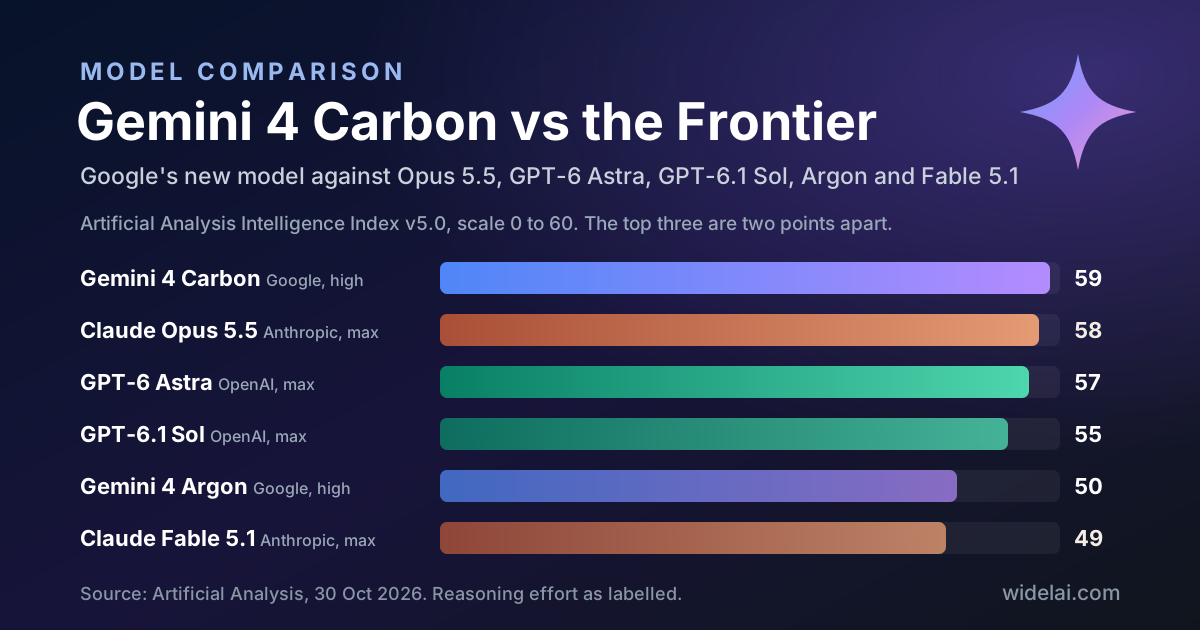
Gemini 4 Carbon is Google's new frontier model, and right now it is the highest-scoring model on the independent Artificial Analysis Intelligence Index. Google DeepMind announced it on October 28, 2026, two weeks after Gemini 4 Argon reached developers, and calls it its strongest model for cybersecurity and long-horizon work. (If you searched for "Gemini Carbon 4", this is the same model: Google puts the generation number first.)
The useful question is not whether Carbon is good. It is whether it beats the models you can already use, by how much, and at what cost. This guide compares Carbon with the models in its rank: Anthropic's Claude Opus 5.5 and Claude Fable 5.1, OpenAI's GPT-6 Astra and GPT-6.1 Sol, and Google's own Gemini 4 Argon.
The short version: Carbon wins 15 of the 17 benchmarks in Google's launch table, leads long-context reasoning and cybersecurity by wide margins, and edges Opus 5.5 by a single point on the overall index. It is also a heavy token spender, it is not yet open to developers, and most of its numbers come from Google. Gemini 4 Carbon is coming soon to WidelAI and WidelCode, and every other model in this comparison, Gemini 4 Argon included, is available there today.
Sources: Google's Gemini 4 Carbon announcement and evaluation methodology; Artificial Analysis model pages and leaderboard (Intelligence Index v5.0), checked October 30, 2026; Google's Gemini API pricing and Argon developer launch; Anthropic's Claude Opus 5.5 and Fable 5.1 announcements; OpenAI's GPT-6 Astra and GPT-6.1 Sol announcements. Benchmark tables are Google-reported unless marked otherwise.
The Short Answer
- Highest overall score: Gemini 4 Carbon. It scores 59 on the Artificial Analysis Intelligence Index v5.0, one point ahead of Opus 5.5 (58) and two ahead of GPT-6 Astra (57). One point is within the noise, so read this as a three-way race with Carbon nominally first.
- Best with very long inputs: Gemini 4 Carbon. On GraphWalks, a reasoning test over 256K to 1M tokens of context, it scores 96.2% against 71.8% for GPT-6 Astra and 66.8% for Opus 5.5. That is the largest gap in Google's table.
- Best for security work: Gemini 4 Carbon. It leads all three cybersecurity benchmarks Google reports: finding, exploiting and patching vulnerabilities.
- Best for desktop and computer-use agents: Claude Opus 5.5. It leads OSWorld-2.1 at 87.2%, 5.7 points ahead of Carbon.
- Best on FrontierSWE 2: GPT-6 Astra. It scores 65.5%, with Opus 5.5 second and Carbon third at 61.2%.
- Best value: GPT-6.1 Sol. It scores 55 on the same index for $1.27 per task, about a sixth of Carbon's cost at Google's standard price.
- On WidelAI today: Opus 5.5, Fable 5.1, GPT-6 Astra, GPT-6.1 Sol and Gemini 4 Argon. Gemini 4 Carbon is coming soon. Google is giving it to cyber defenders first and has not set a date for developers.
The Models at a Glance
| Released | Context | Direct price (in / out per 1M) | AA Index v5.0 | Cost per AA task | WidelAI credits per 1K (in / out) | |
|---|---|---|---|---|---|---|
| Gemini 4 Carbon (high) | Oct 28, 2026 | 1M | $2 / $10 introductory, then $4 / $20 | 59 | $7.76 | Coming soon |
| Claude Opus 5.5 (max) | Sep 22, 2026 | 1M | $4 / $20 | 58 | $10.04 | 0.80 / 4.00 |
| GPT-6 Astra (max) | Sep 3, 2026 | 1.05M | $10 / $50 | 57 | $6.24 | 2.00 / 10.00 |
| GPT-6.1 Sol (max) | Sep 29, 2026 | 1.05M | $2 / $10 | 55 | $1.27 | 0.40 / 2.00 |
| Gemini 4 Argon (high) | Sep 30, 2026 | 1M | $2 / $10 until Nov 30, then $4 / $20 | 50 | $7.68 | 0.40 / 2.00 until Nov 30 |
| Claude Fable 5.1 (max) | Sep 1, 2026 | 1M | $10 / $50 | 49 | $12.99 | 2.00 / 10.00 |
AA Index is the Artificial Analysis Intelligence Index v5.0 at the reasoning setting shown, checked October 30, 2026. Artificial Analysis prices Carbon and Argon at Google's $4 / $20 standard rate; at the $2 / $10 introductory rate their cost per task halves to about $3.88 and $3.84. Google has not said when Carbon's introductory price ends; Argon's ends on November 30, 2026. GPT-6 Astra and GPT-6.1 Sol bill a whole request at a higher rate above 272K input tokens. WidelAI bills 1 credit per $0.005 of provider API cost.
Two things stand out. First, the top of the index is crowded: three models from three labs sit within two points of each other. Second, the index itself changed. Version 5.0 is built from nine evaluations: AA-Briefcase v1.1, AutomationBench-AA, Terminal-Bench 4.0, FrontierCode 2.0, AA-Omniscience v1.1, GDP.pdf, HLE-Diamond, CritPt v2 (hard subset) and Terminal-Bench-Science 0.1. Scores are not comparable with v4.3.2, which our earlier comparisons used. Kimi K3.1 Pro, for example, scored 55 on v4.3.2 and scores 46 on v5.0. The model did not change; the test did.
Agentic Coding
| Benchmark | Gemini 4 Carbon | Gemini 4 Argon | GPT-6 Astra | Claude Opus 5.5 | Claude Fable 5.1 |
|---|---|---|---|---|---|
| Terminal-Bench 4.0 (AA run) | 65.2% | 57.1% | 59.1% | 59.6% | 52.0% |
| FrontierSWE 2 | 61.2% | 55.0% | 65.5% | 62.3% | 56.3% |
| SWE-sweep | 9.6% | 4.3% | 9.5% | 3.6% | 2.9% |
What the table shows:
- Carbon leads terminal-based agent work. On Artificial Analysis's own run of Terminal-Bench 4.0 it is 5.6 points ahead of Opus 5.5 and 6.1 ahead of GPT-6 Astra. That is a meaningful gap on the benchmark closest to how coding agents like WidelCode actually work: reading files, running commands and fixing what breaks.
- GPT-6 Astra still wins FrontierSWE 2, by 4.3 points over Carbon, and Opus 5.5 is ahead of Carbon there too. Carbon is not the best coder on every kind of task.
- SWE-sweep is hard for everyone. No model clears 10%. Carbon and Astra are effectively tied and more than double Opus 5.5.
- Web front-end work is strong but not first. Google reports Carbon at 1768 Elo on WebDev Arena, a jump of 89 points that places it fourth. At least three models still rank above it there.
Google also says its internal teams have seen Carbon "run for days" on multi-step engineering tasks, pushing through dead ends instead of stopping. That is an anecdote, not a benchmark, but it matches the Terminal-Bench result and the model's design goal of sustained agentic work.
Computer Use and Knowledge Work
| Benchmark | Gemini 4 Carbon | Gemini 4 Argon | GPT-6 Astra | Claude Opus 5.5 | Claude Fable 5.1 |
|---|---|---|---|---|---|
| Vals Index v2.2 | 70.4% | 69.2% | 65.0% | 70.2% | Not reported |
| Agents' Last Exam v1.1 | 77.4% | 69.0% | 73.1% | 71.6% | Not reported |
| OSWorld-2.1 (offline subset) | 81.5% | 74.7% | 80.9% | 87.2% | 76.8% |
| AutomationBench (Zapier) | 53.9% | 51.3% | 41.4% | 42.5% | 31.4% |
| Vending-Bench 2 (final balance) | $16,484 | $13,718 | $15,515 | $9,235 | $5,422 |
- Opus 5.5 is still the computer-use model. Its 5.7-point lead on OSWorld-2.1 is the clearest loss in Carbon's launch table. If your agent clicks through desktop apps, Opus 5.5 is the safer choice.
- Business automation is a Gemini strength. Carbon and Argon are first and second on Zapier's AutomationBench, and Carbon is 11.4 points ahead of Opus 5.5.
- Carbon is the best long-running operator. Vending-Bench 2 has an agent run a simulated vending business and scores the money left at the end. Carbon finishes with 78% more than Opus 5.5 and about three times Fable 5.1.
- On broad professional tasks, Carbon and Opus 5.5 tie. The Vals Index v2.2 gap is 0.2 points.
Long Context, Vision and Science
| Benchmark | Gemini 4 Carbon | Gemini 4 Argon | GPT-6 Astra | Claude Opus 5.5 | Claude Fable 5.1 |
|---|---|---|---|---|---|
| GraphWalks, 256K to 1M (BFS, F1) | 96.2% | 84.2% | 71.8% | 66.8% | 65.0% |
| Chartography | 72.5% | 71.6% | 71.0% | 66.3% | 46.2% |
| Blueprint-Bench 2 (similarity) | 58.6% | 54.4% | 49.7% | 51.2% | 41.9% |
| RiemannBench | 80.0% | 76.0% | 72.0% | 69.6% | 65.6% |
| Terminal-Bench-Science 0.1 (AA run) | 64.8% | 52.9% | 63.3% | 59.0% | 43.3% |
- Long context is Carbon's biggest lead. GraphWalks asks a model to follow connections through graph data spread across 256K to 1M tokens. Carbon is 24.4 points ahead of GPT-6 Astra and nearly 30 ahead of Opus 5.5. Every model here accepts a 1M-token prompt, but this result says Carbon actually uses all of it. If you load whole repositories, contract sets or log exports into a single prompt, this is the most important number in the launch.
- The lead is a Gemini family trait. Even Argon is 12.4 points ahead of Astra on GraphWalks.
- Science now has two leaders. Our earlier comparisons named GPT-6 Astra the pick for scientific computing. On Artificial Analysis's run of Terminal-Bench-Science, Carbon edges it by 1.5 points, and it leads the RiemannBench math test by 8 points.
- Vision is close at the top. Carbon, Argon and Astra are within 1.5 points on chart reading. Fable 5.1 trails by more than 25 points.
Cybersecurity: Carbon's Headline Strength
| Benchmark | What it tests | Gemini 4 Carbon | Gemini 4 Argon | GPT-6 Astra | Claude Opus 5.5 | Claude Fable 5.1 |
|---|---|---|---|---|---|---|
| SEC-bench Pro | Finding vulnerabilities | 88.2% | 83.4% | 85.4% | Not reported | Not reported |
| ExploitGym | Exploiting vulnerabilities | 54.8% | 42.0% | 42.4% | 34.5% | Not reported |
| CWE-bench | Patching vulnerabilities | 71.0% | 68.0% | 68.0% | 67.0% | 58.0% |
Google ran these cybersecurity evaluations without guardrails, to measure raw capability. The CWE-bench figures come from Collinear's leaderboard. In Google's separate SEC-bench Pro chart, GPT-6.1 Sol scores 78.8%.
- The exploit gap is the largest. Carbon is 12.4 points ahead of GPT-6 Astra on ExploitGym and 20.3 ahead of Opus 5.5. That is why Google is giving it to defenders first: the skill that finds and fixes a bug is the same skill that can abuse one.
- For developers, patching and secure code matter most. Google reports that Carbon more than doubles Argon's success rate at generating secure code on its internal tests. A model that writes fewer vulnerabilities saves more time than one that finds them later.
- Some claims cannot be checked. Google says its Chrome team found Carbon more than 10 times better than "another lab's large frontier model" at writing high-quality patches, and that Wiz found it leads web penetration-testing benchmarks. Neither names the comparison or publishes the data.
Only use any of these models on systems you are authorized to test. Capability is not permission.
Safety, Honesty and Prompt Injection
Agents that browse the web or read issues, emails and documents can be hijacked by instructions hidden in that content. Google's Gray Swan indirect prompt injection results show how often an attacker succeeded within 15 attempts. Lower is better.
| Model | Attack success rate (15 attempts) |
|---|---|
| Gemini 4 Carbon | 0.0% |
| Gemini 4 Argon | 0.7% |
| Claude Opus 5.5 | 1.0% |
| Claude Fable 5.1 | 1.0% |
| Gemini 3.8 Flash | 5.5% |
| GPT-6 Astra | 8.5% |
| GPT-6.1 Sol | 8.6% |
| GLM 5.3 | 31.5% |
| Kimi K3 | 52.7% |
- Carbon, Argon and the two Claude models are in a class of their own. All four are at 1% or below. GPT-6 Astra and GPT-6.1 Sol are around 8.5%, and the open-weight models are far higher.
- Google reports better behavior on the job, too. On Terminal-Bench 4.0, Carbon's successful cheating fell to 0.0% and attempts to cheat to 0.4%. Google says unsupported claims fell by about half compared with Argon, and that high-severity misalignment alerts during live coding with its internal teams fell by almost 80%. It also reports 26% less overreach (doing more than asked) and 29% less under-service (doing less than asked).
- Google is running Carbon through the U.S. government's voluntary pre-release testing and has published a separate Gemini 4 safety report.
These are Google's own measurements. They are still a strong signal for one practical choice: if your agent reads untrusted content, prefer the models at the top of this table, and keep approvals on for anything irreversible.
What a Task Really Costs
Per-token price is half the story. The other half is how many tokens a model spends to finish. Artificial Analysis measures both together as cost per index task.
| Model | Direct price (in / out per 1M) | Cost per AA task | Output tokens to run the AA index | Output speed | Time to first token |
|---|---|---|---|---|---|
| Gemini 4 Carbon (high) | $4 / $20 standard ($2 / $10 introductory) | $7.76 (about $3.88 introductory) | 200M | 98 tokens/s | 103 s |
| Claude Opus 5.5 (max) | $4 / $20 | $10.04 | 220M | 98 tokens/s | 648 s |
| GPT-6 Astra (max) | $10 / $50 | $6.24 | 54M | 78 tokens/s | 232 s |
| GPT-6.1 Sol (max) | $2 / $10 | $1.27 | 64M | 79 tokens/s | 249 s |
| Gemini 4 Argon (high) | $4 / $20 standard ($2 / $10 introductory) | $7.68 (about $3.84 introductory) | 110M | 83 tokens/s | 47 s |
| Claude Fable 5.1 (max) | $10 / $50 | $12.99 | 160M | 66 tokens/s | 180 s |
Artificial Analysis figures on each vendor's own API, checked October 30, 2026. Time to first token includes thinking, which is why reasoning models at high effort take minutes. Introductory costs are our arithmetic: halving both prices halves the cost.
- Carbon thinks a lot. It used 200M output tokens to complete the index, almost four times GPT-6 Astra's 54M. That is why Astra, at two and a half times Carbon's standard per-token price, is still cheaper per task.
- During the introductory period, Carbon is the cheapest way to get top-of-index quality. At about $3.88 a task it costs well under Astra ($6.24) and Opus 5.5 ($10.04). At the standard rate it is still about 23% cheaper per task than Opus 5.5.
- Carbon starts answering sooner than its rivals at max effort. Its 103-second time to first token compares with 648 seconds for Opus 5.5 at max. Carbon was measured at high and the others at max, so this is not a like-for-like latency test, but it is how each model reaches its top score.
- GPT-6.1 Sol is still the value pick. It is four index points below Carbon for a sixth of the standard-rate cost.
On WidelAI the same logic applies in credits. A turn with 20,000 tokens of input and a 2,000-token answer costs about 12 credits on GPT-6.1 Sol or on Gemini 4 Argon until November 30, 24 on Opus 5.5 and 60 on GPT-6 Astra or Fable 5.1. WidelAI bills at provider cost, so the same turn on Carbon would cost about 12 credits at Google's introductory price and 24 at the standard price. Google bills thinking as output, and Carbon thinks hard, so a difficult prompt will cost more than an easy one. Every rate is on the pricing transparency page.
When Can You Use Gemini 4 Carbon?
Google is taking what it calls a deliberate approach to the rollout:
- This week: a subset of cyber defenders.
- Next: more trusted partners through Google's Fairwind Program.
- Then: developers, businesses and consumers "as soon as possible", with no date given.
Argon took the same path. Google announced it for cybersecurity partners on September 30, 2026 and opened it to developers on the Gemini API paid tier, in AI Studio and Android Studio, on October 13, 13 days later. Carbon may move faster or slower; Google has not committed to a timeline.
Google has not yet published Carbon's API model ID, maximum output or thinking levels. Artificial Analysis lists a 1M-token context window, text, image, speech and video input, and text output.
Which Model to Use for Each Task
| If you need... | Use | Why |
|---|---|---|
| The highest overall score | Gemini 4 Carbon when it ships; Claude Opus 5.5 today | 59 vs 58 on the AA index, effectively a tie |
| Reasoning over very long inputs | Gemini 4 Carbon | 96.2% on GraphWalks 256K to 1M, 24.4 points ahead of Astra |
| Security review and patching | Gemini 4 Carbon | Leads SEC-bench Pro, ExploitGym and CWE-bench |
| Terminal-based coding agents | Gemini 4 Carbon, then Opus 5.5 | 65.2% vs 59.6% on Terminal-Bench 4.0 (AA run) |
| FrontierSWE-style software projects | GPT-6 Astra or Opus 5.5 | Lead FrontierSWE 2 |
| Desktop and computer-use agents | Claude Opus 5.5 | 87.2% on OSWorld-2.1 |
| Business automation | Gemini 4 Carbon | Leads AutomationBench and Vending-Bench 2 |
| Scientific computing and math | Gemini 4 Carbon or GPT-6 Astra | 1.5 points apart on Terminal-Bench-Science |
| Agents that read untrusted content | Gemini 4 Carbon, Opus 5.5 or Fable 5.1 | Prompt-injection success at 1% or below |
| High volume on a budget | GPT-6.1 Sol | $1.27 per AA task at 55 on the index |
Real work rarely fits one row. A coding agent might plan with Opus 5.5, hand a whole-repository audit to Carbon, send scientific code to Astra and run bulk, low-risk steps on GPT-6.1 Sol. No single model wins every row, which is the case for routing by task instead of committing to one vendor.
Caveats Before You Switch
- Google chose the benchmarks and published the table. Its methodology document cites third-party leaderboards and Anthropic's Opus 5.5 system card as sources, but no independent lab has reproduced the whole table. The Artificial Analysis index is the independent anchor in this guide.
- Harnesses change results. Moonshot's launch table put Opus 5.5 at 66.4% on Terminal-Bench 4.0; Artificial Analysis's run in Google's table gives 59.6%. Compare models within one table, not across vendors' tables.
- Cybersecurity scores were measured without guardrails. The model you can use will have safeguards, so it may decline some requests that the raw model completed.
- Verbosity drives cost. Budget on cost per task, not price per token, and check whether Carbon's introductory rate has ended before you forecast.
- Gaps of one or two points are mostly noise. The GraphWalks, ExploitGym, AutomationBench and OSWorld gaps are large enough to matter; the 59 vs 58 index gap is not.
- Test on your own work. Five to ten tasks you have already solved will tell you more than any leaderboard.
Gemini 4 Carbon Is Coming Soon to WidelAI and WidelCode
Today, Gemini 4 Carbon is limited to cyber defenders and Google's trusted partners. We are bringing Gemini 4 Carbon to WidelAI and WidelCode soon: as soon as Google opens Carbon's API to developers, it joins the model picker on the same plan and credit balance you already use for every other model.
When it arrives, you will be able to:
- Run Carbon as your coding agent in WidelCode, in the Mac app, the CLI or the VS Code extension, next to Claude Opus 5.5, GPT-6 Astra and GPT-6.1 Sol. Switch models per prompt: Carbon for whole-repository and security-review turns, a cheaper model for routine edits.
- Test the long-context lead yourself by loading a full repository, contract set or log export into WidelAI chat, then sending the same prompt to Opus 5.5 in the same thread to compare answers side by side.
- Skip the extra accounts. No Google Cloud project, AI Studio key or separate Gemini subscription. WidelAI bills 1 credit per $0.005 of provider cost, so Carbon would cost 0.40 / 2.00 credits per 1K tokens at Google's introductory price.
- Keep the same safety rails. WidelCode applies the same checkpoints, approvals and per-run credit ceiling to every model, which matters more for a model that can run for hours.
You do not have to wait to start. Claude Opus 5.5, Claude Fable 5.1, GPT-6 Astra, GPT-6.1 Sol, Gemini 4 Argon and Gemini 3.8 Flash are available on WidelAI and in WidelCode today. Argon is the closest thing to Carbon you can use now; we compare it with Opus 5.5, Astra and Fable 5.1 in Gemini 4 Argon vs Claude Opus 5.5, GPT-6 Astra and Fable 5.1. Create your WidelAI account now so Gemini 4 Carbon is ready to use the day it lands, browse every model on the models page, and download WidelCode or read the WidelCode CLI and VS Code extension guide.
The Verdict
Gemini 4 Carbon puts Google at the top of the independent index, but by a single point. Its real advantages are specific and large: reasoning across very long inputs, finding and fixing security flaws, long-running business automation, and resisting prompt injection. If those describe your work, Carbon is worth waiting for.
It does not replace the rest. Claude Opus 5.5 is level overall and still the best at computer use, GPT-6 Astra leads FrontierSWE 2 and matches Carbon on science, and GPT-6.1 Sol delivers near-frontier quality for a fraction of the cost. Until Carbon ships to developers, the best setup is the one you can run today. When it does, add it to the rotation for the tasks it wins, measure it on your own work, and keep every model one click away.
Related Reading
- Gemini 4 Argon vs Claude Opus 5.5, GPT-6 Astra and Fable 5.1
- Muse Wonder vs Opus 5.5, Fable 5.1, GPT-6 Astra, Sol and Argon
- Kimi K3.1 Pro vs Opus 5.5, GPT-6 Astra, Fable 5.1, DeepSeek & GLM
- GPT-6.1 Sol vs Claude Sonnet 5.5 vs Opus 5.5: Which to Use?
- Gemini 3.8 Flash Guide: Coding, Agents, Price, and Migration

Do your best AI work in one place
Bring your next question, draft, file, or idea to WidelAI. Choose the model that fits the moment, keep your work together, and stay in control of privacy and usage.
Leading models, one workspace
Use powerful AI models without juggling separate tabs, accounts, or workflows.
Switch without starting over
Change models as your work evolves while keeping the conversation and context together.
The right model for every task
Choose speed for everyday work or deeper reasoning for complex questions and decisions.
Clear credits and model rates
See your balance, understand each model’s rate, and track usage from one place.
Bring your files and images
Work with documents and images alongside your prompts in the same focused experience.
Your work stays yours
Your data is encrypted in transit and at rest, and your content is never used to train AI models.