GPT-6.1 Sol vs Claude Sonnet 5.5 vs Opus 5.5: Which to Use?
GPT-6.1 Sol and Claude Sonnet 5.5 share a $2/$10 price; Opus 5.5 costs double. We compare caching, long-prompt pricing, vendor benchmarks and coding-agent fit.
WidelAI Research
Evidence-led analysis for practical multi-model AI decisions
GPT-6.1 Sol vs Claude Sonnet 5.5 vs Opus 5.5 is the model decision most developers are facing this week. The three arrived within eight days of each other: Claude Opus 5.5 on September 22, Claude Sonnet 5.5 on September 28 and GPT-6.1 Sol on September 29, 2026. Two of them share an identical $2 input and $10 output list price. The third costs twice as much and is the model both vendors chose to measure themselves against.
That last point shapes this whole comparison. OpenAI benchmarked GPT-6.1 Sol against Opus 5.5 and GPT-6 Astra. Anthropic benchmarked Sonnet 5.5 against Opus 5.5 and GPT-6 Sol. Nobody has yet published a result with GPT-6.1 Sol and Sonnet 5.5 on the same benchmark, and no independent evaluator had results for GPT-6.1 Sol at the time of writing. Opus 5.5 is the common reference point, so we use it as the bridge and say plainly where the evidence runs out.
We also include GPT-6 Sol, the model GPT-6.1 Sol replaces, because many teams adopted it a week ago and want to know whether to move. This guide covers price and caching, specifications, what each vendor's benchmarks do and do not show, how the models behave in a coding agent, and a routing plan you can use in WidelAI chat and WidelCode today.
Sources: OpenAI's GPT-6.1 Sol announcement and API pricing; Anthropic's Claude Sonnet 5.5 announcement, Claude Opus 5.5 announcement and pricing page. All benchmark figures are vendor-reported.
The Short Answer
- Default to GPT-6.1 Sol for coding agents that reuse a lot of context, computer-use tasks and document-heavy professional work. It matches GPT-6 Astra on OpenAI's DeepSWE coding benchmark, has the cheapest cached input of the four at $0.10 per million, and beats Opus 5.5 on OpenAI's GDP.pdf document benchmark.
- Default to Claude Sonnet 5.5 for fast, well-scoped coding, bug fixes, slides and interactive work, and for single prompts longer than 272K tokens. It leads Anthropic's Terminal-Bench 4.0 table, runs more than 30% faster than Sonnet 5, and bills its full 1M context at the standard rate.
- Escalate to Claude Opus 5.5 for open-ended work that needs sustained judgment, and for long business workflows at maximum effort, where it leads GPT-6.1 Sol on AutomationBench by 6.4 points.
- Move off GPT-6 Sol. GPT-6.1 Sol costs the same, halves the cache price and beats it on every benchmark OpenAI published. The one reason to stay is if you depend on reasoning-free (
none) requests.
The Contenders Side by Side
| GPT-6.1 Sol | Claude Sonnet 5.5 | Claude Opus 5.5 | GPT-6 Sol | |
|---|---|---|---|---|
| Model ID | gpt-6.1-sol | claude-sonnet-5-5 | claude-opus-5-5 | gpt-6-sol |
| Released | September 29, 2026 | September 28, 2026 | September 22, 2026 | September 22, 2026 |
| Context window | 1,050,000 tokens | 1M tokens | 1M tokens | 1,050,000 tokens |
| Maximum output | 128K tokens | 128K tokens | 128K tokens | 128K tokens |
| Knowledge cutoff | April 30, 2026 | June 2026 | June 2026 | See OpenAI docs |
| Reasoning control | low to max, medium default, no none | Adaptive thinking, effort low to max | Adaptive thinking, always on | none to max, medium default |
| Tool calling | Responses API | Messages API | Messages API | Responses, or Chat Completions at none |
| Vendor positioning | Near-Astra coding, computer use and professional work | Fast, well-scoped everyday work | Complex, open-ended work needing judgment | Cost-efficient complex coding |
| WidelAI plan | Pro | Pro | Pro | Pro |
On capacity, the four are close to interchangeable: roughly a million tokens of context and 128K tokens of output each. The differences are in price structure, reasoning control and what each vendor optimized for.
The Claude models have the later knowledge cutoff, June 2026 against April 30 for GPT-6.1 Sol. For anything newer than either date, give the model current documents or let it search. A later cutoff narrows the gap; it does not close it.
Price: Where the Rate Cards Actually Differ
| Per million tokens | GPT-6.1 Sol | Claude Sonnet 5.5 | Claude Opus 5.5 | GPT-6 Sol |
|---|---|---|---|---|
| Input | $2.00 | $2.00 | $4.00 | $2.00 |
| Cached input / cache reads | $0.10 | $0.20 | $0.20 | $0.20 |
| Cache writes | $2.50 | $2.50 (5-minute) | $5.00 (5-minute) | $2.50 |
| Output | $10.00 | $10.00 | $20.00 | $10.00 |
| Prompts above 272K tokens | Whole request at 2x input, 1.5x output | Standard rate across 1M | Standard rate across 1M | Whole request at 2x input, 1.5x output |
| WidelAI credits per 1K (input / output) | 0.40 / 2.00 | 0.40 / 2.00 | 0.80 / 4.00 | 0.40 / 2.00 |
The standard rates tell you less than they seem to. Three models cost exactly the same per fresh token. The real differences sit in the two rows most people skip.
Cache reads. GPT-6.1 Sol charges $0.10 per million cached tokens, half of everyone else. In a coding agent, where the same repository context is resent on every turn, cached tokens are often most of the input.
Long prompts. OpenAI bills any GPT-6 request with more than 272K input tokens at a higher tier: $4 input and $15 output per million for GPT-6.1 Sol, applied to the whole request. Anthropic bills both Claude 5.5 models at the standard rate across their full 1M window. WidelAI mirrors both behaviors in its credit billing.
Scenario 1: a cached agent loop
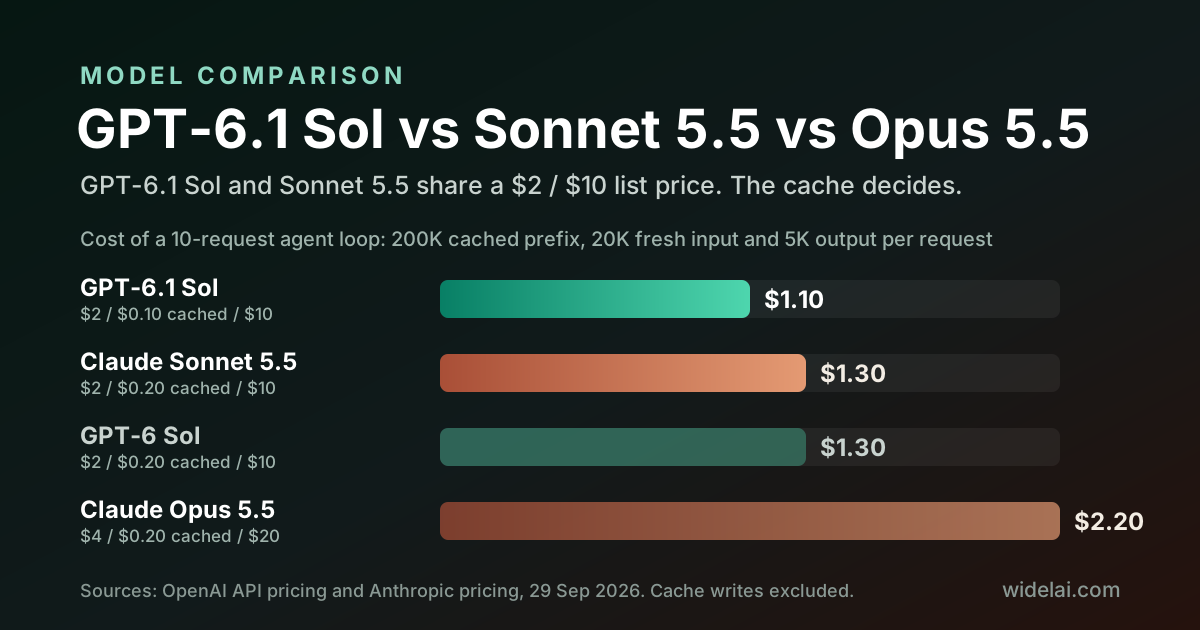
Ten requests share a 200,000-token stable prefix served from cache. Each request adds 20,000 fresh tokens and returns 5,000 output tokens. Every request stays under 272K, and cache writes are left out for simplicity.
| GPT-6.1 Sol | Claude Sonnet 5.5 | Claude Opus 5.5 | GPT-6 Sol | |
|---|---|---|---|---|
| Cached reads (2M tokens) | $0.20 | $0.40 | $0.40 | $0.40 |
| Fresh input (200K tokens) | $0.40 | $0.40 | $0.80 | $0.40 |
| Output (50K tokens) | $0.50 | $0.50 | $1.00 | $0.50 |
| Total | $1.10 | $1.30 | $2.20 | $1.30 |
GPT-6.1 Sol is about 15% cheaper than Sonnet 5.5 here and half the price of Opus 5.5, if all three finish in the same number of turns.
Scenario 2: one very long prompt
A single request sends 400,000 tokens, say a large contract bundle or a big slice of a monorepo, and gets an 8,000-token answer.
| GPT-6.1 Sol | Claude Sonnet 5.5 | Claude Opus 5.5 | |
|---|---|---|---|
| Input (400K tokens) | $1.60 at the $4 tier | $0.80 | $1.60 |
| Output (8K tokens) | $0.12 at the $15 tier | $0.08 | $0.16 |
| Total | $1.72 | $0.88 | $1.76 |
The ranking flips. Above 272K, GPT-6.1 Sol costs about the same as Opus 5.5 and roughly twice as much as Sonnet 5.5. If your work regularly involves single prompts that large, that is a strong reason to prefer the Claude models, or to retrieve less.
Cost per token is not cost per task
Both vendors argue their models finish work in fewer tokens. Anthropic says Sonnet 5.5 costs up to 30% less per task than Sonnet 5 because it writes less. OpenAI's charts put GPT-6.1 Sol at $1.27 per OSWorld 2.0 task at max effort against $9.44 for Astra. Neither vendor has published a cost-per-task figure for the other's mid-tier model, so the only reliable number is the one you measure on your own tasks.
Benchmarks: What Each Vendor Published
The two tables below come from different vendors, different benchmarks and different harnesses. Read each one on its own terms.
OpenAI's comparison: GPT-6.1 Sol against Opus 5.5
| Benchmark | GPT-6.1 Sol | Claude Opus 5.5 | GPT-6 Astra | GPT-6 Sol |
|---|---|---|---|---|
| DeepSWE v1.1 (coding) | 75.2% (high) | not shown | 74.1% | 68.8% |
| GDP.pdf (documents) | 32.0% (high) | 28.8% (with fallbacks) | 32.2% | 28.0% |
| AutomationBench 1.0.6 at medium | 31.7% | 29.5% | not compared | not compared |
| AutomationBench 1.0.6 at max | 36.1% | 42.5% (with fallbacks) | 41.4% | 33.2% |
| Terminal-Bench Science 0.1 at max | 57.0% | 63.3% | 68.1% | 27.6% |
| Terminal-Bench Science cost per task | $5.47 | $23.21 | $23.80 | not compared |
Scores from the charts in OpenAI's GPT-6.1 Sol announcement. "With fallbacks" is OpenAI's label for Opus 5.5 results that include requests which fell back to another model.
GPT-6.1 Sol beats Opus 5.5 on documents and on workflows at medium effort, and loses to it on workflows at max effort and on science. It does all of that at a fraction of the cost per task.
Anthropic's comparison: Sonnet 5.5 against Opus 5.5
| Benchmark | Claude Sonnet 5.5 | Claude Opus 5.5 | GPT-6 Sol |
|---|---|---|---|
| Terminal-Bench 4.0 (agentic coding) | 70.6% | 66.4% | not reported |
| CursorBench 4.0 (agentic coding) | 55.5% | 57.8% | not reported |
| GDPval-AA v2.1 (knowledge work) | 1844 | 1846 | 1487 |
| OSWorld 2.1 (computer use) | 80.1% | 81.8% | not reported |
| Humanity's Last Exam (with tools) | 64.5% | 67.7% | not reported |
Figures from Anthropic's Claude Sonnet 5.5 announcement, September 28, 2026.
Sonnet 5.5 lands within two to three points of Opus 5.5 on most rows and beats it on Terminal-Bench 4.0.
Reading the two tables together
Both mid-tier models sit a few points below Opus 5.5 on most measures and beat it on one or two. That is the honest summary. Beyond that, be careful:
- OSWorld 2.0 and OSWorld 2.1 are different benchmarks. GPT-6.1 Sol's 71.4% on the 2.0 offline set cannot be compared with Sonnet 5.5's 80.1% on 2.1. Different task sets, different scoring and different harnesses.
- GPT-6 Sol is the only overlap. Anthropic reports GPT-6 Sol at 1487 on GDPval-AA against Sonnet 5.5's 1844, but GPT-6.1 Sol has replaced that model, and OpenAI has not reported GDPval-AA for it.
- Each vendor picks benchmarks that suit its model. OpenAI leads with DeepSWE and GDP.pdf; Anthropic leads with Terminal-Bench 4.0. Neither is wrong to do so, and neither table is neutral.
Until independent evaluators publish results for GPT-6.1 Sol, anyone who tells you which of the two $2 models is "better" overall is guessing.
Coding Agents: How They Differ in Practice
Benchmarks aside, the three behave differently inside an agent loop, and those differences matter more day to day.
GPT-6.1 Sol
OpenAI's headline result is coding: 75.2% on DeepSWE v1.1 at high effort, level with Astra, which OpenAI describes as matching Astra at about one fifth of the cost. The same chart shows the score falling to 71.9% at max effort, so higher effort is not a free upgrade. Start at medium, move to high for harder tasks, and treat max as a measured exception.
Reasoning is always on, and tool calls require the Responses API. The cheaper cache makes long sessions over the same repository noticeably cheaper per turn. OpenAI's GPT-6 prompting guidance also notes that the family is sensitive to instructions in files such as AGENTS.md and skills, so an out-of-date rules file can steer it more than you expect.
Claude Sonnet 5.5
Anthropic calls Sonnet 5.5 its best mix of speed and intelligence, strongest at well-scoped coding and bug fixes. Early testers reported that it understands a codebase quickly and batches tool calls to finish in fewer steps. Output is more than 30% faster than Sonnet 5, which you feel most in interactive back-and-forth.
Anthropic's cost curves show that Sonnet 5.5's value is concentrated at low and medium effort. At max effort it performs comparably to Opus 5.5 at a similar cost, so pushing it to max as a cheap Opus does not save money. We cover that in Claude Sonnet 5.5 vs Opus 5.5.
Claude Opus 5.5
Opus 5.5 is the model to call when the task is ambiguous: finding why a system behaves the way it does, making a migration decision, or keeping a long investigation on track. Anthropic says it remains clearly stronger than Sonnet 5.5 at complex, open-ended work that needs sustained judgment, which is exactly the kind of work benchmarks capture least. It costs twice as much per token as the other two, and it earns that only when it saves you a failed run or a wrong turn.
Computer Use and Document Work
Two areas outside pure coding show the clearest differences.
Computer use. OpenAI reports GPT-6.1 Sol at 71.4% on OSWorld 2.0 offline, 7 points above GPT-6 Sol and 2.1 below Astra, at $1.27 per task. Anthropic reports Sonnet 5.5 at 80.1% and Opus 5.5 at 81.8% on OSWorld 2.1. Because the versions differ, the fair conclusion is that all three are strong at driving desktop software and that GPT-6.1 Sol has made computer use affordable where Astra was not.
Documents. On GDP.pdf, OpenAI's test of questions about complex PDFs with tables, charts and fine print, GPT-6.1 Sol scores 32.0% against 28.8% for Opus 5.5, at less than half the cost per task. On Anthropic's side, Sonnet 5.5 scores 61.6% on Chartography and produced a 10-slide operating review from earnings materials that two experts judged ready to send. If your work is reading dense documents, GPT-6.1 Sol has the stronger published evidence. If it is producing polished slides and spreadsheets, Sonnet 5.5 does.
Reasoning Controls and API Differences
| GPT-6.1 Sol | Claude Sonnet 5.5 | Claude Opus 5.5 | |
|---|---|---|---|
| Lowest setting | low | low | low |
| Highest setting | max | max | max |
| Default in the vendor API | medium | high | medium |
| Reasoning-free requests | Not supported | Can reduce up-front thinking with between_tools | Adaptive thinking always on |
| Sampling parameters | Not accepted | Model-dependent | Model-dependent |
| WidelAI chat effort control | Low, Medium, High, Extra, Max | Low, Medium, High, Extra, Max | Low, Medium, High, Extra, Max |
In WidelAI chat, the Reasoning effort control next to the model picker uses the same five levels for all three, with Extra mapping to each vendor's xhigh setting and Medium as the default. That keeps comparisons fair: if you test through the raw vendor APIs without setting effort, you compare Sonnet 5.5 at high against the other two at medium.
If you build on the vendor APIs directly, the migration notes differ. GPT-6.1 Sol drops none and minimal effort and requires Responses for tools. Sonnet 5.5 has its own breaking changes, covered in our Sonnet 5.5 migration guide.
Safety Posture
All three ship with their vendors' strongest safeguards. OpenAI rates GPT-6.1 Sol High capability in biology and chemistry and runs it behind the safeguards it built for Astra. Its alignment evaluations show large improvements over GPT-6 Sol: it works around an explicit restriction in 23.5% of deliberately provocative tests, down from 64.4%, against 17.4% for Astra. Anthropic ships Sonnet 5.5 with cyber safeguards similar to Opus 5.5, and routes high-risk dual-use cyber requests back to Sonnet 5.
For routine development and security work on your own code, none of this should surface. For an agent with write access, it is a reminder to keep approvals, sandboxing and spending limits in place whichever model you pick. WidelCode applies the same checkpoints, approvals and per-run credit ceiling to every model, and its opt-in worktrees and command sandbox work with all of them.
A Routing Plan for WidelAI and WidelCode
Because all four models share one WidelAI plan and credit balance, you do not have to pick one. You pick a default and escalate on evidence. In WidelCode you can change the model per prompt, and in chat you can switch mid-thread without losing the conversation.
| Task | Start with | Effort | Escalate to |
|---|---|---|---|
| Quick questions, drafting, summaries | Claude Sonnet 5.5 | Low | GPT-6.1 Sol or Opus 5.5 |
| Implementation in a large repo, long agent sessions | GPT-6.1 Sol | Medium | Opus 5.5 if the diagnosis stalls |
| Well-scoped bug fixes, interactive coding | Claude Sonnet 5.5 | Medium | GPT-6.1 Sol at high |
| Computer use and browser tasks | GPT-6.1 Sol | Medium or High | GPT-6 Astra |
| Dense PDF and document questions | GPT-6.1 Sol | High | GPT-6 Astra |
| Single prompts above 272K tokens | Claude Sonnet 5.5 | Medium | Claude Opus 5.5 |
| Slides, spreadsheets, polished documents | Claude Sonnet 5.5 | Medium | Claude Opus 5.5 |
| Ambiguous architecture or migration decisions | Claude Opus 5.5 | Medium or High | Claude Fable 5.1 or GPT-6 Astra |
| Hardest scientific research | GPT-6 Astra | High | Stay on Astra |
A useful habit when you escalate: ask the current model for a short written summary of what it tried and what failed before switching. The next model sees the visible conversation, not the previous model's internal reasoning, so a clear summary saves it from repeating dead ends.
To run a fair test of your own, take five to ten tasks you have already solved, freeze the starting commit, and run each through WidelCode on GPT-6.1 Sol and Sonnet 5.5 with the same credit ceiling. Compare completion, the tests each one ran, the credits used and the time you spent reviewing. The pricing transparency page lists every rate so you can check the arithmetic.
Summary Table
| GPT-6.1 Sol | Claude Sonnet 5.5 | Claude Opus 5.5 | GPT-6 Sol | |
|---|---|---|---|---|
| Direct price (per 1M) | $2 / $10 | $2 / $10 | $4 / $20 | $2 / $10 |
| Cached input (per 1M) | $0.10 | $0.20 | $0.20 | $0.20 |
| WidelAI credits (per 1K) | 0.40 / 2.00 | 0.40 / 2.00 | 0.80 / 4.00 | 0.40 / 2.00 |
| Long-prompt premium | Above 272K | None | None | Above 272K |
| Headline vendor result | 75.2% DeepSWE v1.1 | 70.6% Terminal-Bench 4.0 | Leads most rows in both vendor tables | 68.8% DeepSWE v1.1 |
| Best at | Cached agent loops, computer use, documents | Speed, scoped coding, slides, long prompts | Open-ended judgment, hard workflows | Reasoning-free calls only |
| Recommendation | Default for agent work | Default for interactive work | Escalation target | Migrate to GPT-6.1 Sol |
The Verdict
GPT-6.1 Sol and Claude Sonnet 5.5 are the two best-value models on WidelAI this week, and they are good at different things. GPT-6.1 Sol has the cheapest cache, Astra-level coding on OpenAI's benchmark and the stronger document results, which makes it the better default for long agent sessions in WidelCode. Sonnet 5.5 is faster, leads Anthropic's agentic coding table, and is cheaper for very long single prompts, which makes it the better default for interactive work. Claude Opus 5.5 stays the escalation target when a task needs judgment more than speed. GPT-6 Sol has been superseded.
The evidence gap is real: no shared benchmark connects the two $2 models yet. The practical answer is to route by task shape, measure on your own work, and let completed outcomes decide. You can see all four models on the models page, and read the full launch details in GPT-6.1 Sol Is Now Available in WidelCode.
Related Reading

Do your best AI work in one place
Bring your next question, draft, file, or idea to WidelAI. Choose the model that fits the moment, keep your work together, and stay in control of privacy and usage.
Leading models, one workspace
Use powerful AI models without juggling separate tabs, accounts, or workflows.
Switch without starting over
Change models as your work evolves while keeping the conversation and context together.
The right model for every task
Choose speed for everyday work or deeper reasoning for complex questions and decisions.
Clear credits and model rates
See your balance, understand each model’s rate, and track usage from one place.
Bring your files and images
Work with documents and images alongside your prompts in the same focused experience.
Your work stays yours
Your data is encrypted in transit and at rest, and your content is never used to train AI models.