Claude Fable 5.2 vs Opus 5.5, GPT-6 Astra and Gemini 4 Argon
Claude Fable 5.2 tops the Vals Index and the Artificial Analysis index and costs 20% less than Fable 5.1. We compare it with Claude Opus 5.5, GPT-6 Astra and Gemini 4 Argon.
WidelAI Research
Evidence-led analysis for practical multi-model AI decisions
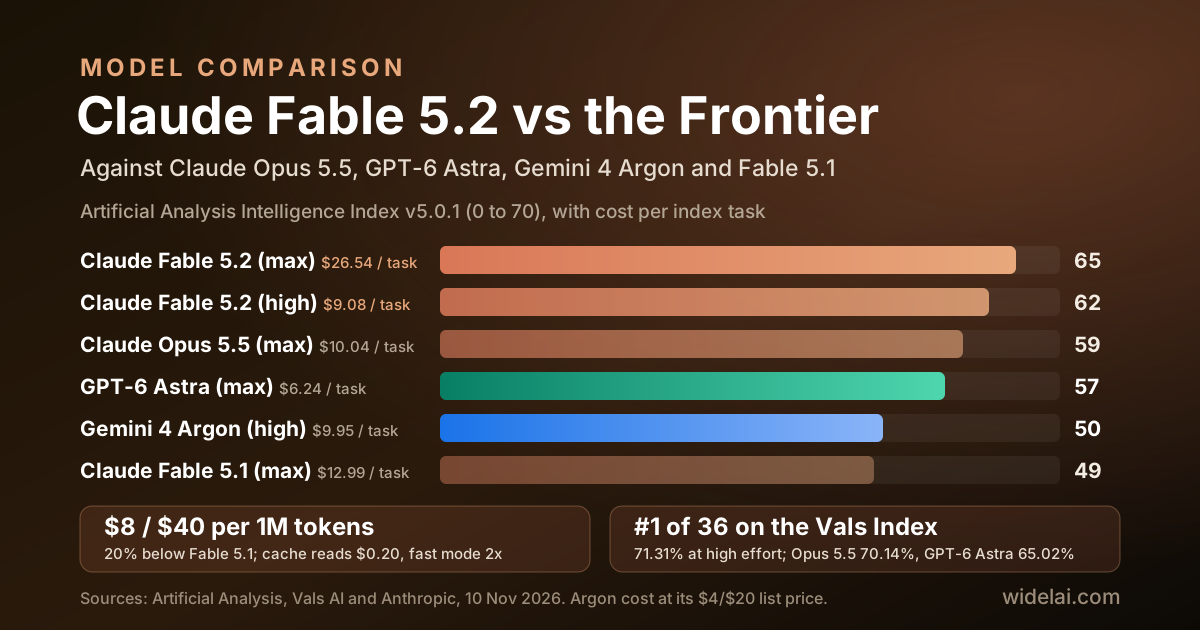
Claude Fable 5.2 is Anthropic's new top model. It shipped on November 9, 2026 as claude-fable-5-2, nine weeks after Claude Fable 5.1, and it does something frontier launches rarely do: it scores higher and costs less. Input is $8 per million tokens and output is $40, both 20% below Fable 5.1's $10 and $50.
The short version: two days in, Fable 5.2 is first of 36 models on the Vals Index and first of 74 on the Artificial Analysis Intelligence Index, and in Anthropic's own launch table it is first on 10 of the 12 rows that include a rival. It is still twice the price of Claude Opus 5.5 per token, it trails Opus on SWE-bench Multimodal and on Vals' legal and tax tests, and Anthropic itself says to start with Opus and move up only when your evals demand it.
This guide compares Fable 5.2 with the models you would weigh it against: Claude Opus 5.5, OpenAI's GPT-6 Astra, Google's Gemini 4 Argon, and Fable 5.1, with Gemini 4 Carbon where the numbers exist. It covers what changed from Fable 5.1, specifications and price, Anthropic's benchmarks, the independent results, cost per task at each effort level, access conditions, and a routing table by task. Claude Fable 5.2, Opus 5.5, GPT-6 Astra and Gemini 4 Argon are all available on WidelAI today, in chat and in WidelCode.
Sources: Anthropic's Fable 5.2 and Mythos 5.2 announcement, model overview, what's new, pricing, fast mode and data retention pages; Artificial Analysis Intelligence Index v5.0.1 leaderboard and Fable 5.2 model page; Vals AI model page, Vals Index and Terminal-Bench 4.0 boards; Anthropic's Claude Opus 5.5 and Fable 5.1 announcements; OpenAI's GPT-6 Astra announcement; Google's Gemini 4 Argon model page and API pricing. All independent figures were checked on November 10, 2026. Benchmark tables are Anthropic-reported unless marked otherwise.
The Short Answer
- Strongest model you can use today: Claude Fable 5.2. It leads both independent indices, and at high effort it scores 62 on the Artificial Analysis index for $9.08 per task, above Opus 5.5 at max (59 for $10.04).
- Best default for most work: Claude Opus 5.5. Half the price per token, level with Fable 5.2 on Terminal-Bench 4.0 and ahead of it on SWE-bench Multimodal. Anthropic's own guidance is to start here.
- Biggest single gain over Fable 5.1: agentic coding. FrontierCode 2.0 rises from 32.4% to 49.1%, FrontierSWE v2 from 56.3% to 69.9%, and the Artificial Analysis Intelligence Index score goes from 49 (Fable 5.1) to 65 (Fable 5.2 at max effort).
- Best for scientific computing: still GPT-6 Astra on independent tests. Vals puts Astra first on Terminal-Bench-Science (62.86%) and its Science Index (65.09%), with Fable 5.2 second on both. Anthropic's own run reverses the order.
- Best for legal work and the lowest price: Gemini 4 Argon. Second of 37 on the Vals Legal Index, where Fable 5.2 is twentieth, and $2 / $10 per million tokens until November 30.
- Cheapest route to Fable 5.2 quality: run it at high, not max. The two settings score within three points of each other on the Artificial Analysis index, and max costs 2.9 times as much per task.
What Changed from Fable 5.1
Fable 5.2 is the same kind of model as Fable 5.1, built for demanding reasoning and agent sessions that run for hours, with the same 1M-token context window and 128K-token output limit. The changes are in price, speed, scores and safeguards.
| Claude Fable 5.1 | Claude Fable 5.2 | Change | |
|---|---|---|---|
| Input per 1M tokens | $10 | $8 | 20% lower |
| Output per 1M tokens | $50 | $40 | 20% lower |
| 5-minute cache write | $12.50 | $10 | 20% lower |
| Cache read | $0.25 | $0.20 | 20% lower, still 0.025x input |
| Batch API (in / out) | $5 / $25 | $4 / $20 | 20% lower |
| Fast mode (in / out) | Not offered | $16 / $80 | New, 2x standard |
| Output speed | Baseline | Up to 30% faster | Anthropic-reported |
| Effort levels | low to max | low to max, API default high | Unchanged |
| WidelAI credits per 1K (in / out) | 2.00 / 10.00 | 1.60 / 8.00 | 20% lower |
Prices from Anthropic's pricing page. WidelAI bills 1 credit per $0.005 of provider API cost.
Four things matter beyond the table:
- Fast mode is new to the Fable line. Set
speed: "fast"on the API and the same model streams up to 2.5 times more output tokens per second, for twice the price. Anthropic says intelligence is unchanged; the gain is in output speed, not time to first token. Opus 5.5 already offers the same option at $8 / $40. - Fewer false refusals. Anthropic reports about 55% fewer blocked requests than Fable 5.1 overall, about 60% fewer in cybersecurity and about 40% fewer in biology. Requests that are blocked are answered by Opus 4.8 (cyber) or Opus 5 (biology) instead.
- Two API changes can break code. The prefix check now applies to every account, so editing an earlier turn invalidates thinking blocks, and only Fable 5.2 and Mythos 5.2 can read Fable 5.2's thinking blocks. If you switch a conversation from Fable 5.2 to any other model, the text history carries over but the reasoning does not.
- Anthropic's advice is to start lower. The model docs say to use the latest Opus for most workloads and move to Fable 5.2 when Opus at higher effort still falls short. The API default effort is high, where Anthropic says most of the gain is already present; xhigh is for the hardest long-running work, and max is for measuring the ceiling.
The Models at a Glance
| Released | Context | Direct price (in / out per 1M) | AA Index (setting) | Cost per AA task | WidelAI credits per 1K (in / out) | |
|---|---|---|---|---|---|---|
| Claude Fable 5.2 | Nov 9, 2026 | 1M | $8 / $40 | 65 (max), 62 (high) | $26.54, $9.08 | 1.60 / 8.00 |
| Gemini 4 Carbon | Oct 28, 2026 | 1M | $2 / $10 introductory, then $4 / $20 | 60 (high) | $7.76 | Not on WidelAI |
| Claude Opus 5.5 | Sep 22, 2026 | 1M | $4 / $20 | 59 (max) | $10.04 | 0.80 / 4.00 |
| GPT-6 Astra | Sep 3, 2026 | 1.05M | $10 / $50 | 57 (max) | $6.24 | 2.00 / 10.00 |
| Gemini 4 Argon | Oct 13, 2026 | 1M | $2 / $10 to Nov 30, then $4 / $20 | 50 (high) | $9.95 | 0.40 / 2.00 until Nov 30 |
| Claude Fable 5.1 | Sep 1, 2026 | 1M | $10 / $50 | 49 (max) | $12.99 | 2.00 / 10.00 |
AA Index is the Artificial Analysis Intelligence Index v5.0.1 at the setting shown, checked November 10, 2026. Artificial Analysis prices Carbon and Argon at Google's $4 / $20 standard rate; at the introductory rate their cost per task is about half. Carbon is not yet open to developers. GPT-6 Astra bills a whole request at a higher rate above 272K input tokens.
Three things stand out before any benchmark:
- Fable 5.2 is the only model above 60 on the index, and it gets there at high effort as well as max. The previous leader, Gemini 4 Carbon at 60, is not generally available.
- Per token, it is the second most expensive model here, behind GPT-6 Astra and Fable 5.1 at $10 / $50 and twice Opus 5.5. Per task, the picture is different, as the effort section below shows.
- Argon's price advantage is a clock. At $2 / $10 it is a quarter of Fable 5.2's token price; from December 1 it is half.
What Anthropic's Benchmarks Show
Anthropic's launch table compares Fable 5.2 with Fable 5.1, Opus 5.5, GPT-6 Astra and Gemini 4 Carbon, each at its highest available effort unless marked. Fable 5.2 is first on 10 of the 12 rows that include a rival. Gemini 4 Argon appears only in the RoboDojo robotics chart, at 34.2% (high), so it is absent from the rest of these tables.
Agentic coding, automation and science
| Benchmark | Fable 5.2 | Fable 5.1 | Opus 5.5 | GPT-6 Astra | Gemini 4 Carbon |
|---|---|---|---|---|---|
| FrontierCode 2.0 | 49.1 (xhigh) | 32.4 (xhigh) | 45.5 | 42.8 | 41.1 (medium) |
| FrontierSWE v2 | 69.9 | 56.3 | 62.3 | 65.5 | 61.2 |
| AutomationBench | 51.4 | 31.4 | 42.5 | 41.4 | 53.9 |
| Terminal-Bench-Science 0.1 | 74.6 | 52.6 | 58.7 | 68.1 | 64.8 |
| RoboDojo Sim (robotics, Anthropic internal) | 64.9 (max) | 27.6 | 39.4 | 29.8 (max) | Not reported |
FrontierCode 2.0 is Cognition's benchmark of 132 real pull-request tasks scored on whether a maintainer would merge the result. Fable 5.2 adds 16.7 points over Fable 5.1 and 3.6 over Opus 5.5. The more useful claim is about cost: Anthropic says Fable 5.2 at high effort scores 45.3%, level with Opus 5.5 at max (45.5%), at about half the cost per task, and ahead of GPT-6 Astra's best result at about the same cost. FrontierSWE v2, a set of 34 long engineering and research tasks, shows a 4.4-point lead over Astra, which held that benchmark against both Argon and Carbon.
Terminal-Bench-Science is the biggest jump in the table: 22 points over Fable 5.1 and 6.5 over GPT-6 Astra, which led the field in Google's Argon and Carbon launch tables. Vals' independent run disagrees, and the next section covers why. AutomationBench, which tests business-workflow automation, is the one row Carbon wins.
Knowledge work, research and computer use
| Benchmark | Fable 5.2 | Fable 5.1 | Opus 5.5 | GPT-6 Astra | Gemini 4 Carbon |
|---|---|---|---|---|---|
| Humanity's Last Exam (with tools) | 74.2 | 65.6 | 67.7 | 57.2 | Not reported |
| WANDR (agentic search) | 82.1 | 68.7 | 72.3 | Not reported | Not reported |
| Remote Labor Index | 41.3 (high) | 17.9 | 21.3 | 20.8 | Not reported |
| AA-Briefcase v1.1 (rubric score) | 66.1 | 61.5 | 61.2 | 52.0 | 61.8 |
| AA-Briefcase v1.1 (preference Elo) | 1785 | 1669 | 1800 | 1569 | 1611 |
| OSWorld 2.1 (offline, partial credit) | 89.3 | 83.5 | 87.2 | 79.5 | 81.5 |
| Chartography (no tools) | 73.4 | 44.8 | 64.4 | 71.0 | 72.5 |
- The Remote Labor Index result is the headline. Scale AI's benchmark asks a model to complete real freelance projects end to end. Fable 5.2 completes 41.3% of them, roughly double Opus 5.5 and GPT-6 Astra and more than double Fable 5.1. If your use case is "give the agent a whole deliverable", this is the row to read.
- Humanity's Last Exam and WANDR show the same pattern: a 6.5-point lead over Opus 5.5 on hard expert questions with tools, and almost ten points on agentic web search. Anthropic adds that at medium effort Fable 5.2 matches Opus 5.5's top WANDR score at about 40% of the cost per task.
- AA-Briefcase splits. Fable 5.2 has the higher rubric score, but human raters still prefer Opus 5.5's documents by a small Elo margin. Writing quality and task completion are not the same thing.
- Computer use improves but does not transform. 89.3% on OSWorld 2.1 is 2.1 points over Opus 5.5 and almost ten over GPT-6 Astra. Vals, which uses a harder computer-use test, ranks Astra first and has not published a Fable 5.2 result yet.
- Chartography, which tests reading and reasoning over charts without tools, nearly doubles from Fable 5.1, though the lead over Carbon and Astra is small.
What Independent Tests Say
Vendors pick the benchmarks in their own tables. Two independent evaluators had Fable 5.2 results within a day of launch, and both put it first overall.
Artificial Analysis
| Model and setting | AA Index v5.0.1 | Cost per AA task |
|---|---|---|
| Claude Fable 5.2 (max) | 65 | $26.54 |
| Claude Fable 5.2 (xhigh) | 62 | $14.83 |
| Claude Fable 5.2 (high) | 62 | $9.08 |
| Gemini 4 Carbon (high) | 60 | $7.76 |
| Claude Opus 5.5 (max) | 59 | $10.04 |
| Claude Opus 5.5 (xhigh) | 57 | $6.05 |
| GPT-6 Astra (max) | 57 | $6.24 |
| Claude Fable 5.2 (medium) | 56 | $3.80 |
| GPT-6 Astra (high) | 55 | $3.24 |
| GPT-6.1 Sol (max) | 55 | $1.27 |
| Claude Fable 5.2 (low) | 54 | $3.10 |
| Gemini 4 Argon (high) | 50 | $9.95 |
| Claude Fable 5.1 (max) | 49 | $12.99 |
Checked November 10, 2026. The index combines nine evaluations, including AA-Briefcase, AutomationBench-AA, Terminal-Bench 4.0, FrontierCode 2.0, AA-Omniscience, HLE-Diamond and Terminal-Bench-Science. Anthropic models run with Anthropic's default fallback. Artificial Analysis had not published output speed or AA-Omniscience results for Fable 5.2 when we checked.
Two points from this table shape the rest of the guide. First, Fable 5.2 at high scores three points above Opus 5.5 at max for 10% less per task, so "twice the price" is true per token and false per task at these settings. Second, xhigh buys nothing on this index: it costs 63% more than high for the same score. Max adds three points for 2.9 times the cost of high. The index also shows how far the Fable line has moved: Fable 5.1 at max scored 49 for $12.99, which Fable 5.2 beats by 13 points at high for less money.
Vals AI
Vals runs enterprise-style evaluations in finance, law, coding and tax, and ran Fable 5.2 at high effort against Opus 5.5 and GPT-6 Astra at max and the Gemini models at high.
| Model | Vals Index v2.2 | Cost per test |
|---|---|---|
| Claude Fable 5.2 (high) | 71.31% | $17.94 |
| Claude Sonnet 5.5 | 70.85% | $16.18 |
| Gemini 4 Carbon (high) | 70.45% | $10.51 |
| Claude Opus 5.5 (max) | 70.14% | $24.77 |
| Gemini 4 Argon (high) | 69.39% | $13.37 |
| GPT-6 Astra (max) | 65.02% | $21.28 |
Vals Index v2.2, 36 models, updated November 9, 2026. Vals does not list Fable 5.1.
The index is close at the top: the first five models are within two points. The individual boards are where the differences show.
| Vals benchmark | Fable 5.2 | Opus 5.5 | GPT-6 Astra | Gemini 4 Argon | Fable 5.2 rank |
|---|---|---|---|---|---|
| Terminal-Bench 4.0 | 65.15% | 65.15% | 59.60% | 57.58% | 1 of 63 (tied) |
| SWE-bench Multimodal | 62.29% | 70.21% | 43.33% | 56.04% | 2 of 22 |
| ProgramBench | 19.00% | 18.50% | 5.50% | 2.50% | 1 of 66 |
| Vibe Code Bench v1.1 | 93.77% | 90.29% | 89.59% | 91.91% | 1 of 127 |
| Code Migration v1.1 | 83.27% | 81.01% | 80.58% | 70.80% | 2 of 30 |
| Terminal-Bench-Science | 55.71% | 47.14% | 62.86% | 44.29% | 2 of 45 |
| Vals Science Index | 63.74% | 58.65% | 65.09% | 55.36% | 2 of 24 |
| Finance Agent v2.1 | 69.47% | 67.85% | 60.43% | 67.66% | 1 of 39 |
| Vals Legal Index | 69.17% | 72.37% | 68.39% | 76.78% | 20 of 37 |
| Tax Agent Bench | 32.09% | 44.54% | Not reported | Not reported | 27 of 84 |
From each model's Vals page, checked November 10, 2026. Ranks count every model Vals has run on that benchmark.
- Coding is a near-sweep, with one exception. Fable 5.2 is first on ProgramBench, Vibe Code Bench and Terminal-Bench 4.0, where it ties Opus 5.5 at 65.15% but costs more per test ($14.56 against $12.04). The exception is SWE-bench Multimodal, which tests fixing bugs in visual front-end code: Opus 5.5 leads by eight points.
- Science is contested. Anthropic's table has Fable 5.2 6.5 points ahead of GPT-6 Astra on Terminal-Bench-Science; Vals, using its own harness, has Astra 7.2 points ahead. Both runs put Fable 5.2 far above Opus 5.5 and Argon. Treat the Fable-versus-Astra order as unsettled until more runs land.
- Finance yes, law and tax no. Fable 5.2 is first on Vals' Finance Agent benchmark, but twentieth of 37 on the Legal Index, behind Argon, Carbon and Opus 5.5, and well behind Opus on Tax Agent Bench. For legal research and tax work, this is not the model to pick.
- Cost per test cuts the other way from Artificial Analysis. On the Vals Index Fable 5.2 at high is cheaper per test than Opus 5.5 at max ($17.94 against $24.77) and GPT-6 Astra ($21.28), which matches the AA finding, but Carbon and Argon are cheaper still.
Where Fable 5.2 Does Not Win
A model that leads two indices is easy to oversell. These are the places the evidence points elsewhere:
- Visual front-end bug fixing: Opus 5.5, by eight points on SWE-bench Multimodal.
- Legal and tax work: Gemini 4 Argon leads the Vals Legal Index; Opus 5.5 leads Tax Agent Bench by 12 points.
- Business-workflow automation: Gemini 4 Carbon edges Fable 5.2 on AutomationBench in Anthropic's own table, though Carbon is not yet available to developers.
- Human preference on documents: Opus 5.5 holds a 15-point Elo lead on AA-Briefcase despite Fable 5.2's higher rubric score.
- Scientific computing on independent runs: GPT-6 Astra on Vals' Terminal-Bench-Science and Science Index.
- Desktop and computer-use agents on independent tests: Vals ranks Astra first and Opus 5.5 second on CUA-bench, and has no Fable 5.2 result yet.
- Raw price per token: Opus 5.5 is half the price, Sonnet 5.5 a quarter, Argon a quarter until November 30, and GPT-6.1 Sol scores 55 on the Artificial Analysis index for $1.27 a task.
Price per Task: Effort Is the Real Dial
Per-token price is the number on the pricing page. What you pay is tokens multiplied by how many the model spends, and effort controls that. Artificial Analysis ran Fable 5.2 at every level:
| Fable 5.2 effort | AA Index | Cost per AA task | Output tokens used | Compared with |
|---|---|---|---|---|
| low | 54 | $3.10 | Not listed | Below GPT-6 Astra at high (55, $3.24) |
| medium | 56 | $3.80 | Not listed | Above Astra at high and Sonnet 5.5 at max (55) |
| high (API default) | 62 | $9.08 | 85.3M | Above Opus 5.5 at max (59, $10.04) |
| xhigh | 62 | $14.83 | 144M | Same score as high, 63% more cost |
| max | 65 | $26.54 | 275M | Top of the leaderboard, 2.6x Opus at max |
Artificial Analysis, checked November 10, 2026. Output tokens are the total spent across the index run.
The practical reading: high is the setting for almost everything, medium is a credible budget option that still beats GPT-6 Astra at its best per-task value, and max exists to find the ceiling. Anthropic's own examples agree. It reports Fable 5.2 at low matching Opus 5.5's top Humanity's Last Exam score at under a tenth of the cost per task, and at medium beating Opus 5.5 at max on Chartography (66.4% against 64.4%) at under a tenth of the cost.
On WidelAI the same logic applies in credits. A chat turn with 20,000 tokens of context and a 2,000-token answer costs:
| Model | Credits per 1K (in / out) | Credits for the example turn |
|---|---|---|
| Gemini 4 Argon, until Nov 30 | 0.40 / 2.00 | 12 |
| Claude Sonnet 5.5 | 0.40 / 2.00 | 12 |
| Claude Opus 5.5 | 0.80 / 4.00 | 24 |
| Gemini 4 Argon, from Dec 1 | 0.80 / 4.00 | 24 |
| Claude Fable 5.2 | 1.60 / 8.00 | 48 |
| Claude Fable 5.1 | 2.00 / 10.00 | 60 |
| GPT-6 Astra | 2.00 / 10.00 | 60 |
The 2,000 output tokens include thinking, which every model here bills as output, so a hard prompt costs more than an easy one. Cache reads change long conversations: Fable 5.2 bills them at 0.025x the input price and Opus 5.5 at 0.05x, which comes to the same 0.04 credits per 1K tokens on both. Once a long thread or repository is cached, re-reading it costs no more on Fable 5.2 than on Opus 5.5; only the fresh tokens cost double. Every rate is on the pricing transparency page.
Access, Retention and Mythos 5.2
Three access details come straight from Anthropic's documentation and are worth knowing before you build on the model.
- 30-day data retention is required. Fable 5.2 is a Covered Model: Anthropic keeps prompts and outputs for 30 days for safety monitoring, and the model is not available under zero data retention unless Anthropic expressly authorizes it. This is the same condition that applied to Fable 5, Fable 5.1 and the Mythos models, so nothing changes for anyone already using the Fable line. Eligible enterprises can apply for an exception ahead of Anthropic's Enterprise Frontier Safeguards program, which is in private beta.
- Mythos 5.2 is the same model with fewer safeguards, for verified organizations only. Anthropic says Fable 5.2 and Mythos 5.2 are one underlying model; Mythos has looser cyber and biology restrictions and goes only to organizations verified through the Cyber Verification Program or the Life Sciences Verification Program. Mythos-only results in the launch table, such as 76.3% on CyScenarioBench and 89.6% on CVE Rediscovery, do not apply to the public model.
- It is on every major cloud. Fable 5.2 is on the Claude API, Amazon Bedrock, Google Cloud and Microsoft Foundry, with fast mode on all but Bedrock. The knowledge cutoff is June 2026, the same as Opus 5.5 and later than Argon (March 2026) and GPT-6 Astra (April 2026).
Which Model to Use for Each Task
| If you need... | Use | Why |
|---|---|---|
| The strongest model for hard agentic coding | Claude Fable 5.2 at high | 49.1% FrontierCode 2.0; first on ProgramBench and Vibe Code Bench; 62 on the AA index for less per task than Opus 5.5 at max |
| Whole deliverables, end to end | Claude Fable 5.2 | 41.3% on Remote Labor Index, about double Opus 5.5 and GPT-6 Astra |
| Deep research and hard expert questions | Claude Fable 5.2 | 74.2% HLE with tools, 82.1% WANDR |
| A strong daily driver at half the price | Claude Opus 5.5 | 59 on the AA index, ties Fable 5.2 on Terminal-Bench 4.0, Anthropic's own recommended starting point |
| Visual front-end bug fixing | Claude Opus 5.5 | 70.21% SWE-bench Multimodal, eight points clear |
| Scientific computing | GPT-6 Astra or Fable 5.2 | Astra leads Vals' science boards; Anthropic's run says Fable 5.2. Test both |
| Desktop and computer-use agents | GPT-6 Astra | First on Vals CUA-bench; Fable 5.2 untested there |
| Legal research | Gemini 4 Argon | 76.78% Vals Legal Index, second of 37; Fable 5.2 is twentieth |
| Tax work | Claude Opus 5.5 | 44.54% Tax Agent Bench against 32.09% |
| Frontier quality on a budget this month | Gemini 4 Argon or Sonnet 5.5 | 12 credits for the example turn against 48 on Fable 5.2 |
| Fable 5.1 workloads | Claude Fable 5.2 | Higher on every row Anthropic reports, 20% cheaper, same retention terms |
Real work rarely fits one row. A sensible setup is to run Opus 5.5 as the default, escalate the hardest coding and research tasks to Fable 5.2 at high, send legal and long-document work to Argon, and keep GPT-6 Astra for scientific computing and desktop automation. If you are still on Fable 5.1, there is no case for staying: Fable 5.2 is better and cheaper on every axis Anthropic and the independent evaluators report.
Caveats Before You Switch
- Most of these numbers are two days old. Vals and Artificial Analysis published within a day of launch, and Artificial Analysis had no speed or hallucination data yet. Expect scores to move as more runs land, as Argon's did in October.
- Effort settings differ across evaluators. Vals ran Fable 5.2 at high and Opus 5.5 and GPT-6 Astra at max. Anthropic's table uses each model's highest effort unless marked. Compare like with like where you can.
- Anthropic's table is Anthropic's. It picked the benchmarks and the comparison set. Artificial Analysis and Vals are the independent anchors in this guide, and on one of them Astra beats Fable 5.2 at science.
- Model switching drops Fable 5.2's reasoning. Only Fable 5.2 and Mythos 5.2 can read Fable 5.2's thinking blocks. Switching a conversation to Opus 5.5 keeps the text but not the chain of thought that produced it.
- It can stop early at low effort. Anthropic's docs note that on long multistep tasks Fable 5.2 sometimes ends a turn with a list of what remains, more often at low and medium. For agent runs, stay at high.
- Test on your own work. Five to ten tasks you have already solved will tell you more than any leaderboard.
Try Claude Fable 5.2 on WidelAI and WidelCode
You can run every comparison in this guide on your own prompts, without an Anthropic account, a 30-day retention workspace to configure or an API key. Claude Fable 5.2 is live on WidelAI now, next to Claude Opus 5.5, GPT-6 Astra and Gemini 4 Argon, on one plan and one credit balance.
In WidelAI chat
- Pick Claude Fable 5.2 from the Anthropic group in the chat model picker. It costs 1.60 input and 8.00 output credits per 1K tokens, 20% less than Fable 5.1, with cache reads at 0.04 credits per 1K.
- Compare it in the same thread. Ask Fable 5.2 first, then switch the picker to Opus 5.5, GPT-6 Astra or Gemini 4 Argon and send the same prompt. The conversation history carries over, so you can read the answers side by side and see the credit cost of each.
- Give it whole tasks. Fable 5.2's largest gains are on long, multistep work: a research brief with sources, a data analysis carried through to a finished document, or a migration plan for a codebase you paste in.
In WidelCode
WidelCode, the WidelAI coding agent, lets you choose the model per task, so you can put Fable 5.2 on one hard job and leave the rest on Opus 5.5. The model ID everywhere is claude-fable-5-2.
- Mac app: open the Code tab, choose a project folder and pick Claude Fable 5.2 in the Anthropic group. If you do not have the app yet, download WidelCode.
- CLI: install it once with
npm install -g widelcodeand sign in withwidelcode login. Start a session withwidelcode --model claude-fable-5-2, or switch an existing one with/model claude-fable-5-2. - VS Code: the
widelai.widelcodeextension, on the Visual Studio Marketplace and Open VSX, runs the same agent with the same models and credits. - Cloud agents: give Fable 5.2 a repository task that ends in a pull request, with a hard credit limit:
widelcode --model claude-fable-5-2 --budget 400 cloud run --repo your-org/your-repo --prompt "Fix the flaky integration tests, find the root cause, and open a PR with a regression test" --follow
A good first WidelCode task for Fable 5.2 is the kind FrontierCode measures: a real bug or feature in a real repository, judged on whether you would merge the result. Run the same task on Opus 5.5 with /model claude-opus-5-5 and compare the diffs and the credits.
New to WidelAI? Create your account and choose the Pro plan, which includes Claude Fable 5.2, every other model in this guide and WidelCode. You can see every model and its rate on the models page and the pricing transparency page.
The Verdict
Claude Fable 5.2 is the strongest model you can use today, and for once the independent evaluators agree with the vendor. It leads the Vals Index and the Artificial Analysis index, its gains over Fable 5.1 are large on exactly the work the Fable line is for, and the 20% price cut means it costs less per task than Opus 5.5 at max while scoring higher.
It is not the best model for everything. Opus 5.5 remains the better default at half the price, wins visual bug fixing and tax work, and is where Anthropic says to start. Gemini 4 Argon owns legal research and the budget end of the table through November. GPT-6 Astra still has a claim on scientific computing and desktop agents. The right move is the one these comparisons keep pointing to: route by task, escalate to Fable 5.2 at high when the task earns it, and measure the credits.
Related Reading
- Gemini 4 Argon vs Claude Opus 5.5, GPT-6 Astra and Fable 5.1
- Gemini 4 Carbon vs Opus 5.5, GPT-6 Astra, Fable 5.1 and Argon
- GPT-6 Astra vs Claude Fable 5.1: Which Model Should You Use?
- How to Use Claude Fable 5.1 on WidelAI: A Practical Guide
- Claude Sonnet 5.5 vs Opus 5.5: Which Claude Should You Use?
- The WidelCode CLI and VS Code Extension Are Now Available

Do your best AI work in one place
Bring your next question, draft, file, or idea to WidelAI. Choose the model that fits the moment, keep your work together, and stay in control of privacy and usage.
Leading models, one workspace
Use powerful AI models without juggling separate tabs, accounts, or workflows.
Switch without starting over
Change models as your work evolves while keeping the conversation and context together.
The right model for every task
Choose speed for everyday work or deeper reasoning for complex questions and decisions.
Clear credits and model rates
See your balance, understand each model’s rate, and track usage from one place.
Bring your files and images
Work with documents and images alongside your prompts in the same focused experience.
Your work stays yours
Your data is encrypted in transit and at rest, and your content is never used to train AI models.