Gemini 4 Argon vs Claude Opus 5.5, GPT-6 Astra and Fable 5.1
Gemini 4 Argon leads 14 of 19 rows in Google's table and has the lowest hallucination rate we found. We compare it with Claude Opus 5.5, GPT-6 Astra and Fable 5.1.
WidelAI Research
Evidence-led analysis for practical multi-model AI decisions
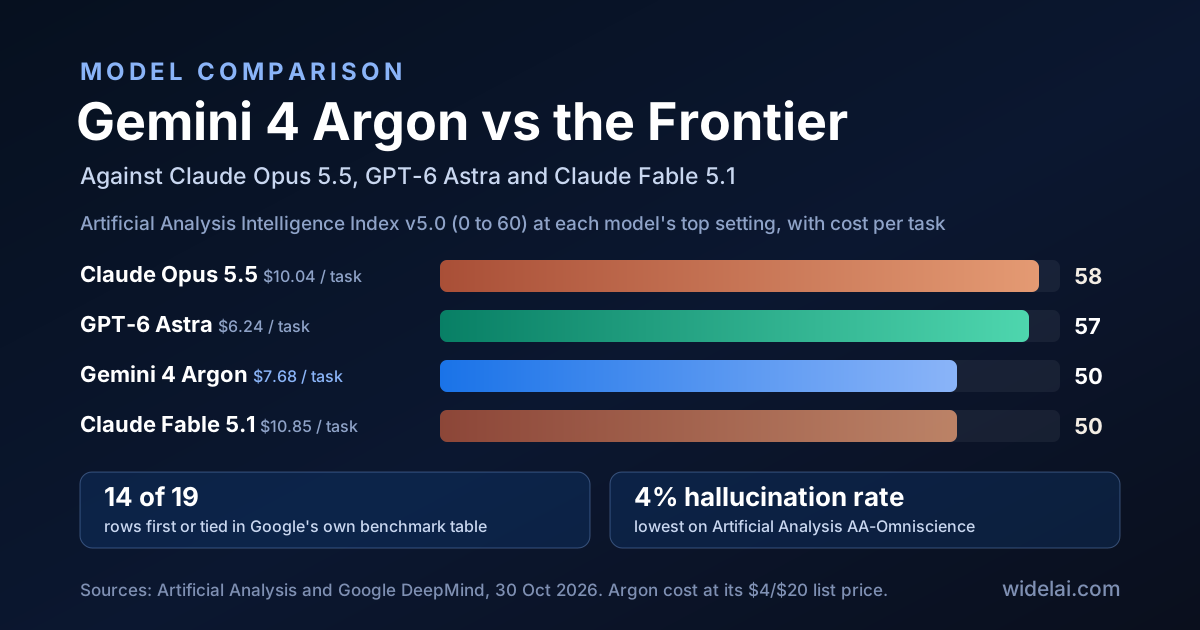
Gemini 4 Argon is Google's first Gemini 4 model, and Google picked its rivals itself. Its launch table puts Argon against Anthropic's Claude Opus 5.5 and Claude Fable 5.1 and OpenAI's GPT-6 Astra, the three closed flagships most teams are already weighing. Argon became generally available in the Gemini API on October 13, 2026 as gemini-4-argon, two weeks after Google first released it to a small group of cyber defenders.
The short version: in Google's own table, Argon is first or tied for first on 14 of 19 benchmarks, with its biggest leads in finance, legal and enterprise knowledge work, and in reasoning over very long inputs. Independent testing is less generous. On the Artificial Analysis Intelligence Index it scores 50, eight points behind Opus 5.5 and seven behind GPT-6 Astra, and level with Fable 5.1. Where independent tests do back Google is accuracy: Argon has a 4% hallucination rate on AA-Omniscience, the lowest on the chart when we checked.
Price is the other headline. Until November 30, Argon costs half as much per token as Opus 5.5 and a fifth as much as GPT-6 Astra and Fable 5.1. On December 1 its price doubles to match Opus 5.5.
This guide covers specifications and price, Google's benchmarks, independent results, hallucinations, speed and real cost, long context, where the newer Gemini 4 Carbon fits, and a routing table by task. Gemini 4 Argon, Opus 5.5, GPT-6 Astra and Fable 5.1 are all available on WidelAI today, in chat and in WidelCode.
Sources: Google's Gemini 4 Argon model page, developer guide, API pricing, changelog and DeepMind model card; Artificial Analysis model pages, leaderboard and AA-Omniscience results, checked October 30, 2026; Vals AI; Anthropic's Claude Opus 5.5 and Fable 5.1 announcements; OpenAI's GPT-6 Astra announcement. Benchmark tables are Google-reported unless marked otherwise.
The Short Answer
- Best all-round model: Claude Opus 5.5. It scores 58 on the Artificial Analysis Intelligence Index, the highest of these four, and leads Terminal-Bench 4.0 by nine points over Argon.
- Best for finance, legal and enterprise knowledge work: Gemini 4 Argon. It leads the Vals Index, Vals Finance Agent, Harvey's Legal Agent Benchmark and AutomationBench in Google's table, and Vals' own leaderboards rank it second for legal and finance-agent work.
- Fewest hallucinations: Gemini 4 Argon. When it does not know an answer, it almost always says so instead of guessing.
- Hardest software engineering and scientific computing: GPT-6 Astra. It beats Argon by 10.5 points on both FrontierSWE v2 and Terminal-Bench Science.
- Broadest factual recall: Claude Fable 5.1. It answers the most AA-Omniscience questions correctly, but in Google's table it trails Argon on 15 of the 17 rows both report, at five times Argon's November price.
- Cheapest frontier model this month: Gemini 4 Argon. It costs $2 input and $10 output per million tokens until November 30, then $4 and $20.
The Four Models at a Glance
| Released | Context | Direct price (in / out per 1M) | AA Index (top setting) | Cost per AA task | WidelAI credits per 1K (in / out) | |
|---|---|---|---|---|---|---|
| Claude Opus 5.5 | Sep 22, 2026 | 1M | $4 / $20 | 58 (max) | $10.04 | 0.80 / 4.00 |
| GPT-6 Astra | Sep 3, 2026 | 1.05M | $10 / $50 | 57 (max) | $6.24 | 2.00 / 10.00 |
| Gemini 4 Argon | Oct 13, 2026 | 1M | $2 / $10 to Nov 30, then $4 / $20 | 50 (high) | $7.68 | 0.40 / 2.00 |
| Claude Fable 5.1 | Sep 1, 2026 | 1M | $10 / $50 | 50 (xhigh) | $10.85 | 2.00 / 10.00 |
AA Index is the Artificial Analysis Intelligence Index v5.0 at each model's best-scoring setting. Artificial Analysis prices Argon at its standard $4 / $20 rate, so its cost per task during the introductory period is about half, roughly $3.84. Argon's 1M window is shared between input, thinking and output. GPT-6 Astra bills a whole request at a higher rate above 272K input tokens. WidelAI bills 1 credit per $0.005 of provider API cost.
Three things stand out before any benchmark:
- Argon tops out at "high". Google offers three thinking levels (low, medium and high), while Anthropic and OpenAI offer xhigh and max settings above that. Artificial Analysis tested each model at its best setting, so part of the gap to Opus 5.5 is effort. At high, Opus 5.5 scores 52 and GPT-6 Astra 55.
- Argon is token-hungry. It used 110 million output tokens to run the index. That is why, at its standard price, it costs more per task than GPT-6 Astra even though its per-token price is less than half of Astra's.
- The December price change matters. From December 1, Argon and Opus 5.5 have identical list prices, so the choice between them comes down to quality alone.
What Google's Benchmarks Show
Google's launch table compares Argon with the other three across 19 benchmarks, and Argon is first or tied for first on 14. Head to head, it beats Opus 5.5 on 14 of the 18 rows both report, and GPT-6 Astra on 14 of 19, with one tie.
Knowledge work, finance and legal
| Benchmark | Argon | Opus 5.5 | GPT-6 Astra | Fable 5.1 |
|---|---|---|---|---|
| Vals Index | 68.9 | 67.0 | 63.1 | 65.8 |
| AutomationBench | 51.3 | 42.5 | 41.4 | 31.4 |
| Vals Finance Agent v2 | 65.4 | 58.6 | 53.5 | 58.9 |
| Harvey's Legal Agent Benchmark | 19.6 | 3.8 | 5.4 | 6.7 |
This is Argon's strongest ground. Its lead on AutomationBench, almost nine points over Opus 5.5, points to better business-workflow automation, and its Finance Agent lead is more than six points over Fable 5.1. The Harvey result is the largest gap in the whole table: Argon completes almost three times as many legal agent tasks as the next model. The absolute score is still low, so read it as "much less bad at very hard legal work" rather than "solves legal work".
Agentic coding and ML engineering
| Benchmark | Argon | Opus 5.5 | GPT-6 Astra | Fable 5.1 |
|---|---|---|---|---|
| DeepSWE v1.1 | 77.9 | 74.2 | 74.1 | 67.4 |
| FrontierSWE v2 | 55.0 | 62.3 | 65.5 | 56.3 |
| Vibe Code Bench | 91.9 | 90.3 | 89.6 | 90.3 |
| Terminal-Bench 4.0 | 57.4 | 66.4 | 58.2 | 57.9 |
| PostTrainBench | 45.3 | 49.3 | 44.3 | 40.2 |
Coding is split. Argon leads DeepSWE, which measures complex software engineering tasks, by 3.7 points, and edges the field on Vibe Code Bench, which tests building whole apps from a description. But it is last of the four on FrontierSWE v2, ten and a half points behind GPT-6 Astra, and last on Terminal-Bench 4.0, nine points behind Opus 5.5. Terminal-Bench is the benchmark closest to how a coding agent actually works in a shell. Opus 5.5 also leads PostTrainBench, which tests machine-learning engineering.
For agent work in a terminal, Opus 5.5 is still the safer default. Argon is a strong choice for well-specified feature work and for reading, reviewing or explaining large codebases, where its long-context strength helps.
Science, math, long context and multimodal
| Benchmark | Argon | Opus 5.5 | GPT-6 Astra | Fable 5.1 |
|---|---|---|---|---|
| Terminal-Bench Science 0.1 | 57.6 | 63.3 | 68.1 | 52.6 |
| LABBench 2 | 88.8 | 73.1 | 85.4 | 68.6 |
| RiemannBench | 76.0 | 69.6 | 72.0 | 65.6 |
| GraphWalks BFS, up to 128K (F1) | 99.7 | 90.6 | 98.7 | 91.4 |
| GraphWalks BFS, 256K to 1M (F1) | 84.2 | 66.8 | 71.8 | 65.0 |
| Chartography | 71.6 | 66.3 | 71.0 | 46.2 |
| LVBench (long video) | 91.7 | 83.7 | 87.5 | 79.7 |
- Argon is the best long-context reasoner of the four. GraphWalks asks a model to follow links through a huge graph pasted into the prompt. Up to 128K tokens the leaders are close, but between 256K and 1M Argon keeps 84.2 F1 while the others fall to between 65 and 72. If you paste whole contracts, data rooms or codebases into one prompt, this is the most relevant row in the table.
- GPT-6 Astra still wins scientific computing. Its 10.5-point lead on Terminal-Bench Science is Argon's clearest loss. For simulations, numerical code and lab pipelines, use Astra.
- Argon leads science knowledge and math. It is 3.4 points ahead of Astra on LABBench 2, a biology research benchmark, and four points ahead on RiemannBench.
- Multimodal results are strong, especially on long video, though Chartography is nearly a tie with GPT-6 Astra.
Computer use and cybersecurity
| Benchmark | Argon | Opus 5.5 | GPT-6 Astra | Fable 5.1 |
|---|---|---|---|---|
| Agent's Last Exam (pass rate) | 39.5 | 38.2 | 34.2 | Not reported |
| OSWorld-2.0 (offline subset) | 69.2 | Not reported | 72.6 | Not reported |
| CWE-bench v1 | 68.0 | 67.0 | 68.0 | 58.0 |
Argon edges Opus 5.5 on Agent's Last Exam but trails GPT-6 Astra on OSWorld-2.0, where Google did not report the Claude models. On CWE-bench, which tests finding software vulnerabilities, Argon and Astra tie. Independent testing is less kind on computer use: Vals ranks Argon eighth of nine on its CUA-bench. For desktop agents, Astra or Opus 5.5 remain the better bet.
What Independent Tests Say
A vendor chooses the benchmarks in its own launch table. Two independent evaluators had published results for Argon when we checked.
Artificial Analysis
| Model and setting | AA Index v5.0 | Cost per AA task | Output speed |
|---|---|---|---|
| Claude Opus 5.5 (max) | 58 | $10.04 | 98 tokens/s |
| GPT-6 Astra (max) | 57 | $6.24 | 78 tokens/s |
| GPT-6 Astra (high) | 55 | $3.24 | 62 tokens/s |
| Claude Opus 5.5 (high) | 52 | $3.46 | 80 tokens/s |
| Gemini 4 Argon (high) | 50 | $7.68 | 83 tokens/s |
| Claude Fable 5.1 (xhigh) | 50 | $10.85 | 64 tokens/s |
Checked October 30, 2026. Opus 5.5 and Fable 5.1 results include Anthropic's default fallback. Argon's cost is at its $4 / $20 standard price; at the introductory price it is about $3.84.
At the same "high" setting, Opus 5.5 and GPT-6 Astra both score higher than Argon for less money per task, even with Argon's November discount. On this evidence, Argon is not the strongest general-purpose model in the group, and the index is the best single measure we have of general capability.
Vals AI
Vals runs its own evaluations of enterprise tasks. It puts Argon fourth of 30 models on the Vals Index at 69.24%, and its individual rankings match Google's story closely:
- Second of 31 on the Vals Legal Index (76.72%) and second of 34 on Finance Agent v2.1 (67.66%).
- Second of 122 on Vibe Code Bench v1.1 (91.91%), and a perfect score on Vals' IOI programming-olympiad set.
- Eighth of 58 on Terminal-Bench 4.0 (57.58%), which independently confirms Google's own 57.4.
- Eighth of nine on CUA-bench, Vals' computer-use test.
The pattern is the same across both evaluators. Argon is a top-tier model for documents, finance, law and long inputs, and a mid-pack one for terminal and computer-use agents.
Hallucinations and Accuracy
Artificial Analysis's AA-Omniscience benchmark asks a large set of hard factual questions and scores two things separately: how many a model answers correctly (accuracy), and how often it guesses wrong instead of admitting it does not know (hallucination rate).
- Gemini 4 Argon has a 4% hallucination rate, the lowest on the AA-Omniscience v1.1 chart when we checked. When it does not know, it nearly always says so.
- It also knows less. Its accuracy is 48%, against 68% for Claude Fable 5.1 at max, the highest listed, and 66% for Opus 5.5 at xhigh.
- Gemini 4 Carbon trades the other way, with 58% accuracy but an 11% hallucination rate.
These are two different strengths. Fable 5.1 and Opus 5.5 answer more questions from memory. Argon is the model least likely to state something false with confidence, which matters most when nobody will check the answer: a summary sent to a client, a figure pasted into a report, a fact in a support reply. Pair Argon with web search to get both, and still verify anything that matters.
On WidelAI, turning on web search lets Argon ground its answers in Google Search results. Google bills grounding per search query, and WidelAI passes that through at 2.8 credits per search.
Speed, Latency and What a Task Really Costs
Per-token price is only half of the cost. The other half is how many tokens a model spends to finish.
- Argon thinks for a long time before it answers. Artificial Analysis measures a 47-second wait for the first token at high thinking, then 83 tokens per second: faster than GPT-6 Astra and Fable 5.1, slower than Opus 5.5.
- It spends a lot of tokens. Thinking bills as output, so a hard prompt costs far more than an easy one.
- Through November, the price offsets that. At $2 / $10, Argon's cost per AA task falls to about $3.84, close to GPT-6 Astra and Opus 5.5 at high.
On WidelAI, a chat turn with 20,000 tokens of context and a 2,000-token answer costs:
| Model | Credits per 1K (in / out) | Credits for the example turn |
|---|---|---|
| Gemini 4 Argon, until Nov 30 | 0.40 / 2.00 | 12 |
| Gemini 4 Argon, from Dec 1 | 0.80 / 4.00 | 24 |
| Claude Opus 5.5 | 0.80 / 4.00 | 24 |
| GPT-6 Astra | 2.00 / 10.00 | 60 |
| Claude Fable 5.1 | 2.00 / 10.00 | 60 |
The 2,000 output tokens include thinking, which all four models bill as output. Long conversations cost less than they look: when Google serves repeated context from its cache, it discounts those tokens by 95%, and WidelAI passes that through, so the cached part of a long thread costs a twentieth of the normal input rate. Opus 5.5 gets the same 95% discount, GPT-6 Astra 90% and Fable 5.1 97.5%. Every rate is on the pricing transparency page.
Long Context and Long Output
All four accept around a million tokens of context, but they use it differently.
- Argon's million is shared. Input, thinking and output all come out of one 1,048,576-token window, so a 900K-token prompt leaves about 148K tokens for thinking and the answer.
- Argon holds up best at the far end of the window, as the GraphWalks results show. It is the model to pick when the evidence is spread across hundreds of thousands of tokens.
- Very long output is an API feature. Through Google's Interactions API, Argon can write up to a million tokens in one background response. Ordinary requests stop at 65,536 tokens, which is also the per-reply ceiling on WidelAI. For a book-length output, ask for it in sections.
- Its knowledge cutoff is March 2026, a few months earlier than GPT-6 Astra (April 2026) and Opus 5.5 (June 2026). Turn on web search for anything recent.
Where Gemini 4 Carbon Fits
On October 28, two weeks after Argon's general release, Google announced Gemini 4 Carbon, a stronger Gemini 4 model. It scores 59 on the Artificial Analysis Intelligence Index, one point above Opus 5.5 and the top score on the leaderboard, and 59 on the AA Coding Agent Index against Argon's 50.
You cannot use Carbon yet. Like Argon at first, it is rolling out to selected cyber defenders through Google's Fairwind Program, and Google has not given a date for API access. Its hallucination rate is also higher than Argon's: 11% against 4%. We compare Carbon with these models in detail in Gemini 4 Carbon vs Opus 5.5, GPT-6 Astra, Fable 5.1 and Argon.
For now, Argon is the strongest Gemini model you can actually build on. When Carbon opens to developers, it will be the natural model to test against Opus 5.5 and GPT-6 Astra, and Argon's case will rest on its accuracy and price.
Which Model to Use for Each Task
| If you need... | Use | Why |
|---|---|---|
| The strongest all-round model | Claude Opus 5.5 | Highest AA index of these four (58); leads Terminal-Bench 4.0 |
| Finance, legal and enterprise knowledge work | Gemini 4 Argon | Leads Vals Index, Finance Agent, Harvey legal and AutomationBench; second on Vals' legal and finance boards |
| Answers with the fewest false claims | Gemini 4 Argon | 4% hallucination rate on AA-Omniscience |
| Reasoning over 256K+ tokens of input | Gemini 4 Argon | 84.2 F1 on GraphWalks 256K to 1M, 12 points clear |
| Terminal-heavy coding agents | Claude Opus 5.5 | 66.4 on Terminal-Bench 4.0, nine points ahead of Argon |
| The hardest software engineering | GPT-6 Astra | Leads FrontierSWE v2 by 3.2 points over Opus 5.5 |
| Scientific computing | GPT-6 Astra | Leads Terminal-Bench Science by 4.8 points over Opus 5.5 |
| Desktop and computer-use agents | GPT-6 Astra | Leads OSWorld-2.0 in Google's table |
| The broadest factual recall | Claude Fable 5.1 | Highest AA-Omniscience accuracy (68%) |
| Frontier quality at the lowest price this month | Gemini 4 Argon | $2 / $10 until November 30 |
Real work rarely fits one row. A sensible setup is to run document, research and long-context work on Gemini 4 Argon, send terminal-heavy coding agents to Opus 5.5, give scientific code to GPT-6 Astra, and keep Fable 5.1 for questions where broad recall matters more than cost. No single model wins every row, which is the case for routing by task instead of committing to one vendor.
Caveats Before You Switch
- Most numbers in the big table are Google's. Google chose the benchmarks and the comparison set. Artificial Analysis and Vals are the independent anchors in this guide, and they rank Argon lower overall.
- Effort settings are not equal. Argon's top setting is high, while Opus 5.5 and GPT-6 Astra go up to max. On WidelAI, Argon runs at Google's default medium thinking level, so expect turns that are faster and cheaper than the high-setting results above, and slightly less thorough.
- The introductory price ends November 30. Budget at $4 / $20 for anything that runs past November.
- Text only on WidelAI for now. Google's API accepts images, audio, video and PDFs, but WidelAI does not yet send images to Gemini models. For a question about a picture, pick a vision model such as Opus 5.5 or GPT-6 Astra.
- The first token is slow. A 47-second wait at high thinking is fine for a report and frustrating for a quick question. Use a Flash model, such as Gemini 3.8 Flash, for quick lookups.
- Test on your own work. Five to ten tasks you have already solved will tell you more than any leaderboard.
Try Gemini 4 Argon on WidelAI and WidelCode
You can run every comparison in this guide on your own prompts, without a Google Cloud account or API key. Gemini 4 Argon is live on WidelAI now, next to Claude Opus 5.5, GPT-6 Astra and Claude Fable 5.1, on one plan and one credit balance.
In WidelAI chat
- Pick Gemini 4 Argon from the Google group in the chat model picker. It costs 0.40 input and 2.00 output credits per 1K tokens until November 30, half the rate of Opus 5.5.
- Compare it in the same thread. Ask Argon first, then switch the picker to Opus 5.5 or GPT-6 Astra and send the same prompt. The conversation history carries over, so you can read the answers side by side.
- Turn on web search for anything time-sensitive. Argon's knowledge stops in March 2026, and grounding plays to its low hallucination rate.
In WidelCode
WidelCode, the WidelAI coding agent, lets you choose the model per task, so you can try Argon on one job without changing anything else. The model ID everywhere is gemini-4-argon.
- Mac app: open the Code tab, choose a project folder and pick Gemini 4 Argon in the Google group. If you do not have the app yet, download WidelCode.
- CLI: install it once with
npm install -g widelcodeand sign in withwidelcode login. Start a session withwidelcode --model gemini-4-argon, or switch an existing one with/model gemini-4-argon. - VS Code: the
widelai.widelcodeextension, on the Visual Studio Marketplace and Open VSX, runs the same agent with the same models and credits. - Cloud agents: give Argon a repository task that ends in a pull request, with a hard credit limit:
widelcode --model gemini-4-argon --budget 300 cloud run --repo your-org/your-repo --prompt "Map the billing module and write a migration plan with tests" --follow
A good first WidelCode task for Argon plays to its strengths: reading a large codebase and explaining it, reviewing a long diff, or implementing a well-specified feature. For a long terminal session, switch the same task to Opus 5.5 with /model claude-opus-5-5 and compare the runs.
New to WidelAI? Create your account and choose the Pro plan, which includes Gemini 4 Argon, every other model in this guide and WidelCode. You can see every model and its rate on the models page and the pricing transparency page.
The Verdict
Gemini 4 Argon is not the best model in this group across the board. Independent tests put Claude Opus 5.5 and GPT-6 Astra ahead on general intelligence, terminal-based coding and scientific computing, and Google has already announced a stronger Gemini 4 model in Carbon.
What Argon does better than any of them is specific and valuable: enterprise knowledge work in finance and law, reasoning across very long inputs, and not making things up. Add a November price that is half of Opus 5.5's, and Argon earns a place as the default for document-heavy and research work, with Opus 5.5 and GPT-6 Astra one click away for the tasks they win.
Related Reading
- Gemini 4 Carbon vs Opus 5.5, GPT-6 Astra, Fable 5.1 and Argon
- Kimi K3.1 Pro vs Opus 5.5, GPT-6 Astra, Fable 5.1, DeepSeek & GLM
- Muse Wonder vs Opus 5.5, Fable 5.1, GPT-6 Astra, Sol and Argon
- GPT-6 Astra vs Claude Fable 5.1: Which Model Should You Use?
- Gemini 3.8 Flash Guide: Coding, Agents, Price, and Migration
- The WidelCode CLI and VS Code Extension Are Now Available

Do your best AI work in one place
Bring your next question, draft, file, or idea to WidelAI. Choose the model that fits the moment, keep your work together, and stay in control of privacy and usage.
Leading models, one workspace
Use powerful AI models without juggling separate tabs, accounts, or workflows.
Switch without starting over
Change models as your work evolves while keeping the conversation and context together.
The right model for every task
Choose speed for everyday work or deeper reasoning for complex questions and decisions.
Clear credits and model rates
See your balance, understand each model’s rate, and track usage from one place.
Bring your files and images
Work with documents and images alongside your prompts in the same focused experience.
Your work stays yours
Your data is encrypted in transit and at rest, and your content is never used to train AI models.