Claude Sonnet 5.5 vs Opus 5.5: Which Claude Should You Use?
Sonnet 5.5 costs half as much as Opus 5.5 per token and lands within a few points on Anthropic's benchmarks. Here's when the cheaper Claude wins and when Opus 5.5 earns its rate.
WidelAI Research
Building the future of AI accessibility
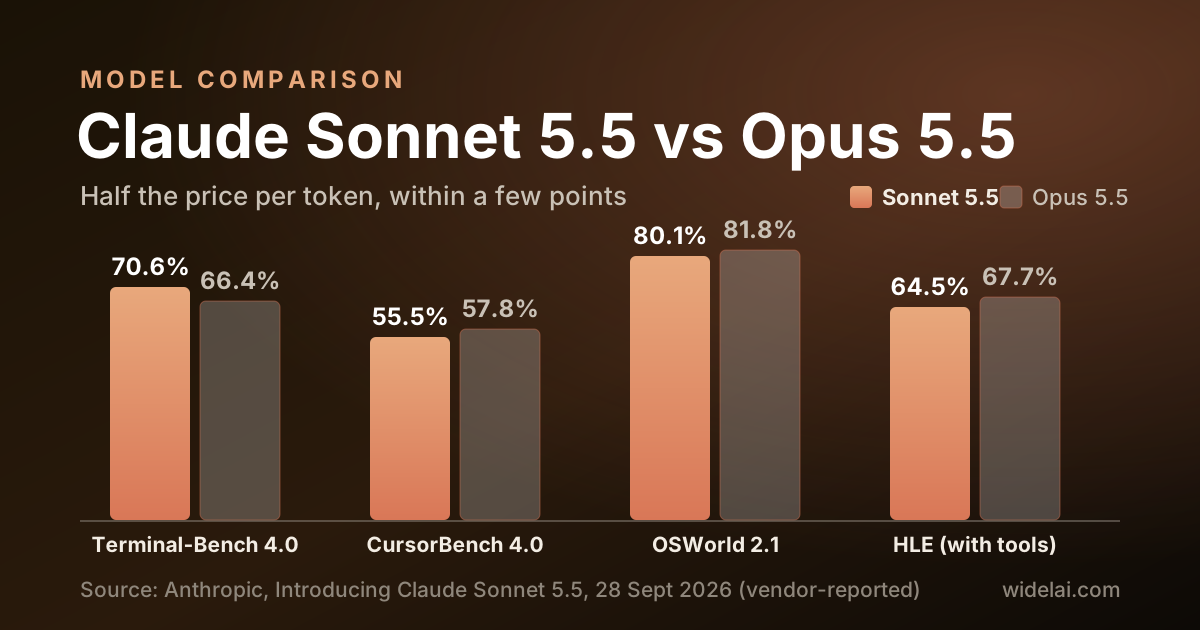
Claude Sonnet 5.5 and Claude Opus 5.5 are the two halves of Anthropic's new Claude 5.5 family, released six days apart. They share a 1M-token context window, a 128K maximum output and a June 2026 knowledge cutoff. Sonnet 5.5 costs exactly half as much per token. On Anthropic's own benchmark table it lands within a few points of Opus 5.5, and on one agentic coding test it finishes ahead.
That makes this the most interesting pricing decision in Anthropic's lineup right now. If the cheaper model is nearly as good, when is the more expensive one worth it? This post works through price, specifications, benchmarks, cost per task and the kinds of work each model suits, then finishes with a routing pattern you can use on WidelAI today.
Benchmark figures are from Anthropic's Claude Sonnet 5.5 announcement. Prices are from Anthropic's pricing page. Both are vendor sources.
The Short Answer
- Default to Claude Sonnet 5.5 for well-scoped coding, bug fixes, documents, slides, spreadsheets and interactive chat. It is faster, half the price per token, and within two points of Opus 5.5 on knowledge work.
- Escalate to Claude Opus 5.5 for complex, open-ended work that needs sustained judgment: ambiguous architecture decisions, long investigations, and tasks where a subtle wrong turn is expensive. Anthropic itself says Opus 5.5 remains clearly stronger there.
- Do not run Sonnet 5.5 at maximum effort as a cheap Opus. Anthropic's cost curves show that at the top effort settings, Sonnet 5.5 performs comparably to Opus 5.5 at a similar cost per task. The saving lives at Low and Medium effort.
Price and Credits
Start with the numbers, because the price gap is simple and exact.
| Claude Sonnet 5.5 | Claude Opus 5.5 | |
|---|---|---|
| Input (per 1M tokens) | $2.00 | $4.00 |
| Output (per 1M tokens) | $10.00 | $20.00 |
| Cache reads (per 1M) | $0.20 | $0.20 |
| 5-minute cache writes (per 1M) | $2.50 | $5.00 |
| Batch input / output (per 1M) | $1.00 / $5.00 | $2.00 / $10.00 |
| Fast mode (per 1M) | Not offered | $8.00 / $40.00, research preview |
| WidelAI input (credits per 1K) | 0.40 | 0.80 |
| WidelAI output (credits per 1K) | 2.00 | 4.00 |
Two rows deserve attention.
Cache reads cost the same. Anthropic prices cache reads at $0.20 per million on both models. Opus 5.5 gets there with a steeper discount, 5% of its input price against Sonnet 5.5's 10%. For workloads dominated by re-reading a large cached prefix, such as a long agent session over the same repository, the input side of the bill converges. The gap that remains is output, where Opus 5.5 is still exactly twice the price.
Output is where the difference compounds. On both models output costs five times input. Because thinking tokens count toward output, a model that thinks longer on a problem also costs more on it. That is why effort level, not just model choice, drives the real bill.
On WidelAI, where 1 credit equals $0.005 of API cost, a turn with 20,000 tokens of context and a 2,000-token answer costs about 12 credits on Sonnet 5.5 and 24 credits on Opus 5.5. The full rate card is on the pricing transparency page.
Specifications Side by Side
| Claude Sonnet 5.5 | Claude Opus 5.5 | |
|---|---|---|
| Model tag | claude-sonnet-5-5 | claude-opus-5-5 |
| Released | September 28, 2026 | September 22, 2026 |
| Context window | 1M tokens | 1M tokens |
| Maximum output | 128K tokens | 128K tokens |
| Knowledge cutoff | June 2026 | June 2026 |
| Relative latency (Anthropic) | Fast | Moderate |
| Thinking | Adaptive, can be reduced to between_tools | Adaptive, always on |
| Default API effort | High | Medium |
| Forced tool use | Not supported | Supported |
| WidelAI plan | Pro | Pro |
The specifications are almost identical where it matters for capacity. Both handle a 1M-token context and both can write up to 128K tokens in a response. The differences are in behavior and control.
Thinking control. On Opus 5.5, adaptive thinking is always on. On Sonnet 5.5, you can reduce up-front thinking with the new between_tools setting, which is useful for latency-sensitive integrations. That option is one reason Sonnet 5.5 suits interactive products.
Default effort. On the API, Sonnet 5.5 defaults to high effort while Opus 5.5 defaults to medium. Anthropic's own apps and Claude Code default both to Medium, and so does WidelAI's reasoning effort picker. If you compare the two models through the raw API without setting effort, you are comparing Sonnet at high against Opus at medium, which skews both cost and quality.
Forced tool use. Sonnet 5.5 rejects tool_choice values that force a tool call. If your integration depends on forcing a specific tool, that is a migration task, covered in our Sonnet 5.5 migration guide.
Benchmarks: Where the Gaps Are
Anthropic published this comparison alongside the Sonnet 5.5 launch. Treat it as vendor-reported: Anthropic ran both its own models in its own harness.
| Benchmark | Sonnet 5.5 | Opus 5.5 | Gap |
|---|---|---|---|
| Terminal-Bench 4.0 (agentic coding) | 70.6% | 66.4% | Sonnet +4.2 |
| CursorBench 4.0 (agentic coding) | 55.5% | 57.8% | Opus +2.3 |
| GDPval-AA v2.1 (knowledge work) | 1844 | 1846 | Opus +2 |
| AA-Briefcase v1.1 (knowledge work) | 1811 | 1822 | Opus +11 |
| Humanity's Last Exam (with tools) | 64.5% | 67.7% | Opus +3.2 |
| OSWorld 2.1 (computer use, partial) | 80.1% | 81.8% | Opus +1.7 |
| Chartography (charts, no tools) | 61.6% | 64.4% | Opus +2.8 |
The cover chart shows four of these rows. Figures from Anthropic's Sonnet 5.5 announcement; Anthropic footnotes its Opus 5.5 Terminal-Bench figure.
What the table says
The gaps are small everywhere. Opus 5.5 leads six of seven rows, but by 1.7 to 3.2 points on the percentage benchmarks and by 2 points on GDPval-AA, a benchmark scored in the thousands. Sonnet 5.5 leads Terminal-Bench 4.0 by 4.2 points.
For bounded work, that is a strong case for Sonnet 5.5. Paying double on every token for a 2 or 3 point lead only makes sense when those points land on your specific task.
What the table does not say
Benchmarks measure well-defined tasks with a clear scoring rule. Anthropic is explicit that they capture only one facet of capability, and that in its own testing and that of external testers, Opus 5.5 remains clearly stronger at complex, open-ended work requiring sustained judgment. That is exactly the kind of work that is hardest to benchmark: deciding what to build, noticing that a requirement is wrong, or keeping a long investigation on track.
In other words, the table tells you Sonnet 5.5 is close on work with a clear answer. It does not tell you Sonnet 5.5 is close on work where finding the question is the hard part.
Cost per Task, Not Cost per Token
Anthropic published accuracy-versus-cost curves for each model at every effort level. They reveal something the per-token price does not.
- At Low and Medium effort, Sonnet 5.5 is where the value is. On several benchmarks, Sonnet 5.5 at Low or Medium beats Sonnet 5's best score for about a tenth of the cost per task. On Terminal-Bench 4.0 at Medium, it far exceeds Sonnet 5's best result for less than a tenth of the cost.
- At High effort, it still undercuts. On FrontierCode at High, Anthropic reports Sonnet 5.5 scoring 10 points above Sonnet 5 at the same setting for about one fifteenth of the cost per task.
- At the top settings, the advantage narrows. Anthropic says Sonnet 5.5 at Max effort performs comparably to Opus 5.5 on several evaluations, and at higher settings it can perform comparably at a similar cost. Pushing Sonnet 5.5 to Max to imitate Opus does not save money.
The practical rule: Sonnet 5.5 complements Opus 5.5 best at lower effort settings. Use it at Low or Medium for the bulk of your work. When a task needs Max-effort thinking, that is usually a signal to switch to Opus 5.5 rather than to turn Sonnet all the way up.
Where Sonnet 5.5 Wins
- Well-scoped coding and bug fixes. Anthropic lists these as Sonnet 5.5's strongest areas, and early testers noted how quickly it understands a codebase and how often it batches tool calls to finish in fewer steps.
- Documents, slides and spreadsheets. Anthropic's internal test produced a 10-slide operating review from earnings materials that two experts judged ready to send on the first draft. Testers also highlighted its eye for design.
- Interactive work. More than 30% faster output than Sonnet 5 makes it the better choice when a person is waiting on the reply.
- High call volumes. Half the per-token price and fewer tokens per task add up quickly across many requests. Slack reported about 14% fewer output tokens than Sonnet 5 on its Slackbot evaluations, with better results.
- Computer use and chart reading at a lower price. It lands within two to three points of Opus 5.5 on OSWorld 2.1 and Chartography.
Where Opus 5.5 Wins
- Open-ended problems. When the task is "figure out why this system behaves this way" rather than "fix this function", Opus 5.5's sustained judgment is what you are paying for.
- High-stakes changes. Migrations, payment paths, security-sensitive refactors and anything where a subtle mistake is costly to undo.
- Long investigations. Anthropic's guidance for Sonnet 5.5 itself says that for the hardest long-horizon work, an Opus model is the better choice.
- Forced tool workflows. If your integration relies on forcing a tool call, Opus 5.5 still supports it.
- Latency-critical Opus work. Opus 5.5 offers a fast mode in research preview at premium pricing, which Sonnet 5.5 does not have. Most users will not need it, since Sonnet 5.5 is already fast.
A Routing Pattern That Works on WidelAI
Because both models share one WidelAI plan and one credit balance, you do not have to choose one. The effective pattern is to default low and escalate deliberately.
| Situation | Model | Reasoning effort |
|---|---|---|
| Quick questions, drafting, summaries | Claude Sonnet 5.5 | Low |
| Everyday coding, bug fixes, documents | Claude Sonnet 5.5 | Medium |
| Longer or trickier well-scoped tasks | Claude Sonnet 5.5 | High |
| Ambiguous, open-ended or high-stakes work | Claude Opus 5.5 | Medium or High |
| Hardest long-horizon research and agent runs | Claude Fable 5.1 | High |
The escalation itself is simple. Work the problem on Sonnet 5.5, and when it stalls or the task turns out to be bigger than it looked, switch the same thread to Opus 5.5 in the model picker. WidelAI carries the visible conversation across models, so Opus 5.5 inherits the context, including the approaches that already failed.
One technical note if you also build on the Anthropic API directly: Sonnet 5.5's internal thinking blocks cannot be read by Opus 5.5 or any other model. When you switch models in your own integration, the new model continues from the visible transcript without the earlier reasoning. That matches how WidelAI behaves, and it is one more reason to ask for a short written summary of findings before you escalate.
A Worked Example
Say you are fixing a flaky integration test in a mid-sized service.
- Start on Sonnet 5.5 at Medium. Paste the failing test, the error and the module under test. A typical exchange of 20,000 tokens in and 2,000 out costs about 12 credits.
- Iterate quickly. Sonnet 5.5's speed makes three or four rounds of hypotheses cheap and fast, roughly 50 credits in total.
- Escalate if the cause is architectural. If it turns out to be a race between two services, switch the thread to Opus 5.5 and ask for a root-cause analysis. One focused Opus turn of the same size costs about 24 credits.
- Drop back down to finish. Writing the regression test is well-scoped work. Switch back to Sonnet 5.5.
Running the whole session on Opus 5.5 would have cost roughly twice as much for work where most turns did not need it. Running it entirely on Sonnet 5.5 would have been cheapest, but risks missing the architectural cause. The mix gets both.
Summary Table
| Claude Sonnet 5.5 | Claude Opus 5.5 | |
|---|---|---|
| Direct price (per 1M) | $2 / $10 | $4 / $20 |
| WidelAI credits (per 1K) | 0.40 / 2.00 | 0.80 / 4.00 |
| Speed | Fast | Moderate |
| Agentic coding (Terminal-Bench 4.0) | 70.6% | 66.4% |
| Knowledge work (GDPval-AA v2.1) | 1844 | 1846 |
| Open-ended judgment | Good | Clearly stronger, per Anthropic |
| Best effort range | Low to High | Medium to High |
| Best used as | Everyday default | Escalation for hard, ambiguous work |
The Verdict
Claude Sonnet 5.5 is the new default for most people. It is fast, half the price of Opus 5.5 per token, and close enough on benchmarks that the gap rarely shows on bounded work. Claude Opus 5.5 earns its rate on the problems where judgment matters more than speed, and it remains the right escalation target.
The best way to settle it for your own work is to run the same task through both. On WidelAI that takes one click in the chat, and you can see both models on the models page.
Related Reading

Do your best AI work in one place
Bring your next question, draft, file, or idea to WidelAI. Choose the model that fits the moment, keep your work together, and stay in control of privacy and usage.
Leading models, one workspace
Use powerful AI models without juggling separate tabs, accounts, or workflows.
Switch without starting over
Change models as your work evolves while keeping the conversation and context together.
The right model for every task
Choose speed for everyday work or deeper reasoning for complex questions and decisions.
Clear credits and model rates
See your balance, understand each model’s rate, and track usage from one place.
Bring your files and images
Work with documents and images alongside your prompts in the same focused experience.
Your work stays yours
Your data is encrypted in transit and at rest, and your content is never used to train AI models.