Muse Wonder vs Opus 5.5, Fable 5.1, GPT-6 Astra, Sol and Argon
Meta's Muse Wonder Full ranks #2 on the Artificial Analysis index. We compare Muse Wonder and Full with Opus 5.5, Fable 5.1, GPT-6 Astra, GPT-6.1 Sol and Gemini 4 Argon.
WidelAI Research
Evidence-led analysis for practical multi-model AI decisions
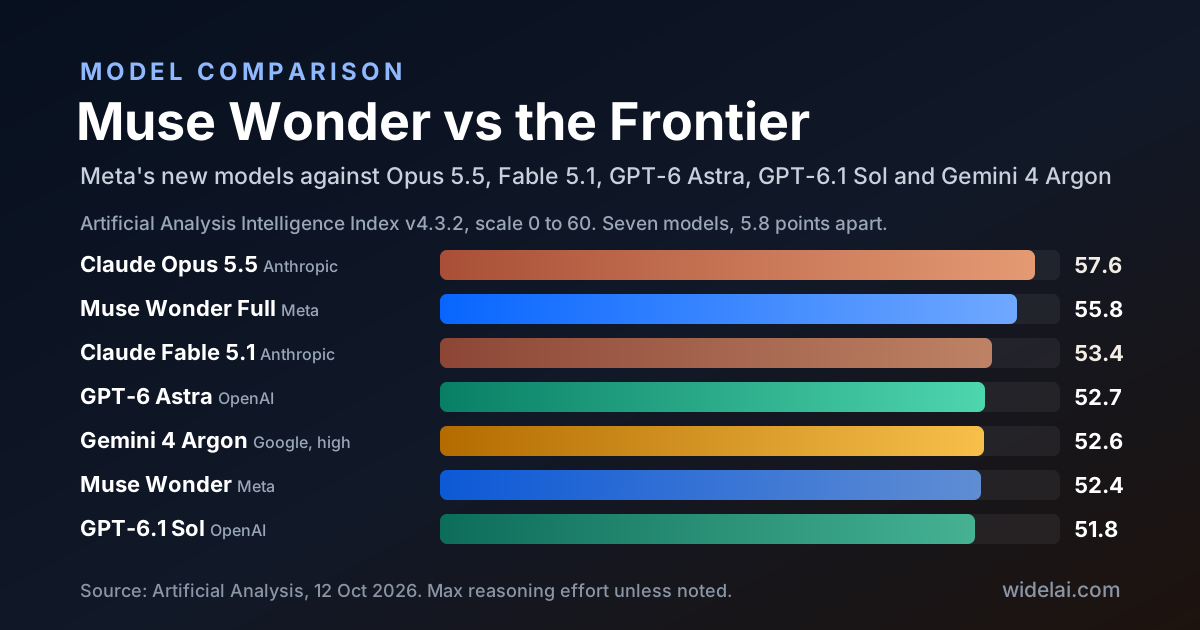
Muse Wonder vs the rest of the frontier is the comparison everyone is running this week. On October 12, 2026, Meta released Muse Wonder and Muse Wonder Full, the first models in its new Muse Wonder series. On the first independent scoreboard, the Artificial Analysis Intelligence Index, Muse Wonder Full ranks second. Only Claude Opus 5.5 scores higher. It also posts the best scores of any model on two long-running coding benchmarks.
That is a big jump for Meta. Its previous model, Muse Spark 1.3, scored 48 on the same index version. Muse Wonder Full scores 56. But a ranking does not tell you which model to use, so this guide compares Muse Wonder and Muse Wonder Full with the five models most teams are choosing between this fall: Claude Opus 5.5, Claude Fable 5.1, GPT-6 Astra, GPT-6.1 Sol and Gemini 4 Argon.
We cover specifications, agent and professional work, coding, knowledge and hallucinations, real cost per task and safety, then finish with a routing plan by task. Four of these models are already on WidelAI, and Muse Wonder and Muse Wonder Full are coming soon to WidelAI and WidelCode.
Sources: Meta's launch announcement, research blog, model card and developer page; Artificial Analysis; Anthropic's Claude Opus 5.5 and Fable 5.1 announcements; OpenAI's GPT-6 Astra and GPT-6.1 Sol announcements. Benchmark tables are vendor-reported unless marked otherwise.
The Short Answer
- Best overall: Claude Opus 5.5. It leads the Artificial Analysis Intelligence Index at 57.6 and wins ProgramBench, Terminal-Bench 4.0, OSWorld and factual knowledge.
- Best for long agentic coding: Muse Wonder Full. It posts the top scores on DeepSWE 1.1 (79.0%) and SWE-Marathon (57.5%). It also ties Claude Code running Sonnet 5.5 on Artificial Analysis's Coding Agents Index.
- Best for memory-heavy personal agents: Muse Wonder. Both Muse models score about 85.5% on Meta's MemoryBench, roughly 4 points ahead of everything else, and standard Muse Wonder gets there at a lower cost than Full.
- Fewest hallucinations: Gemini 4 Argon. Its 15% hallucination rate on AA-Omniscience is the lowest in its tier. Muse Wonder Full is second at 23%.
- Best value at scale: GPT-6.1 Sol. Artificial Analysis puts it at about $0.72 per index task, roughly a sixth of Muse Wonder's cost, while scoring within 0.6 points of it.
- Muse's weak spot: factual knowledge. Muse Wonder Full scores 30 on AA-Omniscience against 46 for Opus 5.5.
What Muse Wonder and Muse Wonder Full Are
Muse Wonder is Meta's new frontier reasoning model family. It builds on the Muse Spark line and was trained at Meta's gigawatt-scale Prometheus data center. It comes in two versions:
| Muse Wonder | Muse Wonder Full | |
|---|---|---|
| Model ID | muse-wonder-1.0 | muse-wonder-full-1.0 |
| Released | October 12, 2026 | October 12, 2026 |
| Context window | 1M tokens | 1M tokens |
| Input / output | Text, image, video and audio in; text out | Text, image, video and audio in; text out |
| Direct price (per 1M tokens) | $4 input, $0.20 cached, $20 output | No public API price |
| Where Meta offers it | Meta Model API and Muse Code | Muse Code subscribers only |
| AA Intelligence Index v4.3.2 | 52.4 | 55.8 |
Meta is pitching both models as the engine for a personal AI agent, one that works across your calendar, messages and documents. Two features stand out:
- Active Memory carries what matters about you from one conversation to the next and brings it back when it is relevant.
- Active Focus keeps the model working toward a goal when a task gets hard. It tries other approaches, works through blockers, asks for clarification and checks in before important actions.
Both features show up in the numbers. The Muse models lead every competitor on MemoryBench, and their biggest gains are on long-running agent work.
Muse Wonder vs Muse Wonder Full
Muse Wonder Full is the same family run with far more compute, and it uses a lot of tokens: Artificial Analysis recorded about 140 million output tokens to run its index, against a median of 88 million for comparable reasoning models. The extra effort pays off on some tasks and barely matters on others.
| Benchmark | Muse Wonder | Muse Wonder Full | Gain |
|---|---|---|---|
| Artificial Analysis Index | 52 | 56 | +4 |
| ProgramBench | 50.0% | 59.0% | +9.0 |
| AutomationBench-AA | 39.1% | 45.4% | +6.3 |
| Terminal-Bench 4.0-AA | 52.0% | 57.1% | +5.1 |
| SWE-Marathon | 53.1% | 57.5% (xhigh) | +4.4 |
| Harvey LAB-AA (legal) | 10.0% | 13.1% | +3.1 |
| DeepSWE 1.1 | 78.8% | 79.0% | +0.2 |
| MemoryBench | 85.6% | 85.5% | -0.1 |
Muse Wonder Full is worth it for building programs from scratch, business automation and terminal-heavy agent work. For fixing bugs in existing repos or memory-heavy assistance, standard Muse Wonder gets you almost all the way.
The Seven Models Side by Side
| Released | Context | Direct price (in / out per 1M) | AA Index | WidelAI credits per 1K (in / out) | |
|---|---|---|---|---|---|
| Claude Opus 5.5 | Sep 22, 2026 | 1M (128K out) | $4 / $20 | 57.6 | 0.80 / 4.00 |
| Muse Wonder Full | Oct 12, 2026 | 1M | Muse Code subscription only | 55.8 | Coming soon |
| Claude Fable 5.1 | Sep 1, 2026 | 1M | $10 / $50 | 53.4 | 2.00 / 10.00 |
| GPT-6 Astra | Sep 3, 2026 | 128K out | $10 / $50 | 52.7 | 2.00 / 10.00 |
| Gemini 4 Argon | Announced Sep 30, 2026 | 1M out (reported) | Not yet generally available | 52.6 (high) | Not available |
| Muse Wonder | Oct 12, 2026 | 1M | $4 / $20 | 52.4 | Coming soon |
| GPT-6.1 Sol | Sep 29, 2026 | 1.05M (128K out) | $2 / $10 | 51.8 | 0.40 / 2.00 |
AA Index is the Artificial Analysis Intelligence Index v4.3.2, published October 12, 2026, at each model's maximum reasoning setting unless noted. GPT-6 Astra and GPT-6.1 Sol bill whole requests at a higher rate above 272K input tokens. WidelAI bills 1 credit per $0.005 of provider API cost.
Look at the spread. Leave out Opus 5.5 and Muse Wonder Full, and the other five sit between 51.8 and 53.4, less than two points apart. At this level, the overall index barely separates them. What matters is how each model does on your kind of work and what it costs to run.
Agents and Professional Work
These figures come from Meta's launch scorecard, which compares Muse with Fable 5.1, GPT-6 Astra and Opus 5.5. Meta's model card explains where each number comes from: third-party results where they exist (Artificial Analysis, Vals AI, Surge), provider-reported results where not, and its own runs for the rest. GPT-6.1 Sol and Gemini 4 Argon are not in Meta's table.
| Benchmark | Wonder Full | Wonder | Opus 5.5 | Fable 5.1 | GPT-6 Astra |
|---|---|---|---|---|---|
| Personal Superintelligence Index (Meta) | 59.1 | 54.3 | 55.2 | 49.9 | 54.5 |
| AutomationBench-AA | 45.4 | 39.1 | 41.2 | 32.1 | 41.6 |
| Vals Finance Agent V2 | 59.1 | 56.6 | 58.6 | 58.9 | 53.5 |
| Harvey LAB-AA (legal) | 13.1 | 10.0 | 4.2 | 6.4 | 8.6 |
| GDP.pdf | 33.2 | 30.8 | 30.6 | 27.6 | 34.2 |
| JobBench | 75.3 | 70.5 | 75.4 | 73.1 | 66.1 |
| HealthBench Pro | 62.3 | 60.5 | 65.6 | 62.1 | 65.3 |
| MemoryBench | 85.5 | 85.6 | 81.5 | 79.0 | 81.4 |
| OSWorld V2.1 (partial) | 78.4 | 72.6 | 81.8 | 80.7 | 75.8 |
| OSWorld V2.1 (binary) | 39.4 | 34.3 | Not reported | 43.1 | 34.3 |
What the table shows:
- Muse Wonder Full is a strong business-automation agent. It leads AutomationBench-AA, Harvey's legal agent benchmark and Vals Finance Agent V2. Harvey LAB-AA scores look low across the board because version 1.1 only credits a deliverable that meets every criterion and passes hallucination checks.
- Treat the Personal Superintelligence Index with care. Meta built it from seven evaluations, including its own internal FocusBench and VBT tests, so it partly measures what Meta optimized for.
- Memory is where both Muse models clearly lead. MemoryBench tests recall across 64K to 100K-token conversations full of distractors and later corrections. If your agent has to remember people, preferences and decisions across sessions, this matters.
- Computer use still belongs to Anthropic. Opus 5.5 and Fable 5.1 lead OSWorld V2.1, and Fable 5.1 has the best strict completion score at 43.1%.
- For health questions, use Opus 5.5 or GPT-6 Astra. Both are about 3 points ahead of Muse Wonder Full on HealthBench Pro.
Google published its own launch table for Gemini 4 Argon, run against GPT-6 Astra rather than Muse. On two benchmarks where Google's Astra figure matches Meta's, Argon scores 65.4% on Vals Finance Agent V2 (above every model in Meta's table) and 77.9% on DeepSWE v1.1. Google also reports Argon well ahead of Astra on its own versions of AutomationBench (51.3% vs 41.4%) and Harvey's legal benchmark (19.6% vs 5.4%), but those runs are not the Artificial Analysis versions Meta used, so they do not line up with the table above.
Coding
Coding is where Muse Wonder made its biggest jump. Meta's Terminal-Bench score went from about 33% with Muse Spark 1.3 to 57%, and Muse Wonder Full ties Claude Code running Sonnet 5.5 at 68 on Artificial Analysis's Coding Agents Index.
| Benchmark | Wonder Full | Wonder | Opus 5.5 | Fable 5.1 | GPT-6 Astra |
|---|---|---|---|---|---|
| DeepSWE 1.1 | 79.0 | 78.8 | 74.2 | 67.4 | 74.1 |
| SWE-Marathon | 57.5 (xhigh) | 53.1 | 46.3 | 45.6 | 42.5 |
| ProgramBench | 59.0 | 50.0 | 70.5 | 55.5 | 52.5 |
| Terminal-Bench 4.0-AA | 57.1 | 52.0 | 59.6 | 52.0 | 59.1 |
How the numbers were produced matters here, and Meta's model card is clear about it:
- DeepSWE 1.1 uses Datacurve's third-party runs for both Muse models and Opus 5.5, OpenAI's own figure for Astra and Anthropic's for Fable 5.1. The top is close: both Muse models land within 1.1 points of Gemini 4 Argon's Google-reported 77.9%, and about 5 points ahead of Opus 5.5 and Astra.
- SWE-Marathon comes from Abundant AI for every model, but Astra ran in Codex and Fable 5.1 in Claude Code, so it is not a like-for-like harness. Muse Wonder Full's 11-point lead over Opus 5.5 is real evidence of stamina on very long projects, but treat the size of the gap as directional.
- ProgramBench puts every model on the same agent, mini-swe-agent, which makes it the cleanest comparison in the table. Opus 5.5 leads by 11.5 points, the biggest gap anywhere in this guide. For building a program from a spec, Opus is still the pick.
- Terminal-Bench 4.0 is a three-way tie between Opus 5.5, GPT-6 Astra and Muse Wonder Full, all within 2.5 points.
Outside Meta's table, Google reports GPT-6 Astra beating Gemini 4 Argon on FrontierSWE v2 (65.5% vs 55.0%) and Terminal-Bench Science 0.1 (68.1% vs 57.6%). For scientific computing, Astra remains the strongest choice.
Knowledge and Hallucinations
This is Muse Wonder's biggest weakness, and it comes from Artificial Analysis's independent AA-Omniscience test, not a vendor table.
| Model | AA-Omniscience (knowledge) | Hallucination rate |
|---|---|---|
| Claude Opus 5.5 | 46 | Not reported here |
| GPT-6 Astra | 43 | 51% |
| Gemini 4 Argon | 42 | 15% |
| Muse Wonder Full | 30 | 23% |
| Muse Wonder | 25 | Not reported here |
| GPT-6.1 Sol | Not reported here | 54% |
- Muse Wonder Full is 16 points behind Opus 5.5 on factual knowledge. For research, fact-heavy questions or anything without retrieval, that is a real gap.
- But it rarely makes things up. Its hallucination rate fell from 33% to 23%, the second lowest among models scoring at least 45 on the index. When it does not know, it is more likely to say so.
- Gemini 4 Argon is the most careful. Its 15% rate is the lowest in its tier. GPT-6 Astra and GPT-6.1 Sol answer far more questions they do not actually know.
The practical fix is the same for every model: give it sources. A model that knows less but hallucinates less does much better when you supply the documents or let it search. Meta's API charges $2.50 per 1,000 queries for built-in web search.
What a Task Really Costs
Per-token price is half the story. The other half is how many tokens a model spends to finish. Artificial Analysis measures cost per Intelligence Index task, which captures both.
| Model | Direct price (in / out per 1M) | Cost per AA Index task |
|---|---|---|
| Claude Fable 5.1 | $10 / $50 | $7.63 |
| Claude Opus 5.5 | $4 / $20 | $5.98 |
| Muse Wonder | $4 / $20 | $4.52 |
| GPT-6 Astra | $10 / $50 | $3.26 |
| Gemini 4 Argon | Not yet generally available | $1.99 |
| GPT-6.1 Sol | $2 / $10 | $0.72 |
| Muse Spark 1.3 (previous Meta model) | $1.25 / $4.25 | $1.60 |
Muse Wonder Full has no per-token price, so Artificial Analysis could not compute its cost.
- Muse Wonder costs about 24% less per task than Opus 5.5 at the same list price, because it writes fewer output tokens. It does read 28% more input tokens than Muse Spark 1.3, and input is 76% of its cost, so prompt caching at $0.20 per million cached tokens cuts its bill sharply.
- GPT-6 Astra lists at 2.5 times Opus 5.5's price but costs less per task because it is efficient with tokens. Very long prompts change that: above 272K input tokens, Astra and Sol bill the whole request at a higher rate.
- GPT-6.1 Sol is the value pick. At 51.8 on the index for $0.72 a task, it is about 6 times cheaper than Muse Wonder for 0.6 points less.
- Claude Fable 5.1 is hard to justify on price alone. Opus 5.5 matches it on most work at 40% of the list price. Fable still earns its place on computer use and the very hardest reasoning.
On WidelAI the same logic applies in credits. A turn with 20,000 tokens of input and a 2,000-token answer costs about 12 credits on GPT-6.1 Sol, 24 on Opus 5.5 and 60 on GPT-6 Astra or Fable 5.1. Every rate is on the pricing transparency page.
Safety and Known Limits
Meta assessed Muse Wonder Full under its Superintelligence Scaling Framework. Without mitigations, Meta could not rule out the model reaching its high-risk threshold for chemical and biological misuse, so it ships with safety post-training and system-level classifiers for that domain. With those in place, Meta rates residual risk at "moderate or lower" across cyber, chem-bio and loss of control. On honesty and control evaluations it reports 87.3% on MASK (staying honest under pressure) and 0% on Agentic Misalignment (no harmful actions to avoid shutdown).
The model card also lists limits worth knowing before you build on it:
- Visual and spatial reasoning, especially 3D tasks, is a known weakness. Validate it if your app depends on precise spatial understanding.
- Results vary with the agent harness, prompts and tools. That is true of every model here, and it is why the harness notes in the coding section matter.
- Meta recommends human confirmation for irreversible actions when the model can act in the real world.
None of these models should run as an agent with write access without approvals, sandboxing and spending limits. WidelCode applies the same checkpoints, approvals and per-run credit ceiling to every model.
Which Model to Use for Each Task
| If you need... | Use | Why |
|---|---|---|
| The strongest all-round model | Claude Opus 5.5 | #1 on the index; leads knowledge, ProgramBench, Terminal-Bench and OSWorld |
| Long-running coding agents | Muse Wonder Full | Best on SWE-Marathon and DeepSWE 1.1 |
| Building a program from a spec | Claude Opus 5.5 | Leads ProgramBench by 11.5 points on a shared harness |
| An assistant that remembers | Muse Wonder | Leads MemoryBench at a lower price than Full |
| Legal and business automation | Muse Wonder Full | Leads AutomationBench-AA and Harvey LAB-AA in Meta's table |
| Finance research | Muse Wonder Full or Gemini 4 Argon | Wonder Full leads Meta's table; Argon reports 65.4% in Google's |
| Answers you can trust without sources | Gemini 4 Argon | 15% hallucination rate, lowest in its tier |
| Scientific computing | GPT-6 Astra | Leads Terminal-Bench Science and FrontierSWE v2 |
| Desktop and computer-use agents | Claude Opus 5.5 or Fable 5.1 | Lead OSWorld V2.1 |
| High volume on a budget | GPT-6.1 Sol | $0.72 per index task, near-frontier quality |
Real work rarely fits one row. A coding agent might plan with Opus 5.5, run a long refactor on Muse Wonder Full, check facts against a careful model and hand bulk, low-risk steps to GPT-6.1 Sol. No single model wins every row, which is the case for routing by task instead of committing to one vendor.
Caveats Before You Switch
- Most numbers are vendor-reported. Meta, Google, OpenAI and Anthropic each picked the benchmarks for their own launches. The Artificial Analysis index and AA-Omniscience results are the independent anchors in this guide.
- Harnesses differ. Meta's model card notes that its internal runs of competitor models are best-effort and may not be optimally tuned. Gaps of one or two points are mostly noise.
- Meta has been criticized for benchmark tuning before. Earlier Muse models were accused of scoring better than they performed in practice. Meta says Muse Wonder Full beats its predecessor's trend on unfamiliar tasks, and independent testing over the coming weeks will show whether that holds.
- Availability varies. Gemini 4 Argon is limited to selected cybersecurity partners with no public release date. Muse Wonder Full has no public API, and Muse Wonder's API is in preview.
- Test on your own work. Five to ten tasks you have already solved will tell you more than any leaderboard.
Muse Wonder Is Coming to WidelAI and WidelCode
Today, Muse Wonder Full is only available inside Meta's own Muse Code subscriptions, at $50 or $200 a month. We are bringing Muse Wonder and Muse Wonder Full to WidelAI and WidelCode soon, on the same plan and credit balance you already use for every other model.
When they arrive, you will be able to:
- Run Muse Wonder Full's long-horizon coding agent in WidelCode, next to Claude Opus 5.5, GPT-6 Astra and GPT-6.1 Sol, and switch models per prompt.
- Use Muse Wonder's memory-focused assistant in WidelAI chat and compare its answers with other models in the same thread.
- Test Muse against the models above on your own prompts without a separate Muse Code subscription or another API key.
Claude Opus 5.5, Claude Fable 5.1, GPT-6 Astra and GPT-6.1 Sol are available on WidelAI and in WidelCode today. Create your WidelAI account now so Muse Wonder is ready to use the day it lands, and see every model on the models page.
The Verdict
Muse Wonder Full puts Meta back in the top tier. It is the strongest model for long, autonomous coding and business-automation work, and both Muse models lead on memory. It is not the best all-rounder: Claude Opus 5.5 still leads overall, knows far more and wins the cleanest coding comparison. Gemini 4 Argon is the most careful with facts once it ships widely, GPT-6 Astra stays the pick for scientific work, and GPT-6.1 Sol delivers near-frontier quality for a fraction of the cost.
The practical answer is to route by task shape, measure on your own work, and keep every model one click away.
Related Reading

Do your best AI work in one place
Bring your next question, draft, file, or idea to WidelAI. Choose the model that fits the moment, keep your work together, and stay in control of privacy and usage.
Leading models, one workspace
Use powerful AI models without juggling separate tabs, accounts, or workflows.
Switch without starting over
Change models as your work evolves while keeping the conversation and context together.
The right model for every task
Choose speed for everyday work or deeper reasoning for complex questions and decisions.
Clear credits and model rates
See your balance, understand each model’s rate, and track usage from one place.
Bring your files and images
Work with documents and images alongside your prompts in the same focused experience.
Your work stays yours
Your data is encrypted in transit and at rest, and your content is never used to train AI models.