Kimi K3.1 Pro vs Opus 5.5, GPT-6 Astra, Fable 5.1, DeepSeek & GLM
Kimi K3.1 Pro scores 55 on the Artificial Analysis index at a third of Opus 5.5's cost per task. We compare it with Opus 5.5, GPT-6 Astra, Fable 5.1, DeepSeek V4.1 and GLM-5.3.
WidelAI Research
Evidence-led analysis for practical multi-model AI decisions
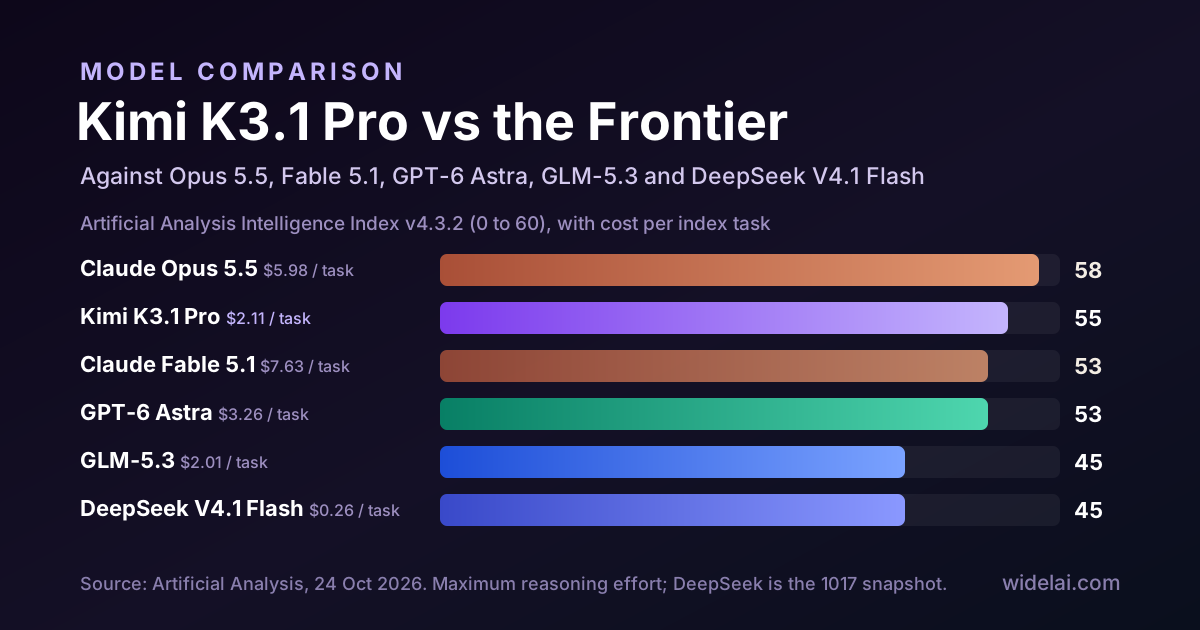
Kimi K3.1 Pro vs Opus 5.5 is the comparison that matters most this week, but it is not the only one. On October 23, 2026, Moonshot AI released Kimi K3.1 Pro and benchmarked it against five rivals: Anthropic's Claude Opus 5.5 and Claude Fable 5.1, OpenAI's GPT-6 Astra, and the two strongest Chinese models besides Kimi, DeepSeek V4.1 Flash and Zhipu's GLM-5.3.
The short version: K3.1 Pro sits level with the Western flagships on agentic work, at half the per-token price of Opus 5.5 and a fifth of GPT-6 Astra and Fable 5.1. On the independent Artificial Analysis Intelligence Index it scores 55, ahead of Fable 5.1 and GPT-6 Astra and three points behind Opus 5.5. It is not the best at everything, and the gaps are in places that matter.
This guide covers specifications and price, coding, knowledge work, reasoning and vision, hallucinations, real cost per task, open weights and safety, and finishes with a routing table by task. Kimi K3.1 Pro, Opus 5.5, Fable 5.1, GPT-6 Astra and GLM-5.3 are all available on WidelAI today.
Sources: Moonshot's Kimi K3.1 Pro launch post and API pricing; Artificial Analysis model pages and leaderboard, checked October 24, 2026; DeepSeek API pricing; Anthropic's Claude Opus 5.5 and Fable 5.1 announcements; OpenAI's GPT-6 Astra announcement. Benchmark tables are Moonshot-reported unless marked otherwise.
The Short Answer
- Best overall: Claude Opus 5.5. It leads the Artificial Analysis Intelligence Index at 58, and wins Terminal-Bench 4.0, GDPval-AA, OSWorld and BenchCAD in Moonshot's own table.
- Best value at the frontier: Kimi K3.1 Pro. It scores 55 on the same index for $2.11 per task, a third of Opus 5.5's cost, and leads SWE-Marathon, Agents' Last Exam, Humanity's Last Exam and OfficeQA Pro.
- Fewest hallucinations: GPT-6 Astra. It has the lowest error rate on both of Moonshot's hallucination tests, with K3.1 Pro a close second. Astra also leads scientific computing by a wide margin.
- Strongest at finance research: Claude Fable 5.1. It tops Frontier Finance and is close to Opus on computer use, but it is the most expensive model here per task.
- Cheapest by far: DeepSeek V4.1 Flash. It costs $0.26 per index task and runs at 195 tokens per second, at the price of about 10 index points.
- Budget coding on WidelAI: GLM-5.3. It ties DeepSeek on the index and is the lowest-priced of these models on WidelAI, but trails K3.1 Pro by 24 points on Terminal-Bench 4.0.
The Six Models at a Glance
| Released | Context | Direct price (in / out per 1M) | AA Index | Cost per AA task | WidelAI credits per 1K (in / out) | |
|---|---|---|---|---|---|---|
| Claude Opus 5.5 | Sep 22, 2026 | 1M | $4 / $20 | 58 | $5.98 | 0.80 / 4.00 |
| Kimi K3.1 Pro | Oct 23, 2026 | 1M | $2 / $10 | 55 | $2.11 | 0.40 / 2.00 |
| Claude Fable 5.1 | Sep 1, 2026 | 1M | $10 / $50 | 53 | $7.63 | 2.00 / 10.00 |
| GPT-6 Astra | Sep 3, 2026 | 1.05M | $10 / $50 | 53 | $3.26 | 2.00 / 10.00 |
| GLM-5.3 | Aug 14, 2026 | 1M | $1.40 / $4.40 | 45 | $2.01 | 0.28 / 0.88 |
| DeepSeek V4.1 Flash | Oct 17, 2026 | 1M | $0.30 / $1.20 | 45 | $0.26 | Not on WidelAI |
AA Index is the Artificial Analysis Intelligence Index v4.3.2 at each model's maximum reasoning setting. "DeepSeek V4.1" in this guide means the DeepSeek-V4.1-Flash-1017 snapshot that Moonshot tested, which DeepSeek serves as deepseek-flash; its prices are peak rates and halve off-peak. GPT-6 Astra bills a whole request at a higher rate above 272K input tokens. WidelAI bills 1 credit per $0.005 of provider API cost.
The price spread is wider than the quality spread. Opus 5.5 is three index points ahead of K3.1 Pro and costs almost three times as much per task. Fable 5.1 and GPT-6 Astra both score two points below K3.1 Pro, at five times its per-token price. Below K3.1 Pro there is a 10-point drop to GLM-5.3 and DeepSeek.
Agentic Coding
| Benchmark | K3.1 Pro | Opus 5.5 | GPT-6 Astra | Fable 5.1 | DeepSeek V4.1 | GLM-5.3 |
|---|---|---|---|---|---|---|
| Terminal-Bench 4.0 | 65.7 | 66.4 | 58.2 | 57.9 | 42.3 | 41.8 |
| SWE-Marathon | 51.7 | 46.3 | 42.5 | 45.6 | 40.0 | 42.5 |
| Kimi Code Bench 3.0 long-horizon (internal) | 61.2 | 58.5 | 66.5 | 58.8 | 51.5 | 45.5 |
| Terminal-Bench Science 0.1 | 38.1 | 63.3 | 68.1 | 40.0 | 15.7 | 8.1 |
What the table shows:
- K3.1 Pro and Opus 5.5 lead terminal-based agent work. They are 0.7 points apart on Terminal-Bench 4.0, and both are more than 7 points ahead of GPT-6 Astra and Fable 5.1.
- K3.1 Pro has the most stamina on long projects. SWE-Marathon tests multi-hour software projects, and K3.1 Pro leads Opus 5.5 by 5.4 points. This is the clearest result of Moonshot's extra post-training on long tasks.
- GPT-6 Astra wins scientific computing by a mile. On Terminal-Bench Science it is 30 points ahead of K3.1 Pro. If your agent runs simulations, numerical code or lab pipelines, use Astra or Opus 5.5.
- GLM-5.3 and DeepSeek V4.1 are a tier below. Both are around 42 on Terminal-Bench 4.0, roughly 24 points behind K3.1 Pro.
Kimi Code Bench is Moonshot's own internal test, so read it as a check on K3.1 Pro's progress rather than a neutral ranking. Even there, Moonshot reports GPT-6 Astra ahead.
Knowledge Work, Finance and Office Tasks
| Benchmark | K3.1 Pro | Opus 5.5 | GPT-6 Astra | Fable 5.1 | DeepSeek V4.1 | GLM-5.3 |
|---|---|---|---|---|---|---|
| GDPval-AA v2.1 (Elo) | 1846 | 1866 | 1573 | 1754 | 1746 | 1650 |
| OfficeQA Pro v2 | 64.4 | 62.2 | 54.4 | 54.5 | 40.4 | 31.1 |
| Frontier Finance | 58.6 | 56.7 | 45.0 | 60.8 | 54.5 | 57.5 |
| GDP.pdf | 34.6 | 30.6 | 34.2 | 27.6 | 17.2 | 11.2 |
| Agents' Last Exam | 43.2 | 42.6 | 32.8 | Not reported | 37.7 | 26.2 |
| OSWorld V2.1 (computer use) | 79.6 | 81.8 | 75.8 | 80.7 | 69.3 | Not reported |
- K3.1 Pro is the strongest document and office worker in this group. It leads OfficeQA Pro v2, which tests answering questions over real office files, and GDP.pdf, which tests reading long PDFs.
- Opus 5.5 still leads general knowledge work. Its 20-point Elo lead over K3.1 Pro on GDPval-AA is small, and it also leads computer use on OSWorld V2.1.
- Fable 5.1 is the finance specialist. It edges K3.1 Pro by 2.2 points on Frontier Finance, though its per-task cost is more than three times higher.
- GPT-6 Astra is weakest on this kind of work among the Western models: last on GDPval-AA and Frontier Finance in Moonshot's table.
- GLM-5.3 is surprisingly good at finance (57.5, third place) for its price, but weak on office documents.
Reasoning, Vision and 3D
| Benchmark | K3.1 Pro | Opus 5.5 | GPT-6 Astra | Fable 5.1 | DeepSeek V4.1 | GLM-5.3 |
|---|---|---|---|---|---|---|
| Humanity's Last Exam (with tools) | 70.0 | 67.7 | 57.2 | 65.6 | 58.8 | 62.5 |
| ZeroBench main (with tools, pass@5) | 63.0 | 61.0 | 58.0 | 59.0 | 51.0 | Not reported |
| ChartoGraphy (with tools) | 90.2 | 89.0 | 91.0 | 88.4 | 83.0 | Not reported |
| BenchCAD with tools (voxel IoU) | 92.7 | 96.2 | 95.9 | 92.6 | 81.6 | Not reported |
| BenchCAD without tools (voxel IoU) | 72.8 | 73.0 | Not reported | 60.6 | 41.2 | Not reported |
K3.1 Pro leads the hardest reasoning test here, Humanity's Last Exam with tools, by 2.3 points over Opus 5.5. Its vision is strong: first on ZeroBench and within a point of GPT-6 Astra on chart reading. On BenchCAD, which turns images into 3D CAD models, Opus 5.5 and GPT-6 Astra lead with tools, but without tools K3.1 Pro is level with Opus and 12 points ahead of Fable 5.1.
Hallucinations
Moonshot's Hallu Bench measures the share of factual claims in an answer that are wrong. Lower is better.
| Model | Without tools | Hard set, with tools |
|---|---|---|
| GPT-6 Astra | 4.2% | 5.5% |
| Kimi K3.1 Pro | 5.4% | 8.3% |
| Claude Opus 5.5 | 6.8% | 15.0% |
| Claude Fable 5.1 | 11.4% | 23.3% |
| DeepSeek V4.1 Flash | 13.1% | 23.3% |
| GLM-5.3 | 14.8% | 22.6% |
- GPT-6 Astra is the most accurate, and K3.1 Pro is second on both tests.
- Tools do not fix hallucinations on their own. On the hard set, Opus 5.5 makes nearly twice as many errors as K3.1 Pro, and Fable 5.1, DeepSeek and GLM all land above 22%.
- This is Moonshot's own benchmark, so treat the ranking as directional. The improvement over Kimi K3 (23.4% to 8.3% on the hard set) is still large enough to show up in daily use.
If your work is fact-heavy, give every model sources and verify numbers that matter. Between these six, K3.1 Pro and GPT-6 Astra are the safest starting points.
What a Task Really Costs
Per-token price is only half of the cost. The other half is how many tokens a model spends to finish. Artificial Analysis measures both together as cost per index task.
| Model | Cost per AA task | Output speed | Tokens used to run the AA index |
|---|---|---|---|
| DeepSeek V4.1 Flash | $0.26 | 195 tokens/s | 210M |
| GLM-5.3 | $2.01 | 78 tokens/s | 210M |
| Kimi K3.1 Pro | $2.11 | 77 tokens/s | 150M |
| GPT-6 Astra | $3.26 | 56 tokens/s | Not compared here |
| Claude Opus 5.5 | $5.98 | 96 tokens/s | Not compared here |
| Claude Fable 5.1 | $7.63 | 68 tokens/s | Not compared here |
Artificial Analysis figures at maximum reasoning effort, checked October 24, 2026. Speeds are medians on each vendor's own API.
- K3.1 Pro costs about the same per task as GLM-5.3 despite a higher per-token price, because it finishes with fewer tokens. For 10 more index points, that is the best trade in this group.
- DeepSeek V4.1 Flash is in a price class of its own. At about an eighth of K3.1 Pro's cost and two and a half times its speed, it is the right choice for bulk work where a 10-point quality gap is acceptable.
- Opus 5.5 is worth its premium on the tasks it leads. Fable 5.1 is hard to justify on price unless finance research or computer use is your main workload.
On WidelAI the same logic applies in credits. A turn with 20,000 tokens of input and a 2,000-token answer costs about 7.4 credits on GLM-5.3, 12 credits on Kimi K3.1 Pro, 24 on Opus 5.5 and 60 on GPT-6 Astra or Fable 5.1. K3.1 Pro always reasons before answering, and its reasoning is billed as output, so a hard prompt costs more than an easy one. Every rate is on the pricing transparency page.
Open Weights, Privacy and Safety
- Kimi K3.1 Pro will be open-weight. Moonshot has committed to releasing the full weights by November 4, 2026. That makes it the strongest model in this group you will be able to self-host, though at 2.8 trillion parameters it needs serious hardware.
- DeepSeek V4.1 Flash is open-weight today under the MIT license, with 552 billion parameters (16 billion active), which makes it far easier to run yourself.
- Opus 5.5, Fable 5.1 and GPT-6 Astra are closed and available only through their vendors' APIs and partners.
- Moonshot reduced K3.1 Pro's cyber capability on purpose. It removed cyber-related training data for the open-weight release. On Moonshot's internal xdev-bench-hard (pass@3), the released model solves 81.0% of problems, against 90.5% for an unrestricted version and 85.7% for DeepSeek V4.1 Flash.
- Zero data retention is available on Moonshot's API.
None of these models should run as an agent with write access without approvals, sandboxing and spending limits.
Which Model to Use for Each Task
| If you need... | Use | Why |
|---|---|---|
| The strongest all-round model | Claude Opus 5.5 | #1 on the AA index; leads Terminal-Bench 4.0, GDPval-AA and OSWorld |
| Frontier quality at a third of the cost | Kimi K3.1 Pro | AA index 55 for $2.11 per task |
| Long-running coding agents | Kimi K3.1 Pro | Leads SWE-Marathon by 5.4 points |
| Office documents and long PDFs | Kimi K3.1 Pro | Leads OfficeQA Pro v2 and GDP.pdf |
| Answers with the fewest factual errors | GPT-6 Astra, then Kimi K3.1 Pro | Lowest Hallu Bench rates with and without tools |
| Scientific computing | GPT-6 Astra | Leads Terminal-Bench Science by 4.8 points over Opus 5.5 |
| Finance research | Claude Fable 5.1 or Kimi K3.1 Pro | Fable leads Frontier Finance; K3.1 Pro is 2.2 points behind at a fraction of the cost |
| Desktop and computer-use agents | Claude Opus 5.5 | Leads OSWorld V2.1 |
| Bulk, low-risk work at the lowest price | DeepSeek V4.1 Flash, or GLM-5.3 on WidelAI | $0.26 and $2.01 per AA task |
| A model you can self-host | DeepSeek V4.1 Flash now, Kimi K3.1 Pro from November 4 | Open weights |
Real work rarely fits one row. A sensible setup is to run most agentic and document work on Kimi K3.1 Pro, escalate to Opus 5.5 for the hardest open-ended problems, send scientific code to GPT-6 Astra, and hand bulk, low-risk steps to GLM-5.3. No single model wins every row, which is the case for routing by task instead of committing to one vendor.
Caveats Before You Switch
- Most benchmark numbers come from Moonshot. Moonshot chose the benchmarks and ran the competitor models itself, and it notes that Claude models may include fallbacks and GPT models may include cyber safeguards. Artificial Analysis is the independent anchor in this guide.
- Some tests are Moonshot's own. Kimi Code Bench, Hallu Bench and xdev-bench-hard are internal, so treat them as directional.
- Gaps of one or two points are mostly noise. The SWE-Marathon, Terminal-Bench Science and OfficeQA gaps are large enough to matter; the Terminal-Bench 4.0 gap between K3.1 Pro and Opus 5.5 is not.
- K3.1 Pro thinks on every turn. There is no non-reasoning mode, so simple prompts cost more than they would on a model that can answer directly.
- Test on your own work. Five to ten tasks you have already solved will tell you more than any leaderboard.
Try Kimi K3.1 Pro on WidelAI
You can run every comparison in this guide yourself, on your own prompts, without a Moonshot account or API key. Kimi K3.1 Pro is live on WidelAI now, next to Claude Opus 5.5, Claude Fable 5.1, GPT-6 Astra and GLM-5.3, on one plan and one credit balance.
- Pick Kimi K3.1 Pro from the Moonshot group in the chat model picker. It costs 0.40 input and 2.00 output credits per 1K tokens, the same rate as Claude Sonnet 5.5 and a third less than Kimi K3.
- Compare it in the same thread. Ask K3.1 Pro first, then switch the model picker to Opus 5.5 or GPT-6 Astra and send the same prompt. The conversation history carries over, so you see both answers side by side.
- Escalate only when you need to. Start on K3.1 Pro and move to Opus 5.5 for the few tasks that need it, instead of paying flagship rates for every turn.
New to WidelAI? Create your account and pick Kimi K3.1 Pro on the Pro plan. You can see every model and its rate on the models page and the pricing transparency page. For what changed from Kimi K3, read Kimi K3.1 Pro Is Now Available on WidelAI.
The Verdict
Kimi K3.1 Pro is the highest-ranked model on the Artificial Analysis index from outside the US labs, and it competes with Western flagships on quality, not just on price. It ties Opus 5.5 on terminal-based agent work, leads every model here on long coding projects, office documents and the hardest reasoning test, and makes the second-fewest factual errors, for about a third of Opus 5.5's cost per task.
It does not replace the rest. Claude Opus 5.5 is still the best all-rounder, GPT-6 Astra is the most accurate and the pick for scientific work, Fable 5.1 leads finance research, and DeepSeek V4.1 Flash is unbeatable on price. The practical answer is to make K3.1 Pro your default for agentic and document work, route the exceptions to the model that wins them, and keep every model one click away.
Related Reading

Do your best AI work in one place
Bring your next question, draft, file, or idea to WidelAI. Choose the model that fits the moment, keep your work together, and stay in control of privacy and usage.
Leading models, one workspace
Use powerful AI models without juggling separate tabs, accounts, or workflows.
Switch without starting over
Change models as your work evolves while keeping the conversation and context together.
The right model for every task
Choose speed for everyday work or deeper reasoning for complex questions and decisions.
Clear credits and model rates
See your balance, understand each model’s rate, and track usage from one place.
Bring your files and images
Work with documents and images alongside your prompts in the same focused experience.
Your work stays yours
Your data is encrypted in transit and at rest, and your content is never used to train AI models.