Gemini 3.8 Flash Guide: Coding, Agents, Price, and Migration
Learn Gemini 3.8 Flash for coding and agents, including its 1M context, introductory pricing, thinking levels, API migration steps, and safe rollout plan.
WidelAI Engineering
Practical guidance for building reliable multi-model AI workflows
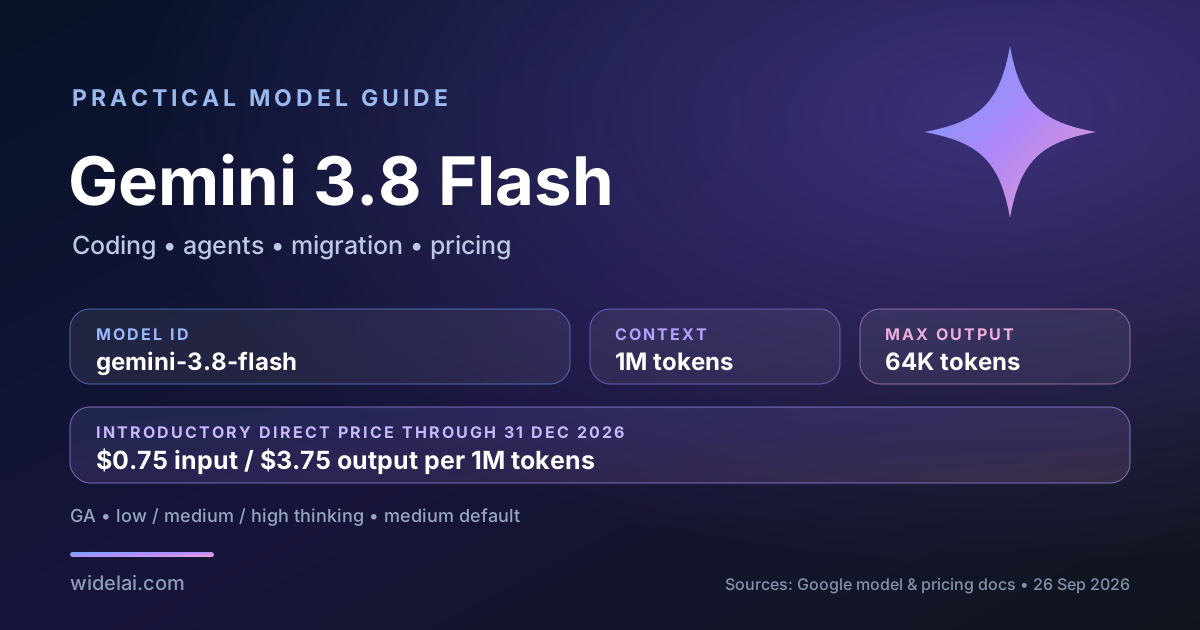
This Gemini 3.8 Flash guide covers the choices that matter when adopting Google's generally available model: where it fits, how thinking levels work, what the introductory price means, which request fields to remove, and how to validate an agent migration safely. Gemini 3.8 Flash, model ID gemini-3.8-flash, was released on September 2, 2026 with a 1M-token context window and 64K maximum output.
Google positions the model for long-horizon software engineering, autonomous agents, and enterprise workflows while retaining Flash speed and cost intent. That combination is useful, but “Flash” should not be interpreted as “always uses few tokens.” Google says the model may use more tokens on difficult tasks by design. Budgeting must therefore account for output behavior and completed-work quality, not just the list price.
You can find the model in the WidelAI catalog, compare it in WidelAI chat, and understand the current credit conversion on pricing transparency. For related choices, read the September four-model announcement, Claude Opus 5.5 vs GPT-6 Sol, and GPT-6 Sol vs GPT-6 Luna.
Gemini 3.8 Flash at a Glance
| Category | Detail |
|---|---|
| Model ID | gemini-3.8-flash |
| Release | September 2, 2026; generally available |
| Context | 1M tokens |
| Maximum output | 64K tokens |
| Thinking levels | low, medium, high |
| Default thinking | medium |
| Introductory direct price | $0.75/M input; $3.75/M output through December 31, 2026 |
| Standard direct price | $1.50/M input; $7.50/M output from January 1, 2027 |
| Current WidelAI rate | 0.15 input; 0.75 output credits per 1K |
| Intended work | Long-horizon software engineering, autonomous agents, enterprise workflows |
The current WidelAI values follow the introductory direct rates through the usual conversion: one credit equals $0.005, and direct dollars per million multiplied by 0.2 gives credits per thousand. Thus $0.75 becomes 0.15 credits per 1K input and $3.75 becomes 0.75 per 1K output. Direct provider rates and WidelAI credits remain distinct units and should be labeled separately in budgets.
Google reports 54.9% on HLE-Verified. This is a vendor-reported result, not an independently reproduced comparison with Opus, Sol, or Luna. Use it as one data point for selecting evaluation tasks, not as proof that the model will win on a repository or workflow.
Where the Model Fits
Long-horizon software engineering
A long coding task requires more than generating a patch. The model must understand the code path, maintain constraints through several tool calls, interpret validation failures, and avoid broad edits that make review harder. Gemini 3.8 Flash is explicitly aimed at this class of work, so test it on realistic repository tasks rather than isolated function completion.
A strong request defines the outcome, files or behavior that must not change, acceptance tests, and permission boundaries. Ask the agent to inspect before editing and to state the evidence behind its diagnosis. Require diffs and deterministic validation. A fast wrong patch remains slower than a measured investigation.
Autonomous agents
Autonomy should mean the model can make bounded progress, not that it receives unlimited authority. Give the agent narrow tools, schema validation, a maximum number of iterations, and clear stop conditions. Require confirmation before destructive, expensive, or externally visible actions. Log every tool call and response.
For authorized defensive security review, scope the system and credentials explicitly. Do not use the model to access systems without permission. Gemini 3.8 Flash can support defensive analysis and remediation, but model capability is not authorization.
Enterprise workflows
Enterprise work often combines long documents, structured records, approval policies, and tool calls. The 1M context can help when relationships across a large evidence set matter. It does not remove privacy, retention, access-control, or data-minimization responsibilities. Retrieve only the information required for the task, redact unnecessary sensitive fields, and apply the organization's approved data handling policy.
Thinking Levels and Token Behavior
Gemini 3.8 Flash supports low, medium, and high thinking, with medium as the default. Start low for bounded transformations with objective checks. Use medium for ordinary coding, analysis, and agent steps. Test high for difficult diagnosis, multi-constraint planning, or cases where the lower settings repeatedly fail.
Do not map old numeric thinking budgets directly onto the new labels. The migration requires replacing thinking_budget with thinking_level. A level expresses an intended behavior tier; it is not a fixed promise of an exact token count.
Google notes that Gemini 3.8 Flash may use more tokens on hard tasks by design. That can be rational if additional reasoning avoids failed attempts, but it can also surprise a budget based only on average output. Monitor output-token distributions by task and thinking level. Set application limits and stop conditions, then evaluate whether accepted-result cost improves.
| Task shape | Starting level | Validation |
|---|---|---|
| Classification or schema extraction | low | Schema and business-rule checks |
| Focused coding change | medium | Tests, type checks, diff review |
| Multi-step agent workflow | medium | Tool logs and end-state assertion |
| Difficult root-cause analysis | high | Reproduction plus regression test |
| Consequential action | Any under review | Explicit human approval |
A higher thinking level should earn its latency and tokens through fewer failures or safer decisions. If low consistently passes the same acceptance checks, high is unnecessary.
Price Today and After December
The introductory direct price is $0.75 per million input tokens and $3.75 per million output tokens through December 31, 2026. On January 1, 2027, standard direct pricing becomes $1.50 input and $7.50 output per million. That is a scheduled 2× change in both directions and should appear explicitly in forecasts that cross the year boundary.
At the current WidelAI rate, 50,000 input tokens and 8,000 output tokens use:
- Input: 50 × 0.15 = 7.5 credits.
- Output: 8 × 0.75 = 6 credits.
- Total: 13.5 credits.
At direct introductory pricing, the same token quantities cost $0.0375 input plus $0.03 output, or $0.0675. The credit total multiplied by $0.005 produces the same reference value. This arithmetic explains the listed conversion; actual usage still depends on measured tokens and current product terms.
A hard task may produce more output or require extra tool turns, so estimate cost from task traces rather than a single prompt. Record inputs, outputs, thinking level, retries, and accepted completion. Revisit budgets before January 1 instead of allowing the scheduled rate change to become an incident.
Check Google's current Gemini pricing and WidelAI's pricing transparency when making a forecast. Published prices can change, and provider-direct options should not be described as WidelAI features unless the product exposes them.
Migration Checklist
Migrating safely requires more than replacing a string. Make these request changes together:
- Set the model ID to gemini-3.8-flash.
- Remove temperature, top_p, and top_k rather than carrying unsupported sampling assumptions forward.
- Replace thinking_budget with thinking_level and choose low, medium, or high.
- Remove candidate_count.
- Preserve interaction requirements and function-call requirements instead of dropping them during request cleanup.
Before-and-after request intent
An older request may combine a numeric thinking budget with sampling controls and multiple candidates. The migrated request should express the desired thinking level, one clear interaction contract, and the same validated function declarations. Avoid copying a request object wholesale and deleting fields only after runtime errors.
A practical migration review asks:
- Does every environment use the exact new model ID?
- Are removed fields absent rather than set to null?
- Is the default medium level intentional, or should this task begin at low?
- Are required function calls still required after the refactor?
- Are tool argument schemas unchanged and validated outside the model?
- Do cancellation, retries, and streaming still reach a clean terminal state?
Keep a rollback path to the previous known-good model and request shape. Deploy behind a model configuration or limited cohort, not an irreversible code fork.
Function Calling and Agent Reliability
A reliable tool loop has explicit states: the application sends context and available functions, the model requests a call, the application validates arguments and authorization, the tool runs, and the result returns to the model. Completion occurs only when the required end state is verified.
Preserving function-call requirements during migration is critical. If an old workflow required the model to call a retrieval or verification tool before answering, losing that requirement can produce fluent responses unsupported by current evidence. Add an integration check that rejects a final answer when a mandatory call never occurred.
Guardrails outside the prompt
Prompts communicate policy, but application code enforces it. Use allowlisted tools, typed schemas, narrow credentials, execution timeouts, iteration limits, and human approval for consequential operations. Treat tool output as untrusted data; it can be stale, malformed, or contain text that attempts to redirect the agent.
Recovery behavior
Test invalid arguments, unavailable tools, partial results, rate limits, and user cancellation. The model should correct schema errors without inventing a success, use available evidence when a nonessential tool fails, and stop rather than loop when the budget expires. Capture request and tool logs so failures can be reproduced.
Context Management for 1M Tokens
The 1M context window is valuable for large repositories, policy sets, and longitudinal records. It is not a target size. Large prompts increase latency, cost, and the chance that irrelevant material competes with authoritative evidence.
Use a layered context strategy:
- Keep stable system policy and tool contracts concise.
- Retrieve documents or files tied to the current question.
- Put authoritative evidence before speculative notes.
- Summarize completed branches while retaining decisions and source references.
- Remove duplicate generated content and obsolete tool output.
The 64K maximum output supports substantial artifacts, but most production responses should be much smaller. Define a deliverable shape: a patch, a JSON object, a decision table, or a plan with a page limit. Unlimited prose makes review expensive and can obscure whether the task actually completed.
For coding, provide a repository map and implicated files first. Let the agent request additional context based on evidence. For enterprise documents, use retrieval metadata and citations so reviewers can trace claims to the source record.
Evaluation and Rollout Plan
Build a representative set
Select real tasks across easy, normal, and failure-prone categories. Include a long coding issue, a multi-tool workflow, a structured extraction, a post-cutoff research question with supplied sources, and a case that requires human approval. Freeze the inputs and expected checks.
Compare the previous and new request shapes
Run the same tasks through the existing model and Gemini 3.8 Flash. Track first-pass acceptance, output tokens, tool-call validity, elapsed time, total direct cost or WidelAI credits, and human repair minutes. Test all three thinking levels instead of comparing only defaults.
Validate migration-specific edges
Add cases that fail if temperature or top_p remains, if thinking_budget is sent, if candidate_count persists, or if a required function call disappears. Test the exact production client and streaming path. A playground success does not prove the application integration is correct.
Roll out gradually
Start with internal traffic or a small cohort. Monitor errors, latency percentiles, output growth, tool loops, and accepted-result cost. Set an alert for unexpected token increases and schedule a budget review before the introductory rate expires.
Keep a human stop
Agents should stop safely when evidence conflicts, permissions are missing, or consequences exceed policy. The most valuable behavior in an uncertain high-impact case may be a concise escalation packet rather than an attempted solution.
Common Mistakes to Avoid
Copying every old parameter. The new model requires removing temperature, top_p, top_k, and candidate_count and replacing thinking_budget. Compatibility should be deliberate.
Treating medium as universally optimal. Medium is the default, not proof of best cost-quality balance for your workload. Evaluate low first on bounded tasks and high only where it changes outcomes.
Budgeting from list price alone. Hard tasks may use more tokens by design. Track accepted-result cost, retries, and repair time.
Filling the context window. Capacity is not relevance. Retrieve and organize evidence rather than attaching everything.
Dropping function requirements. Preserve mandatory interactions and verify them in logs.
Calling a vendor score independent. Google's 54.9% HLE-Verified result is vendor-reported. Do not use it as a neutral cross-model verdict.
Giving agents broad authority. Validate arguments, narrow permissions, and require review for consequential actions.
Related Model Choices
Gemini 3.8 Flash is one part of a broader routing decision. The new-model announcement compares its role with the other September additions. Claude Opus 5.5 vs GPT-6 Sol covers higher-priced coding and agent options. GPT-6 Sol vs GPT-6 Luna shows how an efficient tier and complex tier can form a cascade.
Primary references are Google's Gemini 3.8 announcement, latest-model guide, and pricing documentation. The official material is summarized and rephrased.
Conclusion: Migrate the Contract, Then Measure the Model
Gemini 3.8 Flash offers a compelling combination: a 1M context window, 64K output, three thinking levels, and an introductory $0.75/$3.75 direct price for a model designed around long-horizon engineering and agents. The scheduled move to $1.50/$7.50 on January 1, 2027 makes timing part of responsible capacity planning.
A successful migration changes the complete request contract: use gemini-3.8-flash, remove the unsupported sampling and candidate fields, replace thinking_budget with thinking_level, and preserve interaction and function-call requirements. Then measure accepted-result cost, tool reliability, token distribution, and review effort on real tasks. The model is ready for serious evaluation; production readiness depends on the controls and evidence around it.

Do your best AI work in one place
Bring your next question, draft, file, or idea to WidelAI. Choose the model that fits the moment, keep your work together, and stay in control of privacy and usage.
Leading models, one workspace
Use powerful AI models without juggling separate tabs, accounts, or workflows.
Switch without starting over
Change models as your work evolves while keeping the conversation and context together.
The right model for every task
Choose speed for everyday work or deeper reasoning for complex questions and decisions.
Clear credits and model rates
See your balance, understand each model’s rate, and track usage from one place.
Bring your files and images
Work with documents and images alongside your prompts in the same focused experience.
Your work stays yours
Your data is encrypted in transit and at rest, and your content is never used to train AI models.