GPT-6 Astra vs Claude Fable 5.1: Which Model Should You Use?
Compare GPT-6 Astra and Claude Fable 5.1 on coding, agents, context, pricing, safeguards, and workflow fit—and learn how to use both in WidelAI and WidelAI Code.
WidelAI Research
Independent analysis for practical multi-model AI decisions
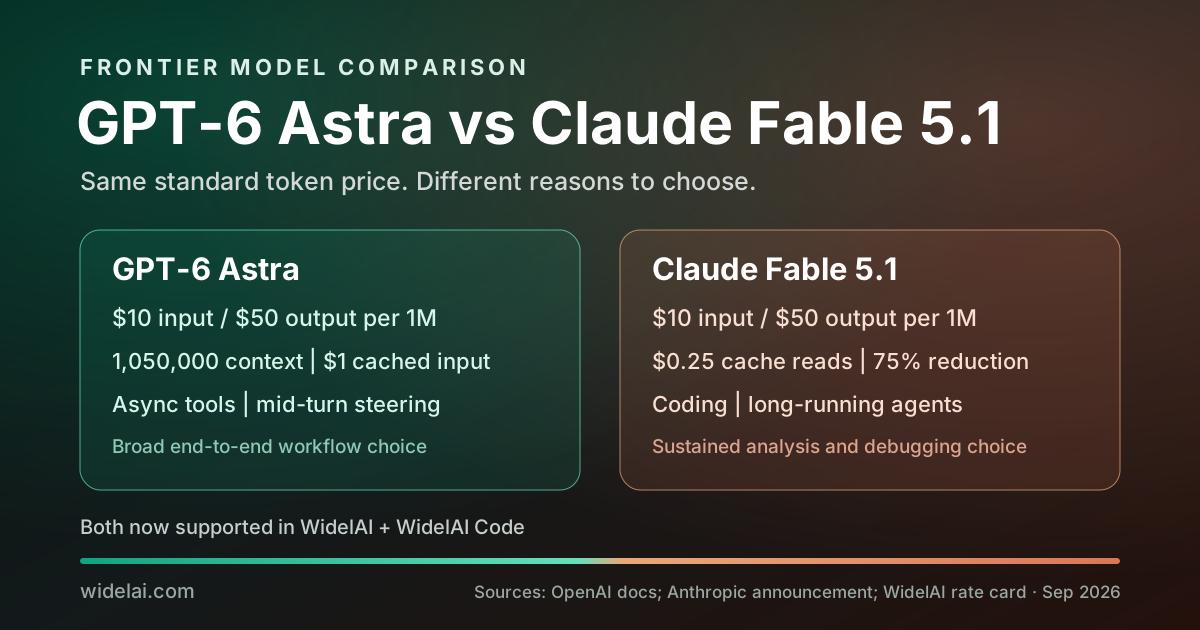
GPT-6 Astra vs Claude Fable 5.1 is the frontier-model decision many teams now face. Both models target difficult coding, research, knowledge-work, and agentic tasks. Both carry the same headline API price of $10 per million input tokens and $50 per million output tokens. Both are now supported in WidelAI and WidelAI Code, so you can compare them in one workspace and use either model to drive a local coding workflow.
There is no honest one-word winner. OpenAI and Anthropic emphasize different capabilities, publish different evaluation details, and expose different workflow controls. A benchmark table from one provider is useful evidence, but it is not a neutral head-to-head test. The valuable question is which model fits your task, tools, review process, and cost profile.
This guide compares verified specifications, coding behavior, agent workflows, cache economics, safeguards, and practical selection rules. It also shows how to run a fair evaluation in WidelAI instead of choosing from launch-day claims.
What is WidelAI Code? In this article, WidelAI Code means the Code tab in WidelAI for Mac: the local coding agent that can read and edit files in a project you open, run commands in your own shell, show reviewable diffs, and checkpoint work for rollback. Both GPT-6 Astra and Claude Fable 5.1 are available as tool-capable model choices there for Pro members.
The Short Answer
Choose GPT-6 Astra when your work spans code, browsers, computer interfaces, research, and document creation; when you want explicit reasoning-effort controls; or when your application can use OpenAI's newer Responses API features such as asynchronous tools, mid-turn steering, and configuration updates.
Choose Claude Fable 5.1 when the center of gravity is long-running coding, root-cause analysis, knowledge work, or an agent that must stay readable over many steps. Anthropic's published results show strong performance on its agentic coding, scientific-research, computer-use, and business-workflow evaluations. Its $0.25-per-million cache-read price is also attractive when a long agent repeatedly revisits the same repository context.
If both models can complete the task, compare the entire workflow: successful completion rate, number of retries, tool-call count, elapsed time, credits consumed, review burden, and regression-test results. A more expensive-looking response can be cheaper if it avoids a second run; an impressive first answer can be costly if a human has to repair it.
Verified Comparison at a Glance
| Category | GPT-6 Astra | Claude Fable 5.1 |
|---|---|---|
| Provider | OpenAI | Anthropic |
| WidelAI model ID | gpt-6-astra | claude-fable-5-1 |
| Released | September 3, 2026 | September 1, 2026 |
| Provider positioning | Hard end-to-end reasoning, coding, computer use, research, and document creation | Coding, knowledge work, scientific research, and long-running problem solving |
| Standard API input | $10 per 1M tokens | $10 per 1M tokens |
| Standard API output | $50 per 1M tokens | $50 per 1M tokens |
| Published cache price | $1 per 1M cached-input tokens | $0.25 per 1M cache-read tokens |
| WidelAI rate | 2 input / 10 output credits per 1K tokens | 2 input / 10 output credits per 1K tokens |
| WidelAI access | Pro | Pro |
| WidelAI Code | Supported | Supported |
| Distinctive workflow controls | Five reasoning levels, async tools, mid-turn steering, configuration updates | Effort controls, lower-cost cache reads, emphasis on sustained agent work |
| Best first evaluation | Cross-application workflows and difficult tool orchestration | Long coding runs, debugging, research, and context-heavy agents |
OpenAI publishes exact limits for Astra: a 1,050,000-token context window, up to 128,000 output tokens, text and image input, and an April 30, 2026 knowledge cutoff. Those figures describe capacity, not an instruction to send an entire repository on every turn.
Anthropic's Fable 5.1 announcement focuses on task performance, safeguards, and reduced cache cost rather than repeating every platform limit in the launch article. Check the current model response in WidelAI or Anthropic's current documentation before designing around a maximum. Provider limits, regional availability, and product-specific controls can change independently of a model's core capability.
Official references: OpenAI's GPT-6 Astra model page and model guidance, plus Anthropic's Claude Fable 5.1 announcement.
Benchmark Evidence: Direct Astra vs Fable 5.1 Comparisons
The most useful independent head-to-head comes from Artificial Analysis, an evaluation organization rather than either model provider. Its Coding Agent Index places GPT-6 Astra at 67 in Codex and Claude Fable 5.1 at 70 in Claude Code. Its Intelligence Index v4.1.1 places Astra at 61 using max effort and Fable 5.1 at 66 using max effort with fallback.
Horizontal bar charts showing GPT-6 Astra at 67 versus Claude Fable 5.1 at 70 on the Artificial Analysis Coding Agent Index, and 61 versus 66 on its Intelligence Index
Independent results reproduced from Artificial Analysis's GPT-6 Astra benchmark report. The coding scores use each provider's agent harness; the Fable intelligence result includes fallback. Content was rephrased for licensing compliance.
This independent result favors Fable 5.1 by three points on the coding index and five points on the intelligence index. The harnesses still differ, so read the scores as evidence for a controlled trial rather than a universal ranking.
Direct work and coding benchmarks
OpenAI's official Astra launch table includes both models on seven useful work and coding rows. Astra leads Agents' Last Exam (59.3% vs 48.7%), AutomationBench (41.4% vs 31.4%), BenchCAD (95.9% vs 84.3%), Terminal-Bench 4.0 (57.9% vs 55.8%), DeepSWE v1.1 (74.1% vs 67.4%), and both FrontierCode 1.1 tracks.
Paired horizontal bars comparing GPT-6 Astra and Claude Fable 5.1 on seven work and coding benchmarks
Results reproduced from OpenAI's official GPT-6 Astra launch table. OpenAI reports the maximum score at any effort and notes that research-environment or API results can differ from production ChatGPT. Content was rephrased for licensing compliance.
The size of the lead matters. Astra's reported advantage is substantial on BenchCAD and AutomationBench, but Terminal-Bench and both FrontierCode tracks are close. A one- or two-point launch-table gap should not outweigh a repeatable win in your repository, tool harness, or review process.
Direct science, reasoning, and health benchmarks
The same launch table includes seven rows where both models have scores. Astra leads six: Terminal-Bench Science 0.1 (64.6% vs 52.6%), FrontierMath Tier 4 v2 (97.6% vs 78.0%), GPQA Diamond (96.0% vs 93.7%), HealthBench Professional (63.4% vs 58.1%), ARC-AGI-2 (95.0% vs 90.0%), and ARC-AGI-1 (98.5% vs 97.5%). Fable 5.1 leads Humanity's Last Exam with tools (65.0% vs 57.2%).
Paired horizontal bars comparing GPT-6 Astra and Claude Fable 5.1 on seven science, reasoning, and health benchmarks
Results reproduced from OpenAI's official GPT-6 Astra launch table. They are provider-reported rather than independently reproduced, and benchmark harnesses can affect the result. Content was rephrased for licensing compliance.
This panel prevents a one-sided verdict. Astra has the stronger OpenAI-reported result on most selected rows, while Fable 5.1 leads the tool-assisted HLE result and leads both independent Artificial Analysis indices above.
Direct computer-use safety comparison
OpenAI also reports both models on its internal computer-use safety benchmark, where lower is better. Astra records a 2.4% failure rate versus 9.5% for Fable 5.1. The revised graphic uses a fixed 0–10% track and clips each bar to that boundary.
Bounded progress bars showing GPT-6 Astra at 2.4 percent and Claude Fable 5.1 at 9.5 percent on OpenAI's internal computer-use safety benchmark
Result reproduced from OpenAI's official GPT-6 Astra launch table. This is an internal provider evaluation, not an independent safety audit or a general capability score. Content was rephrased for licensing compliance.
Why Published Benchmarks Still Do Not Settle the Comparison
The direct graphs now compare Astra with Fable 5.1 rather than mixing either model with predecessors. They still tell two different evidence stories: OpenAI's provider table favors Astra on most selected task benchmarks, while Artificial Analysis favors Fable 5.1 on its independent aggregate coding and intelligence indices.
Use the disagreement to design your test plan:
- Test Astra first on cross-application work, CAD-like structured tasks, agentic science, and tool workflows represented by its larger provider-reported leads.
- Test Fable 5.1 first on broad coding and intelligence workloads represented by its independent index leads.
- Treat close rows such as Terminal-Bench, FrontierCode, GPQA, and ARC-AGI-1 as practical ties until your own repeated runs separate them.
- Record task completion, retries, tool calls, elapsed time, cache use, total credits, safety interventions, and review defects.
- Keep the prompt, files, tools, effort budget, and acceptance tests fixed across both models.
Even direct rows can differ in harness, prompt, effort, fallback, safeguards, and pass count. Your acceptance tests remain the final evidence.
Coding: Different Strengths at the Same Headline Price
Where GPT-6 Astra stands out
Astra is designed for work that crosses boundaries. A coding task may begin in a repository, require reading current documentation, interact with a browser or hosted tool, and end with a polished migration plan. OpenAI's Responses API supports web search, file search, code interpreter, hosted shell, apply-patch tools, computer use, MCP, and custom functions for Astra.
Three controls are especially relevant to agent builders:
- Asynchronous tools let the model continue useful reasoning or work on independent parts while an application executes a slow tool.
- Mid-turn steering lets a user correct direction or add a requirement while a response is still running.
- Configuration updates can change reasoning effort during a conversation without rewriting the stable prompt prefix.
Astra supports low, medium, high, xhigh, and max reasoning effort. This makes it easier to establish a routing policy: use low or medium for routine implementation, then increase effort for architecture, difficult debugging, or high-consequence review. Higher effort can increase latency and token use, so it should correspond to a measurable quality need.
Where Claude Fable 5.1 stands out
Anthropic positions Fable 5.1 for coding, knowledge work, and long-running problem solving. The launch material emphasizes root-cause diagnosis and sustained readability rather than only code generation. That distinction matters. Most costly engineering work is not typing syntax; it is building a correct mental model of an unfamiliar system, preserving constraints across many steps, and finding why an apparently reasonable fix fails.
Fable 5.1's published Terminal-Bench and CursorBench results make it a serious first candidate for agentic coding. Its cache-read reduction also targets the economics of these runs. A coding agent often reads a stable system prompt, repository map, recent tool results, and conversation history repeatedly. Cheaper reuse can matter more than the headline input rate when the same context appears across dozens of turns.
Anthropic says Fable 5.1 defaults to High effort in Claude Code and to Medium in other Claude products. WidelAI controls and defaults are product-specific, so judge the behavior you observe in WidelAI rather than assuming a provider application's default transfers unchanged.
A practical coding rule
Start with Astra for multi-surface workflows, complex tool orchestration, or tasks where steering during execution is central. Start with Fable 5.1 for deep repository analysis, stubborn root-cause debugging, and long implementation runs over stable context. Then test the other model on the failures. The first choice narrows the experiment; it should not end it.
Price: Equal Token Rates, Different Cache Economics
At standard direct API rates, both models cost $10 per million input tokens and $50 per million output tokens. On WidelAI, both use 2 input credits and 10 output credits per 1,000 tokens. This makes the initial comparison unusually clean: for an uncached exchange of the same length, their standard token cost is equal.
Suppose a turn contains 30,000 input tokens and produces 3,000 output tokens. At WidelAI's listed rates:
- Input: 30 × 2 = 60 credits
- Output: 3 × 10 = 30 credits
- Total: 90 credits
The arithmetic is the same for Astra and Fable 5.1. Real agent runs will diverge because they may produce different output lengths, invoke different numbers of tools, retry, or carry different context from turn to turn.
Direct provider cache pricing is not equal. OpenAI lists Astra cached input at $1 per million tokens. Anthropic lists Fable 5.1 cache reads at $0.25 per million tokens, 75% below Fable 5's cache-read rate. Anthropic estimates roughly 25% lower total cost than Fable 5 for typical metered workloads and up to about 45% lower for highly agentic, context-heavy work.
Do not convert those figures into a blanket “Fable is four times cheaper” claim. Cache systems have provider-specific write rules, eligibility, prefix requirements, expiration, and product implementation details. Compare total observed credits or invoice cost for the full run. Stable instructions and repository context near the beginning of a thread generally create a better opportunity for reuse than constantly rebuilding the prompt.
Astra has another direct-API consideration: OpenAI says requests above 272,000 input tokens use higher rates for the full request. This is a reason to retrieve relevant files and summarize evidence rather than treating a million-token window as a target.
WidelAI and WidelAI Code Support
Both models are now supported in the WidelAI model catalog on the Pro plan. In the web chat, you can select either model, keep a conversation in one place, and switch models when you want a second opinion. The same WidelAI account and credit balance carry into the native Mac app.
In WidelAI Code, both model IDs are eligible for tool use. The agent sends the selected model through the same local workflow: it can inspect files in the project folder you opened, propose edits, and request shell commands. You review the resulting diffs, and runs are checkpointed so you can revert an edit or roll back the session.
The model does not gain unrestricted access merely because it supports tools. The Code tab scopes filesystem work to the opened project, exposes actions through tool calls, and keeps the human review step visible. That matters more as model capability grows. A strong model can make a larger correct change, but it can also make a larger wrong change faster.
A sensible WidelAI Code workflow is:
- Open the smallest project folder that contains the task.
- Select GPT-6 Astra or Claude Fable 5.1 in the Code model picker.
- State the outcome, boundaries, files that must not change, and acceptance tests.
- Let the agent inspect before editing; require it to cite the code path that supports its diagnosis.
- Review every diff, especially configuration, authentication, billing, and destructive operations.
- Run the narrow test first, then the affected package's broader checks.
- Switch to the other model when the diagnosis is uncertain or the first patch fails its acceptance test.
Download WidelAI for Mac to use the local coding agent, or read the WidelAI for Mac launch guide for its scope, diff review, and rollback model.
Safeguards and High-Capability Work
The models take different approaches to frontier safeguards, and those differences can affect legitimate engineering workflows.
OpenAI says Astra meets its Critical cybersecurity capability threshold and uses strengthened monitoring and access controls. For developers, the operational lesson is straightforward: keep security work authorized, scope tools and credentials narrowly, record actions, and require review before consequential changes. Capability is not permission.
Anthropic ships Fable 5.1 and Mythos 5.1 from the same underlying model with different safeguard configurations. Fable 5.1 is generally available. Mythos 5.1 is restricted to trusted-access programs for vetted cybersecurity and life-sciences work. Anthropic says Fable 5.1 now permits vulnerability discovery while redirecting categories such as exploit generation, penetration testing, and binary vulnerability scanning to other controlled paths.
For ordinary product engineering, both models can review code, identify bugs, write tests, and improve defensive practices. For sensitive security or biological work, read the provider's current policy and use the appropriate access program. Do not interpret a model refusal as evidence that a technical idea is wrong, and do not route around safeguards by disguising the request.
Which Model Fits Each Task?
| Task | Start with | Why | What to measure |
|---|---|---|---|
| Cross-app workflow using code, browser, and documents | GPT-6 Astra | Broad computer-use and tool-workflow focus | Completed steps, recovery, tool latency |
| Multi-file feature in an unfamiliar repository | Claude Fable 5.1 | Long-horizon coding and context reuse | Test pass rate, diff size, review defects |
| Root-cause debugging with noisy logs | Claude Fable 5.1 | Strong diagnostic and sustained-agent positioning | Correct diagnosis before patching |
| Research with tools and polished deliverables | GPT-6 Astra | Research, browsing, and document-creation focus | Citation quality, factual errors, editing time |
| Stable-context agent with many turns | Claude Fable 5.1 | Lower published cache-read price | Total run cost, cache usage, interventions |
| Workflow requiring live user correction | GPT-6 Astra | Mid-turn steering in the Responses workflow | Work preserved after correction |
| High-consequence architecture decision | Both | Independent reasoning reveals assumptions | Agreement, evidence, unresolved risks |
| Routine formatting or simple boilerplate | A cheaper model | Neither frontier model needs to be the default | Cost and latency at the same acceptance bar |
The last row is important. Equal pricing does not make either model inexpensive. WidelAI lets you keep routine work on a lower-cost model and escalate only the turns that need frontier reasoning. The best model-routing policy often saves more than optimizing prompts inside the most expensive tier.
How to Run a Fair Side-by-Side Evaluation
A useful evaluation starts with real work and a written acceptance contract. Select five to twenty tasks that represent your workload: a known bug, an unfamiliar module, a migration, a research question, a UI change, and a long tool-driven task. Include tasks that cheaper models already solve so you can detect unnecessary escalation.
For each task, give both models the same:
- Starting files and conversation state
- Tool access and permission boundaries
- Outcome, constraints, and definition of done
- Test command or external verification method
- Maximum time or credit budget
Record more than whether the final answer looks good. Track first-pass success, test results, retries, tokens or WidelAI credits, tool calls, elapsed time, human corrections, and defects found during review. For research, verify citations independently. For code, inspect the diff and run tests rather than accepting the model's statement that tests pass.
Avoid letting one model grade the other. If human review is expensive, use deterministic checks first: compiler output, unit tests, lint rules, schema validation, screenshot comparison, or request logs. A second model can identify risks, but it should not be the sole judge.
WidelAI makes the qualitative part easy: ask one model for a solution, switch the thread to the other, and request a critique against the same requirements. In WidelAI Code, use separate checkpointed runs when you need clean implementation comparisons. Keep the test fixture fixed so each model faces the same starting state.
Decision Framework
Choose GPT-6 Astra when most of these statements are true:
- The workflow crosses code, web, computer interfaces, and business documents.
- You need explicit low-to-max reasoning control.
- Asynchronous tools or mid-turn steering improve the user experience.
- You value OpenAI's broad Responses API tool surface.
- Your evaluation shows fewer retries or better completion despite equal standard rates.
Choose Claude Fable 5.1 when most of these statements are true:
- The task is a long coding, debugging, research, or knowledge-work run.
- Stable context is read repeatedly across many turns.
- Root-cause quality and readable progress matter more than a quick patch.
- Anthropic's published agentic results resemble your workload.
- Your evaluation shows lower total review effort or better end-to-end completion.
Use both when the decision is expensive, the evidence is incomplete, or one model's failure modes are costly. Independent implementations are rarely necessary for every ticket, but independent analysis is valuable for migrations, security-sensitive changes, and architecture choices.
Final Verdict
GPT-6 Astra and Claude Fable 5.1 occupy the same price tier, but they offer different reasons to pay for it. Astra is the stronger first bet for broad end-to-end workflows, live steering, and explicit tool orchestration. Fable 5.1 is the stronger first bet for sustained coding, deep diagnosis, and context-heavy agents. Neither provider's launch material supplies a neutral numeric verdict, so your own acceptance tests should decide.
The practical advantage is that you do not need to commit your entire workflow to one provider. GPT-6 Astra and Claude Fable 5.1 are now supported in WidelAI and WidelAI Code. Compare them in one conversation, route each task to the model that fits it, and use the Mac Code tab when you want the selected model to work against your real local project with reviewable changes.
Open WidelAI chat to compare both models, review transparent model pricing, or download WidelAI for Mac to put GPT-6 Astra and Claude Fable 5.1 to work in WidelAI Code.
For deeper model-specific guidance, read How to Use GPT-6 Astra on WidelAI, GPT-6 Astra Is Now Available on WidelAI, and How to Use Claude Fable 5.1 on WidelAI.

Do your best AI work in one place
Bring your next question, draft, file, or idea to WidelAI. Choose the model that fits the moment, keep your work together, and stay in control of privacy and usage.
Leading models, one workspace
Use powerful AI models without juggling separate tabs, accounts, or workflows.
Switch without starting over
Change models as your work evolves while keeping the conversation and context together.
The right model for every task
Choose speed for everyday work or deeper reasoning for complex questions and decisions.
Clear credits and model rates
See your balance, understand each model’s rate, and track usage from one place.
Bring your files and images
Work with documents and images alongside your prompts in the same focused experience.
Your work stays yours
Your data is encrypted in transit and at rest, and your content is never used to train AI models.