How to Use Claude Fable 5.1 on WidelAI: A Practical Guide
Claude Fable 5.1 is the most capable model on WidelAI and the most expensive. Here's how to prompt it, exploit its 75% cheaper cache reads, and route work between tiers so it earns its rate.
WidelAI Engineering
Building the future of AI accessibility
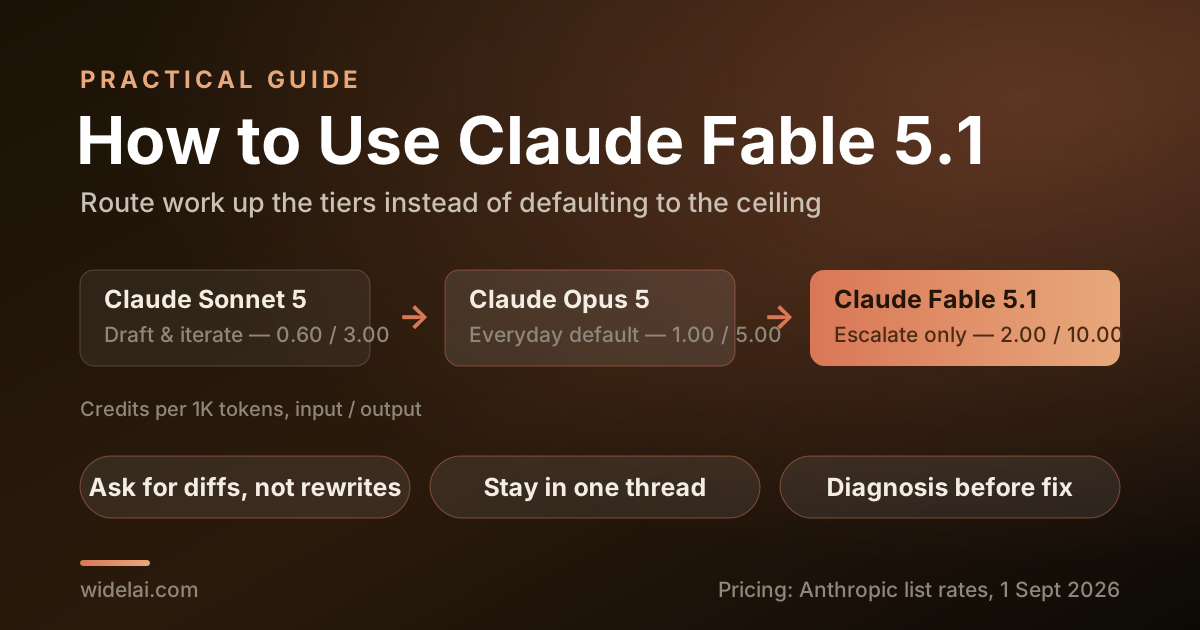
Claude Fable 5.1 is the most capable model on WidelAI, and at 2.00 credits per 1K input tokens and 10.00 per 1K output tokens, it is also the most expensive. Both of those facts should shape how you use it. Treated as a default, it will burn through a credit balance on work a mid-tier model would have handled fine. Treated as an escalation target, it earns its rate several times over.
This guide covers the practical side of running Claude Fable 5.1 on WidelAI: selecting it, structuring prompts to exploit what it is actually good at, controlling spend with the caching behaviour Anthropic just made 75% cheaper, and a routing pattern that keeps most of your work cheap while still putting the frontier model on the problems that need it.
Claude Fable 5.1 is built by Anthropic. See the official announcement for full model details.
Step 1: Select Claude Fable 5.1
Getting to the model takes under a minute:
- Sign in to WidelAI, or create an account if you are new.
- Open the chat and click the model selector at the top of the conversation.
- Pick Claude Fable 5.1 from the Anthropic group. If you are calling WidelAI programmatically, the model tag is
claude-fable-5-1. - Send your prompt.
Fable 5.1 is available on the Pro plan, alongside Claude Opus 5, GPT-5.6 Sol, Gemini 3.1 Pro and the rest of the frontier tier. You can confirm what your plan includes on the pricing page.
The same picker is in the WidelAI apps for Android and Mac, so a conversation you start on your laptop continues on your phone with the same model and the same credit balance.
Note: Switching models mid-conversation is supported and useful. The thread's history carries over, so you can draft on a cheaper model and escalate the same context to Fable 5.1 without re-explaining anything.
Step 2: Understand What You Are Paying For
WidelAI prices in credits, where 1 credit equals $0.005 of real API cost. Input and output are billed separately because generating tokens costs the provider far more than reading them. Fable 5.1's rates:
| Credits per 1K tokens | |
|---|---|
| Input | 2.00 |
| Output | 10.00 |
A short exchange — say a 4,000-token prompt and an 800-token answer — costs about 4 × 2.00 + 0.8 × 10.00 = 16 credits. A long one, 40,000 tokens of context in and a 4,000-token response out, costs about 40 × 2.00 + 4 × 10.00 = 120 credits.
Two things follow from the 5:1 ratio between output and input:
- Context is comparatively cheap. Pasting in a whole file, a full error log or a long spec costs less than you might assume. Do not starve the model of context to save credits.
- Output is where spend accumulates. Asking for a rewritten 2,000-line file when you only needed the changed function is where budgets go. Ask for diffs, targeted patches and summaries rather than full restatements.
Every model's rate is listed on the pricing transparency page, and the usage widget on your dashboard breaks spend down per model so you can see where a month actually went.
Step 3: Write Prompts That Suit a Frontier Model
Fable 5.1 rewards a different prompting style than a fast mid-tier model. The gains Anthropic reports are concentrated in long, multi-step, tool-using work — not in short factual answers, where a cheaper model matches it.
Give it the whole problem, not a slice
The single biggest mistake is decomposing a task into small steps yourself and feeding them one at a time. That is the workflow you use with a weaker model, and it throws away exactly what you are paying for. Anthropic's own example of Fable 5.1's value is diagnostic rather than generative: at the investment firm Millennium, the model identified the cause of an intermittent crash that the team's engineers had not been able to explain over several years of attempts. That kind of result comes from handing over the full picture — the symptom, the logs, the relevant code, the things already ruled out — and letting the model reason across all of it.
State the constraints, not just the goal
Long-horizon runs drift when success is underspecified. Say what must not change, what the output should look like, and how you will judge the result:
Refactor the payment retry logic in this module.

Constraints:
- Public function signatures must not change
- No new dependencies
- Existing tests must pass unmodified
- Return a unified diff, not the full file

Explain the root cause of the current double-charge bug before proposing the fix.
Ask for the reasoning before the answer
Anthropic notes that Fable 5.1 stays more readable than earlier models over long, multi-step tasks — a point echoed by early-access partner Jane Street, whose Head of Quantitative Research described previous models as becoming harder to follow the longer they worked. Ask it to explain the diagnosis first and the fix second. On a hard bug, the explanation is often the part you actually needed, and it makes a wrong answer obvious instead of plausible.
Do not ask it to pad
Frontier output is the expensive part of the bill. Explicitly suppress preamble, recaps and restated code. "Answer with the diff and a two-sentence rationale" is a real cost control, not just a style preference.
Step 4: Exploit the Cheaper Cache Reads
The substantive pricing change in Fable 5.1 is that cache reads dropped 75%, to $0.25 per million tokens. When the model re-reads context it has already processed, that context is now billed at a fraction of the normal input rate. Anthropic measured about a 25% cost reduction on typical workloads and up to roughly 45% on context-heavy, tool-heavy agentic work.
The practical consequence: long conversations over a stable body of context are now much better value than they were on Fable 5. That inverts some habits worth unlearning.
- Keep the thread going. Starting a fresh conversation for each question re-sends context as fresh, fully priced input. Staying in one thread lets the stable prefix be cached.
- Put the stable material first. Caching works on shared prefixes. Load the spec, the schema, the codebase excerpt at the top of the conversation and keep your varying questions at the end.
- Batch related questions into one session. Ten questions about one document in one thread is meaningfully cheaper than ten separate threads about the same document.
If you have been avoiding long agentic runs on the Fable line purely on cost, this is the change that makes them worth re-testing.
Step 5: Route Work Between Tiers
The highest-leverage habit on a multi-model platform is not picking the best model — it is picking the cheapest model that clears your quality bar, and escalating deliberately. Because every model on WidelAI draws on one credit balance, escalation costs you a click, not a new account.
A routing table that works well in practice:
| Work | Model | Why |
|---|---|---|
| Drafting, summarising, boilerplate | GLM 5.3 Flash, Gemini 3.5 Flash Lite | Lowest rates on the platform; fine for volume |
| Everyday code, analysis, writing | Claude Sonnet 5, GPT-5.6 Terra | Strong general quality at a mid-tier rate |
| Hard refactors, deep reasoning | Claude Opus 5, GPT-5.6 Sol | Frontier-adjacent depth at half Fable's rate |
| Root-cause bugs, long agent runs, research | Claude Fable 5.1 | The current ceiling, priced accordingly |
The escalation move itself is simple: work the problem on a mid-tier model, and when you stall, switch the same thread to Fable 5.1 and ask it to review the trail. It inherits the context, including the approaches that already failed, which is often the most useful input you can give it.
Step 6: Know Where the Safeguards Sit
Fable 5.1 ships with production safeguards, and Anthropic has made them more precise rather than simply looser. Two changes are worth knowing about if your work touches security or the life sciences:
- Vulnerability discovery is now allowed. Fable 5.1 can be used to find software vulnerabilities — defensive work that improves your own code's security. Anthropic reports roughly 60% fewer safeguard interventions per session as a result.
- Some dual-use work is still redirected. Penetration testing, exploit generation and binary-based vulnerability scanning are routed to Anthropic's Opus models instead. Life sciences research and development queries are similarly redirected.
Anthropic also reports that its biology safeguards now fire about 85% less often on benign requests, such as elementary biology or general medical questions — so ordinary technical work is much less likely to hit a false positive than it was at Fable 5's launch.
If your work genuinely needs the looser configuration, that is Claude Mythos 5.1 — the same underlying model behind more permissive safeguards, available only through Anthropic's vetted access programs for cyberdefenders and life scientists. It is not something WidelAI or any other reseller can offer.
A Worked Example: Debugging With Fable 5.1
Here is the full pattern applied to a realistic task.
- Start on a mid-tier model. Open a thread on Claude Sonnet 5. Paste the failing test, the stack trace and the module under suspicion. Ask for likely causes.
- Work the cheap hypotheses. Sonnet 5 will find the obvious ones quickly, at a fraction of Fable's rate. Rule them out in the same thread so the trail is recorded.
- Escalate when you stall. Switch the model selector to Claude Fable 5.1. Then prompt deliberately:
The three hypotheses above are ruled out — see the test output for each.

Reason from the concurrency model rather than the symptom. Identify the root
cause, explain why it produces this specific intermittent failure, and only
then propose a minimal fix as a diff.
- Ask for the diagnosis before the patch. A fix you cannot explain is a fix you cannot trust in a payment path.
- Drop back down to verify. Once you have the root cause, writing the regression test is ordinary work. Switch back to Sonnet 5 for it.
You paid the frontier rate for one focused exchange rather than an entire session, which is exactly the right shape for a model at this price.
Common Mistakes
- Using Fable 5.1 as your default model. It is the ceiling, not the baseline. If a task does not need frontier reasoning, you are paying roughly 3x Opus 5's rate for no gain.
- Restarting the conversation constantly. This forfeits the cheaper cache reads that are the main pricing improvement in 5.1.
- Withholding context to save credits. Input is a fifth the price of output. Under-contexting a frontier model is a false economy.
- Requesting full-file rewrites. Ask for diffs. Output tokens are where the bill is.
- Skipping the reasoning. On the problems worth escalating, the explanation is usually the deliverable.
Get Started
Claude Fable 5.1 is live on WidelAI now. The fastest way to judge whether it is worth its rate for your work is to take a problem a cheaper model already failed on, and escalate that exact thread.
Already a member? Open the chat, switch to Claude Fable 5.1, and give it something hard.
Related Reading

Do your best AI work in one place
Bring your next question, draft, file, or idea to WidelAI. Choose the model that fits the moment, keep your work together, and stay in control of privacy and usage.
Leading models, one workspace
Use powerful AI models without juggling separate tabs, accounts, or workflows.
Switch without starting over
Change models as your work evolves while keeping the conversation and context together.
The right model for every task
Choose speed for everyday work or deeper reasoning for complex questions and decisions.
Clear credits and model rates
See your balance, understand each model’s rate, and track usage from one place.
Bring your files and images
Work with documents and images alongside your prompts in the same focused experience.
Your work stays yours
Your data is encrypted in transit and at rest, and your content is never used to train AI models.