Gemini 4 Neon vs Claude Opus 5.5, GPT-6.2 Sol and GPT-6.2 Astra
Gemini 4 Neon is second on the Vals Index for $7.40 a test and first on its legal, finance and tax boards. We compare it with Claude Opus 5.5, GPT-6.2 Sol, GPT-6.2 Astra, Fable 5.2 and Gemini 4 Carbon.
WidelAI Research
Evidence-led analysis for practical multi-model AI decisions
Gemini 4 Neon is Google's new middle Gemini 4 model, released on November 18, 2026 as gemini-4-neon. It sits between the fast, cheap Gemini 4 Hydrogen and the flagship Gemini 4 Carbon, and Google pitches it for complex coding, long-running agents and enterprise knowledge work at a lower cost than Carbon. It costs $3 per million input tokens and $15 per million output tokens, flat across a 1M-token context window, with cached input at $0.15.
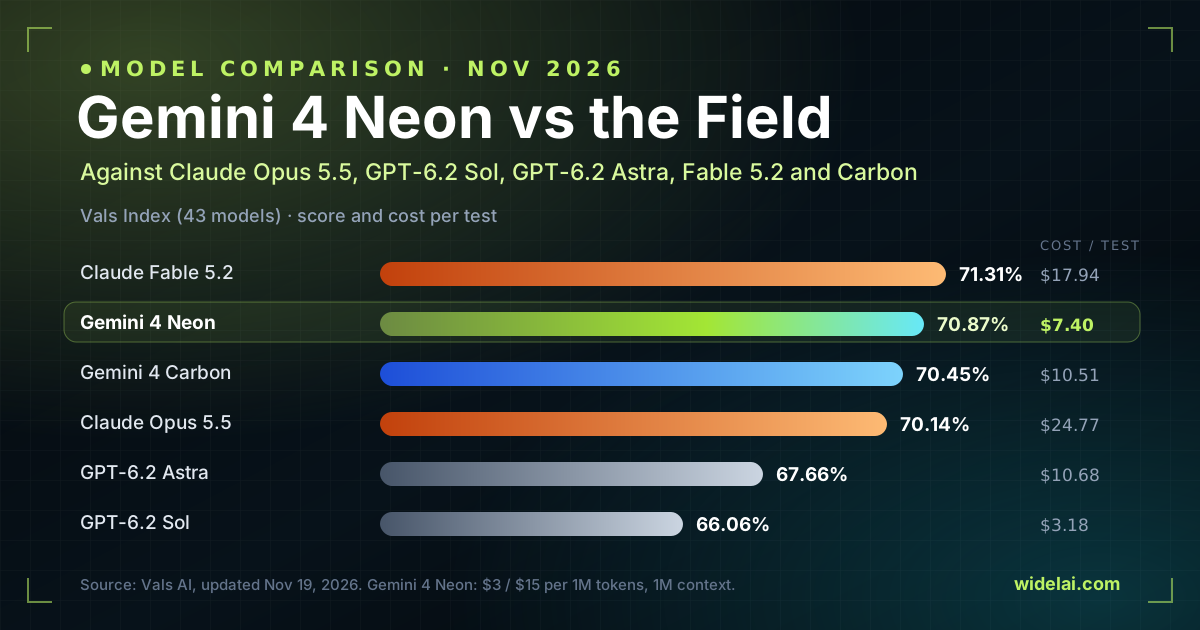
The short version: four days in, Neon is the best-value model on the Vals Index. It scores 70.87%, second of 43 and less than half a point behind Claude Fable 5.2, for $7.40 a test, against $17.94 for Fable 5.2 and $24.77 for Claude Opus 5.5. It is first on Vals' legal, finance and tax indices. On the Artificial Analysis Intelligence Index it scores 61 at xhigh, two points above Opus 5.5 at max for about two-thirds of the cost per task. It is not the best model for everything: GPT-6.2 Astra reaches a higher index score for less per task, GPT-6.2 Sol gets within four points for a sixth of the cost, and Opus 5.5 and Fable 5.2 still lead the agentic coding board.
This guide compares Gemini 4 Neon with the models you would weigh it against: Claude Opus 5.5, OpenAI's GPT-6.2 Sol and GPT-6.2 Astra, Claude Fable 5.2 and Google's own Gemini 4 Carbon, with Hydrogen and Argon where they help. Every chart below is interactive: pick a benchmark, drag the sliders, or tap a dot. Gemini 4 Neon is live on WidelAI today, in chat and in WidelCode.
Sources: Google's Gemini 4 Neon announcement, model page and pricing; Artificial Analysis model pages, Intelligence Index v5.0.1; Vals AI model and benchmark pages and the Vals Index; OpenAI's GPT-6.2 Sol model page and launch post; Anthropic's pricing. Independent figures were checked on November 22, 2026 (Vals pages last updated November 19) unless marked. Claims marked Google-reported come from Google's launch post.
Near the top of the Vals Index, at a mid-tier price
- Vals Index
- 70.87%
- Second of 43, 0.44 points behind Fable 5.2
- Cost per Vals test
- $7.40
- Fable 5.2 costs $17.94, Opus 5.5 $24.77
- AA Intelligence Index
- 61
- At xhigh. Opus 5.5 scores 59 at max
- Input / output per 1M
- $3 / $15
- Flat across 1M context; cached input $0.15
Sources: Vals AI; Artificial Analysis; Google pricing
The Short Answer
- Best value for enterprise work: Gemini 4 Neon. Second on the Vals Index at 70.87% for $7.40 a test, the cheapest model in Vals' top seven.
- Best for legal, tax and finance research: Gemini 4 Neon. First of 44 on the Vals Legal Index (78.36%), first of 46 on the Finance Index (68.31%), first of 91 on Tax Agent Bench (54.89%) and first of 101 on Legal Research Bench (56.25%).
- Neon beats Claude Opus 5.5 on most rows for less. Higher on both independent indices, cheaper per token ($3 / $15 against $4 / $20), and about a third of Opus 5.5's cost per Vals test. Opus 5.5 still wins agentic coding and code migration.
- GPT-6.2 Sol is the budget pick, not the quality pick. Sol scores 57 on the Artificial Analysis index for $1.01 a task and 66.06% on Vals for $3.18. Neon is four to five points higher on both, and 19 to 30 points higher on legal research and tax.
- GPT-6.2 Astra is the better frontier deal on Artificial Analysis. Astra scores 62 for $2.52 a task at xhigh, against Neon's 61 for $6.44, and leads science. Neon leads Astra by more than three points on Vals.
- Hardest coding still goes to Anthropic. Opus 5.5 and Fable 5.2 tie at 65.15% on Vals' Terminal-Bench 4.0; Neon is seventh at 61.62%.
What Gemini 4 Neon Is
Neon is the fourth Gemini 4 model, after Argon, Carbon and Hydrogen. It shares the family's design: one 1,048,576-token window for input, thinking and output, four thinking levels, and native multimodal input.
| Gemini 4 Neon | |
|---|---|
| Model ID | gemini-4-neon |
| Released | November 18, 2026 |
| Input | Text, image, audio, video and PDF |
| Output | Text |
| Context window | 1,048,576 tokens, shared by input, thinking and output |
| Max output | 65,536 tokens synchronous (up to the full window with long decode) |
| Thinking levels | low, medium, high (default), xhigh |
| Price per 1M tokens | $3.00 input, $15.00 output (thinking included), flat across the context |
| Cached input | $0.15, a 95% discount, implicit caching only |
| Batch and Flex | $1.50 / $7.50 |
| WidelAI credits per 1K | 0.60 input / 3.00 output, cache reads 0.03 |
From Google's model page and pricing page. WidelAI bills 1 credit per $0.005 of provider API cost. Neon is on Google's paid tier only, with no free API tier.
Three things set it apart from its siblings:
- It is the efficient one. Google says Neon costs 32% less per task than Carbon at the default high level and cuts redundant file reads in agent sessions. On Artificial Analysis it scores one point above Carbon in less time per task (22.3 minutes at xhigh against 34.9).
- Its price is flat. No long-context tier and no introductory window. Carbon and Argon are $2 / $10 until November 30 and $4 / $20 from December 1, so Neon becomes the cheaper of the three on December 1.
- It is built for professional work. Google's own launch claims lead with finance, accounting, spreadsheet modelling, legal research and tax agents, and the independent Vals boards back them up, as you will see below.
The Models at a Glance
| Direct price (in / out per 1M) | Context | AA Index (setting) | Cost per AA task | Vals Index | Cost per Vals test | On WidelAI | |
|---|---|---|---|---|---|---|---|
| Gemini 4 Neon | $3 / $15 | 1M | 61 (xhigh) | $6.44 | 70.87% | $7.40 | Yes, 0.60 / 3.00 credits |
| Claude Opus 5.5 | $4 / $20 | 1M | 59 (max) | $10.04 | 70.14% | $24.77 | Yes, 0.80 / 4.00 |
| GPT-6.2 Sol | $2 / $10 | 1.05M | 57 (max) | $1.01 | 66.06% | $3.18 | Not yet |
| GPT-6.2 Astra | $8 / $40 | 1.05M | 62 (max, xhigh) | $2.52 (xhigh) | 67.66% | $10.68 | Yes, 1.60 / 8.00 |
| Claude Fable 5.2 | $8 / $40 | 1M | 65 (max) | $26.54 | 71.31% | $17.94 | Yes, 1.60 / 8.00 |
| Gemini 4 Carbon | $2 / $10 to Nov 30, then $4 / $20 | 1M | 60 (high) | $7.76 | 70.45% | $10.51 | Not yet |
AA Index is the Artificial Analysis Intelligence Index v5.0.1 at the setting shown; Artificial Analysis prices Carbon at Google's $4 / $20 standard rate. GPT-6.2 Sol and Astra bill a whole request at 2x input and 1.5x output above 272K input tokens and accept up to 922,000 input tokens. GPT-6.2 Astra's xhigh cost is from our November 18 check.
Gemini 4 Neon vs Claude Opus 5.5
Opus 5.5 has been the everyday default for many WidelAI users since September. Neon is the first model that beats it on both independent indices while costing less per token.
| Gemini 4 Neon | Claude Opus 5.5 | |
|---|---|---|
| Price per 1M (in / out) | $3 / $15 | $4 / $20 |
| Cached input per 1M | $0.15 | $0.20 |
| AA Index, best setting | 61 (xhigh) | 59 (max) |
| Cost per AA task | $6.44 | $10.04 |
| Time per AA task | 22.3 min | 25.3 min |
| Vals Index | 70.87% | 70.14% |
| Cost per Vals test | $7.40 | $24.77 |
| Terminal-Bench 4.0 (Vals) | 61.62% | 65.15% |
| Code Migration (Vals) | 75.8% | 80.5% |
| Finance Agent v2.1 | 68.56% | 67.85% |
| Legal Research Bench | 56.25% | 50.48% |
| Tax Agent Bench | 54.89% | 44.54% |
| WidelAI credits per 1K (in / out) | 0.60 / 3.00 | 0.80 / 4.00 |
Neon wins on price, on both indices, and on every legal, finance and tax row. Opus 5.5 keeps a clear lead where code is the product: 3.5 points on Terminal-Bench 4.0 and almost 5 on Code Migration. If most of your work is documents, research and analysis, Neon is the better default. If most of it is code, keep Opus 5.5.
Gemini 4 Neon vs GPT-6.2 Sol
GPT-6.2 Sol launched a day before Neon as OpenAI's cheaper everyday model. It is the strongest argument against paying for Neon.
| Gemini 4 Neon | GPT-6.2 Sol | |
|---|---|---|
| Price per 1M (in / out) | $3 / $15 | $2 / $10 (2x / 1.5x above 272K) |
| Cached input per 1M | $0.15 | $0.10 |
| Input types | Text, image, audio, video, PDF | Text, image |
| Max output | 65,536 | 128,000 |
| AA Index, best setting | 61 (xhigh) | 57 (max) |
| Cost per AA task | $6.44 | $1.01 |
| Time per AA task | 22.3 min | 10.2 min |
| Vals Index | 70.87% | 66.06% |
| Cost per Vals test | $7.40 | $3.18 |
| Terminal-Bench 4.0 | 61.62% | 60.61% |
| Terminal-Bench-Science | 62.86% | 58.57% |
| Code Migration | 75.8% | 85.3% |
| Legal Research Bench | 56.25% | 37.02% |
| Tax Agent Bench | 54.89% | 24.84% |
Sol is the efficiency champion: it spends about a fifth of Neon's output tokens on the Artificial Analysis run (60.9M against 283M) and finishes in half the time. On coding the two are close, and Sol is far ahead on Code Migration. The gap opens on professional work, where Neon leads by 19 points on legal research and 30 on tax. Use Sol for high-volume coding and general tasks where cost dominates; use Neon when the answer has to be right on a contract, a filing or a tax return. Sol is not on WidelAI yet; Neon is.
The Frontier Map: Score Against Cost
Per-token prices hide the real cost of a reasoning model, which is tokens multiplied by how many the model spends on a task. Artificial Analysis runs every model and reports both the score and the cost per index task. Neon sits in the middle of the map: above Opus 5.5 and Carbon for less, below Astra and Sol on efficiency.
Artificial Analysis Intelligence Index against cost per task
Each dot is one model at one effort setting. Up is smarter, left is cheaper. Tap a model to isolate it.
Hover, tap or tab through the dots. The glowing line is the efficient frontier: no model beats a point on it for both score and cost.
Checked November 22, 2026, except GPT-6.2 Astra at xhigh (November 18) and Fable 5.2 at high (November 10). Artificial Analysis lists cost per task only for each model's top setting.
| Model and setting | AA Index v5.0.1 | Cost per AA task | Time per task | Output speed |
|---|---|---|---|---|
| Claude Fable 5.2 (max) | 65 | $26.54 | 42.2 min | 108 tok/s |
| GPT-6.2 Astra (max) | 62 | $4.00 | 15.0 min | 46 tok/s |
| Claude Fable 5.2 (high) | 62 | $9.08 | 14.9 min | 110 tok/s |
| Gemini 4 Neon (xhigh) | 61 | $6.44 | 22.3 min | 106 tok/s |
| Gemini 4 Neon (high) | 60 | Not listed | 14.5 min | 103 tok/s |
| Gemini 4 Carbon (high) | 60 | $7.76 | 34.9 min | 59 tok/s |
| Claude Opus 5.5 (max) | 59 | $10.04 | 25.3 min | 114 tok/s |
| GPT-6.2 Sol (max) | 57 | $1.01 | 10.2 min | 66 tok/s |
| Gemini 4 Neon (medium) | 55 | Not listed | 8.3 min | 100 tok/s |
| Gemini 4 Hydrogen (xhigh) | 54 | $3.16 | 16.9 min | 153 tok/s |
| Gemini 4 Argon (high) | 50 | $9.95 | 25.6 min | 76 tok/s |
Artificial Analysis. The index combines nine evaluations: AA-Briefcase, AutomationBench-AA, Terminal-Bench 4.0, FrontierCode-AA 2.0, AA-Omniscience, GDP.pdf, HLE-Diamond, CritPt and Terminal-Bench-Science.
Three readings from this table:
- High is Neon's sweet spot. It scores 60 at high, one point below xhigh, in 14.5 minutes instead of 22.3 and with less than half the output tokens (123M against 283M). WidelAI runs Neon at Google's default, high.
- Neon streams fast. At about 105 tokens per second it is more than twice GPT-6.2 Astra's speed and close to the Claude models. It is slower per task than Astra and Sol because it thinks for longer.
- Astra and Sol are more token-efficient. On this index, GPT-6.2 Astra gets one point more for 40% of Neon's cost per task, and Sol gets within four points for a sixth. If the Artificial Analysis mix looks like your work, weigh those first.
What Independent Tests Say
Artificial Analysis leans on coding, science and general reasoning. Vals AI weights enterprise work more heavily: finance, law, tax, coding and medicine. That is where Neon pulls ahead. Pick a benchmark below to compare it with the five models it competes with, or open the scoreboard to see who leads most rows.
Gemini 4 Neon against the field, row by row
Independent results from Artificial Analysis and Vals AI. The crown marks the leader.
Vals Index · Enterprise composite across finance, law, coding, medicine and taxVals AI
| Benchmark | Gemini 4 Neon | Claude Opus 5.5 | GPT-6.2 Sol | GPT-6.2 Astra | Claude Fable 5.2 | Gemini 4 Carbon |
|---|---|---|---|---|---|---|
| Vals Index | 70.87% | 70.14% | 66.06% | 67.66% | 71.31% | 70.45% |
| Cost per Vals test | $7.40 | $24.77 | $3.18 | $10.68 | $17.94 | $10.51 |
| AA Index | 61 | 59 | 57 | 62 | 65 | 60 |
| Cost per AA task | $6.44 | $10.04 | $1.01 | $4.00 | $26.54 | $7.76 |
| Legal Research Bench | 56.25% | 50.48% | 37.02% | 42.79% | 46.15% | 55.77% |
| Tax Agent Bench | 54.89% | 44.54% | 24.84% | 21.84% | 32.09% | 51.78% |
| Finance Agent v2.1 | 68.56% | 67.85% | 58.91% | 60.75% | 69.47% | 67.16% |
| Terminal-Bench 4.0 | 61.62% | 65.15% | 60.61% | 63.13% | 65.15% | 63.13% |
| Vibe Code Bench | 93.7% | 90.3% | 87.6% | 89.9% | 93.8% | 89.1% |
| Code Migration | 75.8% | 80.5% | 85.3% | 83.6% | 85.8% | 80.1% |
| Terminal-Bench-Science | 62.86% | 47.14% | 58.57% | 71.43% | 55.71% | Not reported |
| HLAB-Vals | 19.6% | 9.2% | 12.1% | 16.3% | 5% | 17.5% |
Vals figures as of November 19, 2026; Vibe Code, Code Migration and HLAB values are Vals' rounded index-table figures. Carbon has no Terminal-Bench-Science result.
Sources: Vals AI Gemini 4 Neon; Vals Index; Artificial Analysis
Vals AI
| Rank | Model | Vals Index | Cost per test |
|---|---|---|---|
| 1 | Claude Fable 5.2 | 71.31% | $17.94 |
| 2 | Gemini 4 Neon | 70.87% | $7.40 |
| 3 | Claude Sonnet 5.5 | 70.85% | $16.18 |
| 4 | Gemini 4 Carbon | 70.45% | $10.51 |
| 5 | Claude Opus 5.5 | 70.14% | $24.77 |
| 6 | Gemini 4 Argon | 69.39% | $13.37 |
| 7 | Gemini 4 Hydrogen | 68.49% | $9.84 |
| 8 | GPT-6.2 Astra | 67.66% | $10.68 |
| 10 | GPT-6.2 Sol | 66.06% | $3.18 |
Vals Index, 43 models, updated November 19, 2026. Sonnet 5.5's cost is from our November 13 check.
| Vals benchmark | Gemini 4 Neon | Opus 5.5 | GPT-6.2 Sol | GPT-6.2 Astra | Fable 5.2 | Neon rank |
|---|---|---|---|---|---|---|
| Vals Legal Index | 78.36% | 72.37% | Not checked | 69.68% | 69.17% | 1 of 44 |
| Legal Research Bench | 56.25% | 50.48% | 37.02% | 42.79% | 46.15% | 1 of 101 |
| Tax Agent Bench | 54.89% | 44.54% | 24.84% | 21.84% | 32.09% | 1 of 91 |
| Vals Finance Index | 68.31% | Not checked | Not checked | Not checked | Not checked | 1 of 46 |
| Finance Agent v2.1 | 68.56% | 67.85% | 58.91% | 60.75% | 69.47% | 2 of 46 |
| Vibe Code Bench v1.1 | 93.70% | 90.3% | 87.6% | 89.9% | 93.8% | 2 of 134 |
| Terminal-Bench-Science | 62.86% | 47.14% | 58.57% | 71.43% | 55.71% | 2 of 49 |
| Vals Science Index | 62.63% | 58.65% | 57.76% | 68.44% | 63.74% | 4 of 29 |
| Terminal-Bench 4.0 | 61.62% | 65.15% | 60.61% | 63.13% | 65.15% | 7 of 70 |
From Vals AI's Neon page and benchmark leaderboards. Legal Index figures for Opus 5.5, Astra and Fable 5.2 are from our November 10 and 18 checks.
- Law and tax are Neon's, clearly. It leads every legal and tax board Vals runs, by six points over Opus 5.5 on the Legal Index and ten on Tax Agent Bench. Google's family as a whole is strong here: Hydrogen and Carbon are second and third on Tax Agent Bench, and Carbon is second on Legal Research Bench.
- Finance is a near-tie with Fable 5.2. Neon is 0.91 points behind on Finance Agent v2.1 but first on the broader Finance Index.
- Coding is good, not first. Second on Vibe Code Bench v1.1, a tenth of a point behind Fable 5.2, but seventh on Terminal-Bench 4.0 and the lowest of these six on Code Migration.
- Science is second-tier. Second on Terminal-Bench-Science, but GPT-6.2 Astra leads it by 8.6 points.
What Google's Launch Post Claims
Google's charts mostly state Neon's own numbers and ranks rather than a full table against named competitors, so we list them as Google states them. Treat these as vendor-reported.
- Agentic work: first on Zapier's AutomationBench (56.3%), first on Andon Labs' Vending-Bench 2 ($16,843), second on Arena's Agent Arena index (1,336) and 75.8% on Agents' Last Exam v1.1.
- Coding: first on the Artificial Analysis Coding Agent Index (58.6) and 65.2% on Terminal-Bench 4.1 in Google's harness, up from Hydrogen's 57.0%.
- Science and maths: 71.3% on HLE-Diamond, 84.0% on RiemannBench and 70.5% on Terminal-Bench Science, which Google calls best in class. Vals' independent run of Terminal-Bench-Science scores Neon at 62.86%, second to GPT-6.2 Astra, so the harness matters.
- Cost: 32% lower cost per task than Carbon at high, and 50% to 80% lower than top competing frontier models at the same level.
- Security: state of the art on SEC-bench Pro (90.5%) and WebExploitBench, at about half the cost of larger models. A cyber-tuned variant is going to vetted defenders through Google's Fairwind Program.
- Behaviour: the lowest shortcut-taking rate of any Gemini 4 model on Google's coding cheating evaluation (2.45%), and 0.0% attack success on Gray Swan's prompt-injection benchmark at the highest thinking level.
Price per Task: Run a Simulation
What you actually pay depends on your workload's shape: how much context you send, how much of it is cached, and how long the answers are. Neon's flat price helps on very long prompts, where GPT-6.2 Sol and Astra double their input rate above 272K tokens. Drag the sliders to model your own workload; the per-task differences in the frontier map come on top, from how many tokens each model spends.
What a month of your workload costs on each model
Provider list prices per request, multiplied by runs per month. WidelAI credits are shown at 1 credit per $0.005.
Per-request list prices only; output includes thinking tokens. Real per-task cost also depends on how many tokens each model spends, where GPT-6.2 Sol and Astra are the most efficient on the Artificial Analysis run.
On WidelAI the same logic applies in credits. A chat turn with 20,000 tokens of context and a 2,000-token answer costs:
| Model | Credits per 1K (in / out) | Credits for the example turn |
|---|---|---|
| Gemini 4 Hydrogen | 0.30 / 1.50 | 9 |
| Gemini 4 Argon, until Nov 30 | 0.40 / 2.00 | 12 |
| Gemini 4 Neon | 0.60 / 3.00 | 18 |
| Claude Opus 5.5 | 0.80 / 4.00 | 24 |
| GPT-6.2 Astra | 1.60 / 8.00 | 48 |
| Claude Fable 5.2 | 1.60 / 8.00 | 48 |
The 2,000 output tokens include thinking, which every model here bills as output. Cache reads on Neon bill at 0.03 credits per 1K, the 95% discount Google gives, against 0.04 on Opus 5.5 and 0.08 on GPT-6.2 Astra. Neon has no long-context surcharge, so a 400K-token prompt costs the same per token as a 4K one. Every rate is on the pricing transparency page.
Where Gemini 4 Neon Does Not Win
These are the places the evidence points elsewhere:
- Overall quality ceiling: Claude Fable 5.2 leads both independent indices, by four points on Artificial Analysis and 0.44 on Vals.
- Agentic coding: Opus 5.5 and Fable 5.2 lead Terminal-Bench 4.0 by 3.5 points; GPT-6.2 Astra and Carbon are also ahead.
- Code migration: Neon's 75.8% is the lowest of the six models compared here; Fable 5.2 (85.8%) and GPT-6.2 Sol (85.3%) lead.
- Science: GPT-6.2 Astra leads Terminal-Bench-Science and the Vals Science Index.
- Cost per task on reasoning-heavy work: GPT-6.2 Astra at xhigh and GPT-6.2 Sol both score close to or above Neon on Artificial Analysis for far less per task.
- Raw throughput on a budget: Gemini 4 Hydrogen streams about 45% faster at half the token price, and is second on Tax Agent Bench.
- Long single answers: synchronous output stops at 65,536 tokens, half of GPT-6.2 Sol and Astra's 128,000.
Which Model to Use for Each Task
Pick the kind of work you do and the router below shows where the evidence points, with the runner-up. The same routing is in the table after it.
Which model should take this task?
Routing based on the independent results in this guide. Every pick is on WidelAI; GPT-6.2 Sol and Gemini 4 Carbon appear only as notes.
Routed to
Gemini 4 Neon
First of 44 on the Vals Legal Index (78.36%) and first of 101 on Legal Research Bench, six points ahead of Opus 5.5 on the index.
Also consider: Gemini 4 Argon, 76.78% on the Legal Index at a lower token price until November 30.
Run it on WidelAI| If you need... | Use | Why |
|---|---|---|
| Legal research, contracts and compliance | Gemini 4 Neon | First on the Vals Legal Index (78.36%) and Legal Research Bench |
| Tax work | Gemini 4 Neon | First of 91 on Tax Agent Bench (54.89%) |
| Near-top enterprise quality at a mid-tier price | Gemini 4 Neon | Second on the Vals Index for $7.40 a test |
| Very long documents at a flat price | Gemini 4 Neon | $3 / $15 across the full 1M window, no long-context tier |
| Finance agents | Claude Fable 5.2, or Neon to save | 69.47% against Neon's 68.56% on Finance Agent v2.1 |
| Hard agentic coding | Claude Opus 5.5 or Fable 5.2 | Tied first on Terminal-Bench 4.0 at 65.15% |
| Scientific computing | GPT-6.2 Astra | First on Terminal-Bench-Science and the Science Index |
| The highest overall ceiling | Claude Fable 5.2 | First on both independent indices |
| The cheapest capable model | Gemini 4 Hydrogen on WidelAI; GPT-6.2 Sol elsewhere | 54 on the AA index for $3.16 a task; Sol 57 for $1.01 |
A sensible setup after this launch: make Neon the default for document, research and professional work, keep Opus 5.5 for code, escalate the hardest problems to Fable 5.2, send science to GPT-6.2 Astra, and use Hydrogen for quick, high-volume tasks. If you use Opus 5.5 today for non-coding work, try the same prompts on Neon: it scored higher on both indices for three-quarters of the token price.
Caveats Before You Switch
- The independent numbers are four days old. Expect movement as more runs land, as there was after Carbon, Argon and Fable 5.2 shipped.
- Effort settings differ across evaluators. Artificial Analysis ran every setting and lists cost per task only for each model's top one; Vals runs one setting per model. Compare like with like where you can.
- Google's charts are Google's. Its Terminal-Bench Science result (70.5%) is eight points above Vals' independent run (62.86%), and most of its launch claims have no competitor numbers alongside.
- Implicit caching only. Neon has no explicit context-cache API, so the 95% discount applies when Google's implicit cache hits a repeated prompt prefix. Keep long system prompts and documents at the start of the prompt and unchanged.
- Thinking is never off. The lowest level is low, which scores 44 on the Artificial Analysis index. Every level bills thinking tokens as output.
- Test on your own work. Five to ten tasks you have already solved will tell you more than any leaderboard.
Try Gemini 4 Neon on WidelAI and WidelCode
Gemini 4 Neon is live on WidelAI now, next to Claude Opus 5.5, Claude Fable 5.2, GPT-6.2 Astra, Gemini 4 Hydrogen and Gemini 4 Argon, on one plan and one credit balance.
In WidelAI chat
- Pick Gemini 4 Neon from the Google group in the chat model picker. It costs 0.60 input and 3.00 output credits per 1K tokens, with cache reads at 0.03 credits per 1K.
- Give it the work it leads on. Upload a contract, a set of filings or a tax workbook and ask for a finished deliverable: redlines, a reconciliation, a memo with citations. Those are the boards where Neon is first.
- Compare it in the same thread. Ask Neon first, then switch the picker to Opus 5.5, Fable 5.2 or GPT-6.2 Astra and send the same prompt. The history carries over, so you can read the answers side by side and see each one's credit cost.
- It thinks at high by default. WidelAI uses Google's default thinking level, which scored 60 on the Artificial Analysis index, one point below xhigh in about two-thirds of the time.
In WidelCode
WidelCode, the WidelAI coding agent, lets you choose the model per task. The model ID everywhere is gemini-4-neon.
- Mac app: open the Code tab, choose a project folder and pick Gemini 4 Neon in the Google group. If you do not have the app yet, download WidelCode.
- CLI: install it once with
npm install -g widelcodeand sign in withwidelcode login. Start a session withwidelcode --model gemini-4-neon, or switch an existing one with/model gemini-4-neon. - VS Code: the
widelai.widelcodeextension, on the Visual Studio Marketplace and Open VSX, runs the same agent with the same models and credits. - Cloud agents: give Neon a long-running task that ends in a pull request, with a hard credit limit:
widelcode --model gemini-4-neon --budget 200 cloud run --repo your-org/your-repo --prompt "Audit the invoicing module for tax-calculation edge cases, add failing tests for each, fix them, and open a PR" --follow
A good first test is to run the same task twice: once on Neon and once on Opus 5.5 with /model claude-opus-5-5. Compare the diffs, the time each took and the credits each spent. For most everyday changes Neon should cost less; for the hardest terminal work, Opus 5.5 earns its extra credits.
New to WidelAI? Create your account and choose the Pro plan, which includes Gemini 4 Neon, every other model on WidelAI in this guide and WidelCode. You can see every model and its rate on the models page and the pricing transparency page.
The Verdict
Gemini 4 Neon is not the strongest model you can use today; Claude Fable 5.2 still is, narrowly. What Neon offers is near-Fable quality on enterprise work for well under half the cost per test, and a clean win over Claude Opus 5.5 on everything except code. On legal, tax and finance work it is the best model Vals has tested.
It is not the most efficient reasoner: GPT-6.2 Astra beats it on the Artificial Analysis index for less per task, and GPT-6.2 Sol comes within four points for a sixth of the cost. And for the hardest coding, Opus 5.5 and Fable 5.2 still lead. Route by task: Neon for professional and document work, Anthropic for code, Astra for science, and measure the credits.
Related Reading
- GPT-6.2 Astra vs Claude Fable 5.2, Opus 5.5 and Gemini 4 Argon
- Gemini 4 Hydrogen vs Claude Sonnet 5.5, GPT-6.1 Terra and Gemini 4 Argon
- Claude Fable 5.2 vs Opus 5.5, GPT-6 Astra and Gemini 4 Argon
- Gemini 4 Carbon vs Opus 5.5, GPT-6 Astra, Fable 5.1 and Argon
- Gemini 4 Argon vs Claude Opus 5.5, GPT-6 Astra and Fable 5.1

Do your best AI work in one place
Bring your next question, draft, file, or idea to WidelAI. Choose the model that fits the moment, keep your work together, and stay in control of privacy and usage.
Leading models, one workspace
Use powerful AI models without juggling separate tabs, accounts, or workflows.
Switch without starting over
Change models as your work evolves while keeping the conversation and context together.
The right model for every task
Choose speed for everyday work or deeper reasoning for complex questions and decisions.
Clear credits and model rates
See your balance, understand each model’s rate, and track usage from one place.
Bring your files and images
Work with documents and images alongside your prompts in the same focused experience.
Your work stays yours
Your data is encrypted in transit and at rest, and your content is never used to train AI models.