Claude Opus 5.5 vs GPT-6 Sol: Coding, Agents, and Cost
Compare Claude Opus 5.5 and GPT-6 Sol across coding, agent design, reasoning controls, context, cache economics, direct prices, and WidelAI credit rates.
WidelAI Research
Evidence-led analysis for practical multi-model AI decisions
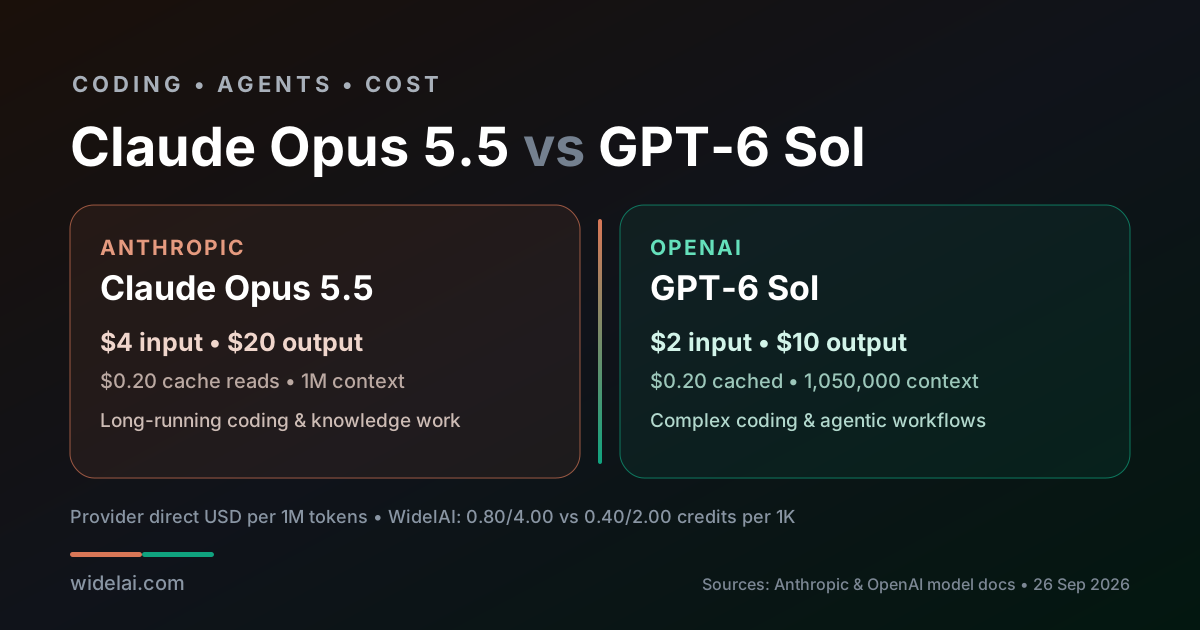
Claude Opus 5.5 vs GPT-6 Sol is a practical comparison between two models released on September 22, 2026 for demanding coding and agentic work. Anthropic positions Opus 5.5 for long-running agentic coding and knowledge work. OpenAI positions Sol for complex coding and agentic workflows. The overlap is real, but their prices, caching, reasoning controls, API paths, and ideal operating patterns differ.
There is no responsible universal winner. Neither vendor's product page is an independent benchmark, and different agent harnesses can dominate a model result. The better question is which model completes your tasks with fewer failed loops, lower total cost, and less human repair. This guide uses official specifications and gives you a repeatable evaluation method rather than converting provider positioning into an unsupported benchmark claim.
You can inspect both in the WidelAI model catalog, compare conversations in WidelAI chat, and review how credits relate to provider rates on the pricing transparency page. For the wider release context, see all four September additions; for tier selection, read GPT-6 Sol vs GPT-6 Luna; and for Google's alternative, use the Gemini 3.8 Flash guide.
The Short Answer
Choose Claude Opus 5.5 as the first trial when work depends on sustaining a coherent repository or knowledge model over a long run, repeatedly revisiting stable context, or producing a careful diagnosis before editing. Its 1M context, 128K output ceiling, adaptive thinking, and $0.20-per-million cache reads make it especially relevant to context-heavy agents. WidelAI exposes low, medium, high, extra, and max effort, with extra mapping to the provider's xhigh level.
Choose GPT-6 Sol first when you want OpenAI's complex coding and agentic tier, six explicit reasoning settings including none, or a Responses-based integration using built-in tools and function calling. It costs half as much as Opus for uncached standard input and output: $2 versus $4 per million input tokens, and $10 versus $20 per million output tokens.
Do not choose from rates alone. Opus can be cheaper if its diagnosis avoids a rerun. Sol can be cheaper if its lower standard rates produce an equally correct result. A fair test tracks completion, tests, tool loops, elapsed time, cache behavior, output length, and review defects.
Verified Specifications Side by Side
| Category | Claude Opus 5.5 | GPT-6 Sol |
|---|---|---|
| Model ID | claude-opus-5-5 | gpt-6-sol |
| Released | September 22, 2026 | September 22, 2026 |
| Primary position | Long-running agentic coding and knowledge work | Complex coding and agentic workflows |
| Standard input | $4 per 1M | $2 per 1M |
| Standard output | $20 per 1M | $10 per 1M |
| Cache reads / cached input | $0.20 per 1M | $0.20 per 1M |
| Cache writes | $5 per 1M for five-minute writes | $2.50 per 1M |
| WidelAI input / output | 0.80 / 4.00 credits per 1K | 0.40 / 2.00 credits per 1K |
| Context represented | 1M | 1,050,000 in repository catalog |
| Maximum output | 128K | 128K |
| Knowledge cutoff | June 2026 reliable cutoff | Consult current model documentation |
| Reasoning | Adaptive thinking always on; five public WidelAI efforts | none, low, medium, high, xhigh, max; medium default |
| Preferred tool API | Anthropic's current messages/tool interface | Responses for built-in tools and function calling |
The direct prices above are provider API rates. WidelAI credits are a product usage unit. One credit equals $0.005, and each displayed per-1K rate equals direct per-1M price multiplied by 0.2. Therefore $4 input becomes 0.80 credits per thousand, while $2 becomes 0.40. This conversion explains the relationship without implying that every provider billing feature is exposed unchanged in WidelAI.
Anthropic also reports $8 input and $40 output per million in fast mode for Opus 5.5. OpenAI reports fast mode at 2× where applicable, Batch and Flex at 50% of Standard, and regional processing at a 10% premium. Those direct service tiers affect provider invoices; consult the actual WidelAI product surface before assuming an equivalent credit mode exists there.
Coding Work: Diagnosis Versus Integration Shape
Where Opus 5.5 is a strong first candidate
Long coding runs are often knowledge-management problems disguised as generation problems. The agent must discover architecture, identify a true fault rather than a symptom, preserve constraints, edit the smallest safe surface, and validate behavior. Opus 5.5's positioning directly addresses that long-running pattern. Its value should be tested on multi-file work, unfamiliar systems, root-cause debugging, migration planning, and review tasks where readability across many steps matters.
A useful Opus prompt asks for evidence before mutation:
Trace the request from route to persistence, identify the earliest violated invariant, cite the files supporting the diagnosis, and propose the smallest patch. Do not edit until the failure can be reproduced. Validate with the narrowest test, then list residual risks.
That contract does not guarantee accuracy, but it turns a vague “fix the bug” instruction into observable stages. Adaptive thinking remains on, so the public effort choice should reflect task difficulty. Low or medium can suit bounded changes; high through max deserve a measurable reason such as uncertain architecture, a stubborn intermittent failure, or a consequential design review.
Where Sol is a strong first candidate
Sol is designed for complex coding and agentic workflows, and its API shape is important when the agent is part of a product. OpenAI recommends the Responses API for built-in tools and function calling. Responses can carry the intended tool workflow at reasoning levels above none. Chat Completions supports function calling for Sol only at reasoning none, so a legacy integration can silently become incompatible if it selects medium reasoning while retaining the older endpoint.
Sol's six reasoning settings make routing granular. None can be useful for direct transformations and compatibility with Chat Completions function calls. Low and medium cover routine implementation and bounded analysis. High, xhigh, and max should be reserved for tasks where additional deliberation improves an acceptance metric enough to justify latency and token use.
A strong Sol evaluation includes tool-sequence accuracy, schema-valid arguments, recovery after a failed call, and whether the model stops when the task is complete. Generating correct code after five unnecessary loops may cost more than a higher-priced model that finishes in two.
Agent Architecture and Tool Safety
The safest agent design does not depend on which model wins. Give either model the least privilege required, validate tool arguments outside the model, and put irreversible actions behind human confirmation. Separate planning from execution when the consequence is high. Log inputs, tool calls, outputs, and permission decisions so an incident can be reconstructed.
For repository agents, scope filesystem access to the project being changed. For cloud tools, use short-lived credentials and narrow roles. For databases, prefer read-only inspection until a reviewed migration is ready. For defensive security work, operate only on systems you own or have explicit authorization to assess. Neither model name changes those boundaries.
Failure modes to test
An agent evaluation should deliberately include difficult paths:
- A tool returns incomplete or contradictory data.
- A file changes after the model read it.
- A function rejects an extra argument.
- A test fails for a reason unrelated to the patch.
- A user changes a requirement during the run.
- The cost or iteration budget is reached before confidence is high.
Score whether the model recognizes uncertainty, gathers the missing evidence, and stops safely. A fluent recovery story without a valid final state is still a failed run.
Human review remains part of the system
Review should focus on evidence and blast radius, not prose confidence. Inspect diffs, run deterministic checks, compare behavior with the acceptance contract, and verify any external citation. Billing, authentication, infrastructure, destructive data operations, and security-sensitive changes require stronger approval regardless of model capability.
Context and Cache Economics
Opus 5.5 provides a 1M context window; WidelAI's repository catalog represents Sol at 1,050,000 tokens. Both allow up to 128K output. These capacities support large repositories and document sets, yet sending the maximum is rarely an efficient first move.
Cache economics reveal a more nuanced comparison than the standard rate. Both list reads or cached input at $0.20 per million tokens. Opus's read price is only 5% of its $4 standard input price. Sol's cached-input price is 10% of its $2 standard input price. Their write prices preserve the 2× relationship: $5 for Opus five-minute cache writes and $2.50 for Sol cache writes.
Consider a simplified direct-provider agent run with a 200,000-token stable prefix used across ten requests, plus 20,000 fresh tokens per request and 5,000 output tokens per request. Ignoring implementation-specific cache eligibility and writes:
- Opus stable reads: 2M cached tokens × $0.20 = $0.40.
- Sol stable reads: 2M cached tokens × $0.20 = $0.40.
- Opus fresh input: 200K × $4/M = $0.80; output: 50K × $20/M = $1.00.
- Sol fresh input: 200K × $2/M = $0.40; output: 50K × $10/M = $0.50.
The simplified total favors Sol, $1.30 versus $2.20, before writes and other service factors. But if Opus finishes in six turns while Sol takes ten, actual totals can converge or reverse. Measure completed work, not a hypothetical equal-token run.
The Sol long-context threshold
OpenAI applies different rates when a GPT-6 request exceeds 272K prompt tokens. Above that threshold, the entire request bills at 2× input and cache rates and 1.5× output rates. A 273K-token prompt does not only surcharge the final thousand tokens. This cliff makes retrieval, summarization, and conversation compaction especially important for Sol.
Opus cache eligibility and write duration have their own provider rules. Do not treat cache prices as automatically achieved discounts. Structure stable prefixes intentionally, record actual cache use, and include writes in the measured invoice.
Reasoning Controls and Knowledge Boundaries
Opus 5.5 has a June 2026 reliable knowledge cutoff and always-on adaptive thinking. The WidelAI effort choices—low, medium, high, extra, and max—change how much deliberation is requested, with extra mapping to xhigh. They do not update the cutoff or make unsupported facts reliable. Supply current documents and require citations when the task depends on post-cutoff events.
Sol exposes none, low, medium, high, xhigh, and max, defaulting to medium. None is not merely a “fast” label; it also determines whether Chat Completions can perform function calling. Higher settings can increase time and tokens, so choose them from a policy tied to task complexity:
| Task shape | Opus starting effort | Sol starting effort |
|---|---|---|
| Bounded rewrite with deterministic checks | low | none or low |
| Ordinary multi-file feature | medium | medium |
| Unfamiliar root-cause investigation | high | high |
| Consequential architecture review | extra | xhigh |
| Last-resort unresolved analysis | max | max |
These are evaluation defaults, not quality promises. A simpler effort that passes all checks is preferable to a maximal run that only produces more explanation.
Cost Comparison With Realistic Scenarios
A routine implementation
Suppose each model receives 40,000 uncached input tokens and returns 6,000 output tokens. At direct Standard rates, Opus costs $0.16 input plus $0.12 output, or $0.28. Sol costs $0.08 input plus $0.06 output, or $0.14. At WidelAI's listed conversion, the same lengths are 32 input plus 24 output credits for Opus, and 16 plus 12 for Sol.
If both outputs pass the same tests and require equal review, Sol wins economically. If the Sol run needs a second full attempt while Opus succeeds once, the simple advantage disappears.
A long cached agent
For a stable 150,000-token prefix read 20 times, either model's listed $0.20-per-million read price produces $0.60 in cache reads, assuming full eligibility. Fresh tokens and outputs then drive most of the difference. Opus's higher write price may also matter when prefixes churn. A stable architecture brief that is reused is cache-friendly; a constantly regenerated transcript is not.
Service modes
Provider mode can change latency and price. Anthropic reports Opus fast mode at $8/$40. OpenAI's applicable fast mode is 2×; Batch and Flex are 50% of Standard; regional processing is 10% extra. Compare equivalent service requirements. It is misleading to place one provider's asynchronous discounted tier against another provider's low-latency tier and call the result a model-price comparison.
How to Run a Fair Evaluation
Build a set of ten to thirty tasks sampled from your real queue. Include known bugs, unfamiliar modules, a feature crossing several files, a tool schema failure, a document synthesis task, and an easy case that should not require an expensive model. Freeze the starting commit or fixture for every run.
Give both models the same outcome, evidence, boundaries, tool permissions, and acceptance checks. Use equivalent starting reasoning effort, then run a separate effort sweep rather than tuning one model more carefully. Keep provider-specific prompt adaptations documented; identical words are not always a fair test when APIs express tools differently.
Record:
- First-pass completion and deterministic test results.
- Number of tool calls, retries, and invalid arguments.
- Input, cached input, cache writes, and output tokens.
- Elapsed time and time waiting for human decisions.
- Review defects by severity and minutes to repair.
- Whether the run crossed Sol's 272K threshold.
- Final direct cost or WidelAI credits for the completed outcome.
Repeat noisy tasks. One lucky pass does not establish a routing policy. Do not let one model serve as the sole judge of the other; use compilers, tests, schema validators, request logs, and qualified human review.
Decision Matrix
| If your priority is... | Start with | Why |
|---|---|---|
| Lowest standard price between these two | GPT-6 Sol | Half the uncached input and output list price |
| Long-running repository understanding | Claude Opus 5.5 | Explicit long-agent and knowledge-work position |
| Repeated stable context | Test both | Same listed $0.20/M read price; turns and writes decide |
| Responses built-in tools | GPT-6 Sol | Recommended OpenAI API path |
| Explicit no-reasoning mode | GPT-6 Sol | Opus adaptive thinking stays on |
| June 2026 documented reliable cutoff | Claude Opus 5.5 | Published boundary for knowledge planning |
| A costly architecture or migration decision | Both | Different provider perspective exposes assumptions |
If neither needs frontier-level depth, evaluate a cheaper tier. GPT-6 Luna is designed for focused volume, while Gemini 3.8 Flash targets fast long-horizon and enterprise workflows at an introductory rate. Expensive models should earn escalation through measurable success.
Primary references are Anthropic's Claude Opus 5.5 announcement, pricing documentation, and model overview, plus OpenAI's GPT-6 Sol documentation and Sol and Luna announcement. Official material is summarized and rephrased.
Conclusion: Select the Whole Agent, Not the Name
Claude Opus 5.5 and GPT-6 Sol are both credible starting points for serious coding agents, but they optimize different parts of the operating model. Opus offers long-running depth, adaptive thinking, a documented June 2026 reliable cutoff, and unusually low cache reads relative to its own standard input price. Sol offers half the standard uncached rates, granular reasoning including none, and a clear Responses-first tool path.
Choose Sol when equivalent task success makes price decisive. Choose Opus when sustained diagnosis, stable-context reuse, or fewer repair cycles offsets its higher standard rates. For important workflows, run both against the same frozen tasks and let completed outcomes—not vendor claims, isolated demos, or token prices alone—set the routing rule.

Do your best AI work in one place
Bring your next question, draft, file, or idea to WidelAI. Choose the model that fits the moment, keep your work together, and stay in control of privacy and usage.
Leading models, one workspace
Use powerful AI models without juggling separate tabs, accounts, or workflows.
Switch without starting over
Change models as your work evolves while keeping the conversation and context together.
The right model for every task
Choose speed for everyday work or deeper reasoning for complex questions and decisions.
Clear credits and model rates
See your balance, understand each model’s rate, and track usage from one place.
Bring your files and images
Work with documents and images alongside your prompts in the same focused experience.
Your work stays yours
Your data is encrypted in transit and at rest, and your content is never used to train AI models.