Claude Sonnet 5.5 Is Now Available on WidelAI
Claude Sonnet 5.5 is live on WidelAI. It scores 70.6% on Terminal-Bench 4.0, runs 30%+ faster than Sonnet 5, and costs 0.40/2.00 credits per 1K tokens. Here's what changed.
WidelAI Team
Building the future of AI accessibility
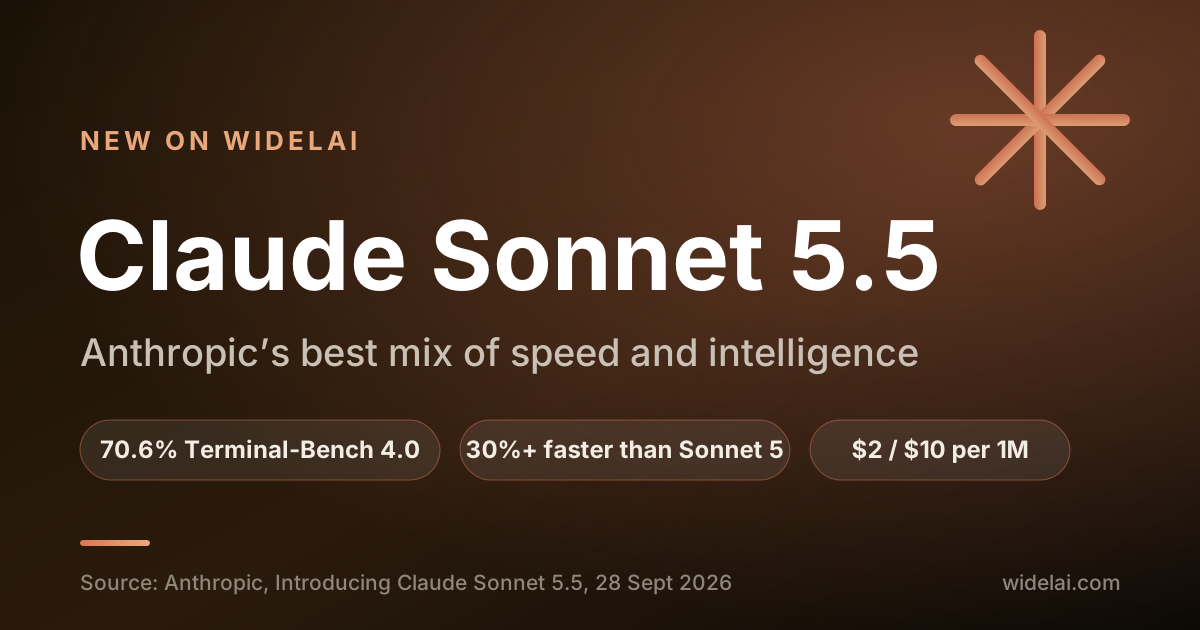
Claude Sonnet 5.5 is live on WidelAI today, the same day Anthropic released it. You will find it in the model picker under the Anthropic group, with the tag claude-sonnet-5-5. There is no waitlist, no separate Anthropic account and no API key to manage.
Sonnet 5.5 is the second model in Anthropic's Claude 5.5 family, arriving six days after Claude Opus 5.5. Anthropic positions it as the faster, lower-cost partner to Opus 5.5: strongest at well-scoped everyday work, fixing bugs, and producing polished documents, slides and spreadsheets. It generates output more than 30% faster than Sonnet 5, and in Anthropic's testing it costs up to 30% less per task because it needs fewer tokens to reach the same result.
The figure that stands out is agentic coding. Anthropic reports 70.6% on Terminal-Bench 4.0, against 10.3% for Sonnet 5 and 66.4% for Opus 5.5. This post covers what changed, what it costs in WidelAI credits, where it fits next to Opus 5.5, and how to start using it in under a minute.
Claude Sonnet 5.5 is built by Anthropic. Read the official announcement and the model documentation for full details.
What Is Claude Sonnet 5.5?
Anthropic describes Sonnet 5.5 as its best combination of speed and intelligence. It sits in the middle of the current lineup: below Claude Fable 5.1 and Claude Opus 5.5 on sustained, open-ended judgment, and well above them on speed and price per token. Claude Haiku 5.5, aimed at high-volume and cost-sensitive work, is due to join the family in the coming weeks.
| Specification | Claude Sonnet 5.5 |
|---|---|
| Model tag | claude-sonnet-5-5 |
| Released | September 28, 2026 |
| Context window | 1M tokens |
| Maximum output | 128K tokens |
| Knowledge cutoff | June 2026 |
| Input | Text and images |
| Thinking | Adaptive, on by default |
| Direct API price | $2 input / $10 output per million tokens |
| Cache reads | $0.20 per million tokens |
| WidelAI credits | 0.40 input / 2.00 output per 1K tokens |
| WidelAI plan | Pro |
Two details in that table matter more than they look. The 1M-token context window is both the default and the maximum, and it is billed at the standard rate across the whole window, so a very long document costs the same per token as a short one. And the tokenizer is unchanged from Sonnet 5, so the same text produces the same token count. Any cost difference you see comes from how much the model writes, not from how your input is counted.
What Changed From Sonnet 5
Anthropic frames the release around five improvements. Here is what each one means in practice.
Performance
The headline gain is in agentic coding and knowledge work. On Terminal-Bench 4.0, which measures multi-step professional tasks in a command-line environment, Sonnet 5.5 jumps from Sonnet 5's 10.3% to 70.6%. On GDPval-AA v2.1, a test of real-world work across 44 occupations, it scores 1844, about 400 points above Sonnet 5 and two points below Opus 5.5. It is also the first Sonnet model to beat Pokémon Red working only from screenshots, which is a playful but real test of long-horizon planning and image understanding.
Collaboration
Like Opus 5.5, Sonnet 5.5 writes more clearly than the previous generation. Early testers described it as a better collaborator than Sonnet 5, and its speed makes it a good fit for fast back-and-forth iteration on tasks that do not need deep deliberation.
Cost
The per-token price is unchanged from Sonnet 5 at $2 input and $10 output per million tokens, with $0.20 per million for cache reads. The saving comes from efficiency. Sonnet 5.5 typically needs far fewer tokens to finish the same job, which Anthropic measured as up to 30% less per task. Early testers also saw it batch tool calls together more often, which means fewer round trips in agent loops.
Speed
Output generation is more than 30% faster than Sonnet 5, making this the fastest Sonnet model Anthropic has shipped. In an interactive chat, that is the difference you notice first.
Safety
Sonnet 5.5 improves on or matches Sonnet 5 on most measures in Anthropic's automated behavioral audit, which runs roughly 1,850 scenarios. Because its cyber capabilities are now comparable to Opus 5, it is the first Sonnet model to launch with the stronger cyber safeguards Anthropic uses on its most capable models. More on that below.
The Benchmarks
Anthropic published results against Sonnet 5, Opus 5.5 and OpenAI's GPT-6 Sol. These are vendor-reported figures from Anthropic's own evaluation harness, so treat them as directional rather than neutral.
| Benchmark | Sonnet 5.5 | Sonnet 5 | Opus 5.5 | GPT-6 Sol |
|---|---|---|---|---|
| Terminal-Bench 4.0 (agentic coding) | 70.6% | 10.3% | 66.4% | not reported |
| CursorBench 4.0 (agentic coding) | 55.5% | 34.1% | 57.8% | not reported |
| GDPval-AA v2.1 (knowledge work) | 1844 | 1449 | 1846 | 1487 |
| AA-Briefcase v1.1 (knowledge work) | 1811 | 1359 | 1822 | 1483 |
| Humanity's Last Exam (with tools) | 64.5% | 54.9% | 67.7% | not reported |
| OSWorld 2.1 (computer use, partial) | 80.1% | 57.0% | 81.8% | not reported |
| Chartography (charts, no tools) | 61.6% | 15.6% | 64.4% | 53.6% |
Figures from Anthropic's Claude Sonnet 5.5 announcement, September 28, 2026. Anthropic footnotes some Opus 5.5 and GPT-6 Sol entries; see the source for methodology.
The pattern is clear. Sonnet 5.5 closes most of the gap to Opus 5.5 and in one agentic coding benchmark moves ahead of it. Anthropic is candid about the limits of that table, though: in its own testing and that of external testers, Opus 5.5 remains clearly stronger at complex, open-ended work that needs sustained judgment. We break that trade-off down in Claude Sonnet 5.5 vs Opus 5.5.
What It Costs on WidelAI
WidelAI prices every model in credits, where 1 credit equals $0.005 of real API cost. Sonnet 5.5's rates follow directly from Anthropic's price list:
| Direct API (per 1M tokens) | WidelAI credits (per 1K tokens) | |
|---|---|---|
| Input | $2.00 | 0.40 |
| Output | $10.00 | 2.00 |
A typical chat turn with 6,000 tokens of context and a 1,000-token answer costs about 6 × 0.40 + 1 × 2.00 = 4.4 credits. A heavier session, 60,000 tokens in and 6,000 out, costs about 60 × 0.40 + 6 × 2.00 = 36 credits. On the Pro plan's 7,000 monthly credits, that is close to 200 heavy sessions.
For comparison, Opus 5.5 is 0.80 input and 4.00 output, exactly double. Every rate on the platform is listed on the pricing transparency page.
When Anthropic serves part of a long conversation from its prompt cache, WidelAI passes the discount through. Cached Sonnet 5.5 input bills at a tenth of the normal input rate, which is why long threads over a stable document or codebase are better value than starting fresh each time.
Where Sonnet 5.5 Fits in the Claude Lineup
With Sonnet 5.5 in place, Anthropic's current generally available lineup on WidelAI looks like this:
| Model | Direct price (per 1M) | Best used for |
|---|---|---|
| Claude Fable 5.1 | $10 / $50 | The hardest long-horizon agentic and research work |
| Claude Opus 5.5 | $4 / $20 | Complex, open-ended work that needs careful judgment |
| Claude Sonnet 5.5 | $2 / $10 | Fast, well-scoped coding, bug fixes, documents and everyday work |
| Claude Sonnet 5 | $2 / $10 | Superseded by Sonnet 5.5 for most work |
A reasonable default is to start on Sonnet 5.5 and escalate the same thread to Opus 5.5 when a task turns out to need deeper judgment. Because both models share one WidelAI credit balance, escalating is a click in the model picker rather than a new account. You can see the full catalog on the models page.
What Early Testers Reported
Anthropic shared feedback from early-access partners that goes beyond benchmark scores.
- Epic Games said Sonnet 5.5 cleared the quality bar they would expect from a higher-tier model on a system design audit and a data flow review. It handled tens of thousands of lines of gameplay architecture code, stayed responsive, and worked through multi-hour tasks with less prescriptive prompting.
- Slack reported that, with no prompt changes, Sonnet 5.5 beat Sonnet 5 on almost all of their offline Slackbot evaluations, in fewer steps and with about 14% fewer output tokens.
- Anthropic's own test gave the model a public company's quarterly earnings materials, call transcripts and a slide template, and asked for a 10-slide operating review. Two experts judged the first draft ready to send as it was.
Testers also called out a sharp eye for design. It adds polish to user interfaces and follows slide templates closely, which makes it a strong pick for decks and documents that normally need several rounds of cleanup.
Safety and Safeguards
Sonnet 5.5 is a large step up in cyber capability over Sonnet 5, so Anthropic ships it with safeguards similar to those on Opus 5.5.
- Routine security work is unaffected. Finding and fixing bugs in your own code is part of normal software development and works as usual.
- Higher-risk cyber tasks fall back. Requests in the high-risk dual-use category visibly fall back to Sonnet 5 rather than running on Sonnet 5.5.
- Biology safeguards are unchanged from Sonnet 5. Most research, education and clinical questions are unaffected, though Anthropic notes some microbiology and virology requests may be flagged in error.
- Reasoning extraction is blocked. Sonnet 5.5 is the first Sonnet with classifiers that stop requests asking the model to reproduce its internal reasoning. Asking it to explain its answer is fine; asking it to dump its hidden chain of thought is not.
For most WidelAI users none of this will ever surface. It is worth knowing if your work sits close to security research.
How to Start Using Claude Sonnet 5.5 on WidelAI
- Sign in to WidelAI, or create an account if you are new.
- Open the chat and click the model selector at the top of the conversation.
- Choose Claude Sonnet 5.5 from the Anthropic group.
- Optionally set Reasoning effort next to the model picker. WidelAI defaults to Medium, which matches the default Anthropic uses in its own apps and suits most chat and coding work.
- Send your prompt.
Sonnet 5.5 is on the Pro plan, alongside Opus 5.5, Fable 5.1, GPT-6 Sol and the rest of the frontier catalog. The same model picker is available in the WidelAI apps for Android and Mac, including the local coding agent in the Mac app.
For practical prompting and effort advice, read How to Use Claude Sonnet 5.5. If you build on the Anthropic API directly, the Sonnet 5.5 migration guide covers the five breaking changes you need to handle before switching.
Who Should Switch Today
- Sonnet 5 users: switch. Anthropic prices the two models identically per token, and Sonnet 5.5 is faster and stronger across every benchmark Anthropic published.
- Opus 5.5 users on routine work: try Sonnet 5.5 for well-scoped coding, bug fixes and document work. At half the per-token rate, the savings add up quickly if it clears your quality bar.
- Teams running high-volume assistants: Sonnet 5.5's speed and lower token use make it a strong default for interactive products, with Opus 5.5 held back for escalations.
The quickest way to decide is to run a task you already know well through Sonnet 5.5 and compare the result with your current model in the same thread.
Related Reading

Do your best AI work in one place
Bring your next question, draft, file, or idea to WidelAI. Choose the model that fits the moment, keep your work together, and stay in control of privacy and usage.
Leading models, one workspace
Use powerful AI models without juggling separate tabs, accounts, or workflows.
Switch without starting over
Change models as your work evolves while keeping the conversation and context together.
The right model for every task
Choose speed for everyday work or deeper reasoning for complex questions and decisions.
Clear credits and model rates
See your balance, understand each model’s rate, and track usage from one place.
Bring your files and images
Work with documents and images alongside your prompts in the same focused experience.
Your work stays yours
Your data is encrypted in transit and at rest, and your content is never used to train AI models.