Kimi K3.1 Pro Is Now Available on WidelAI
Kimi K3.1 Pro is live on WidelAI. It scores 65.7% on Terminal-Bench 4.0, cuts hallucinations from 23.4% to 8.3%, and costs a third less than Kimi K3 at 0.40/2.00 credits per 1K tokens.
WidelAI Team
Building the future of AI accessibility
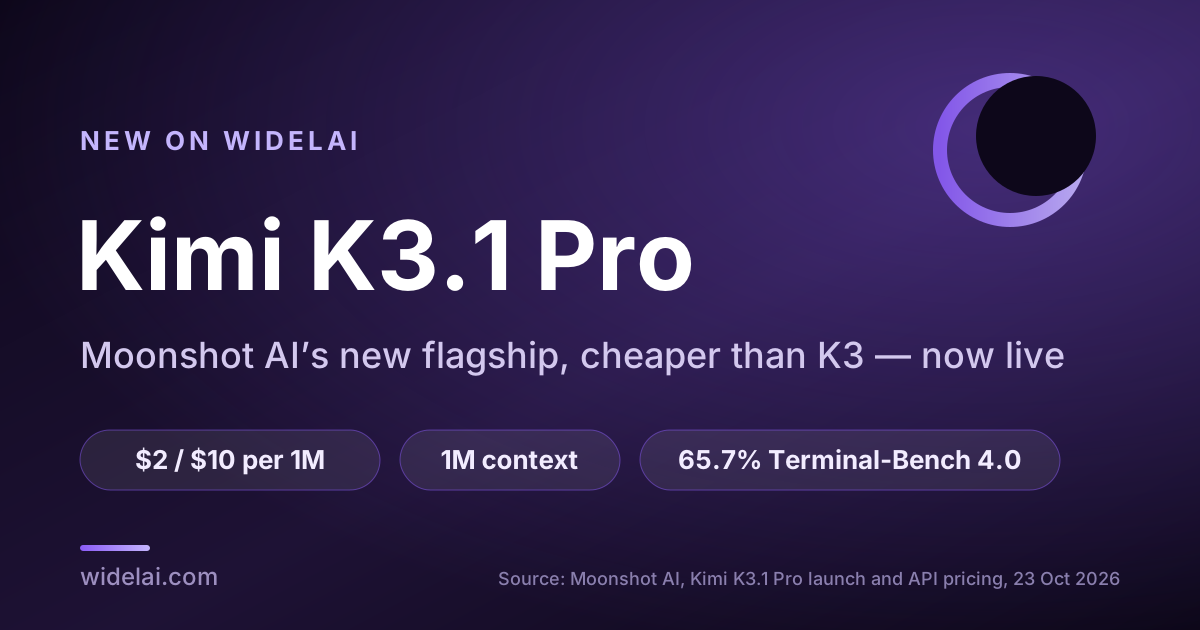
Kimi K3.1 Pro is live on WidelAI today, one day after Moonshot AI released it. You will find it in the model picker under the Moonshot group, with the tag kimi-k3.1-pro. You do not need a Moonshot account, an API key or a separate subscription.
Kimi K3.1 Pro is the first model in Moonshot's K3.1 series. It is a post-trained version of Kimi K3, built on the same base but with much more post-training compute, and it improves on K3 in nearly every area Moonshot measured. The biggest gains are in long-horizon agentic coding, finance and office work, and factual accuracy: claim-level hallucinations on Moonshot's hardest internal test fell from 23.4% to 8.3%.
It also costs less. Moonshot prices K3.1 Pro at $2 input and $10 output per million tokens, a third below Kimi K3's $3 and $15. On WidelAI that works out to 0.40 input and 2.00 output credits per 1K tokens. This post covers what changed, the benchmarks, what it costs, where it fits next to Kimi K3, GLM 5.3 and Claude Opus 5.5, and how to start using it.
Kimi K3.1 Pro is built by Moonshot AI. Read the official launch post, the API quickstart and the pricing page for full details.
What Is Kimi K3.1 Pro?
Moonshot calls K3.1 Pro the most capable 3T-class open-weight model released so far. It keeps everything that made Kimi K3 useful, including the 1M-token context window, native vision and always-on reasoning, and adds a large round of reinforcement learning aimed at long-running agent work.
| Specification | Kimi K3.1 Pro |
|---|---|
| Model tag | kimi-k3.1-pro |
| Released | October 23, 2026 |
| Base model | Kimi K3 (2.8T-parameter mixture-of-experts), post-trained |
| Context window | 1M tokens |
| Input | Text, images and video |
| Reasoning | Always on; effort levels low, high and max (default max) |
| Direct API price | $2 input / $10 output per million tokens |
| Cache hits | $0.20 per million tokens |
| WidelAI credits | 0.40 input / 2.00 output per 1K tokens |
| WidelAI plan | Pro |
| Open weights | Promised by November 4, 2026 |
Moonshot also launched Kimi K3.1 Pro Highspeed, a 2 to 3 times faster version at double the price ($4 / $20). WidelAI offers the standard K3.1 Pro, which gives the same answers at the lower rate.
What Changed From Kimi K3
Long-horizon coding
K3.1 Pro was trained to keep working on a task for hours without losing the thread. On Moonshot's internal Kimi Code Bench 3.0 long-horizon test it scores 61.2%, up from 55.95% for K3. The gap is much wider on Moonshot's internal xdev-bench-hard, a set of difficult software-exploitation problems: K3.1 Pro solves 81.0% (pass@3) against 33.3% for K3.
Moonshot's showcase example is a human walking simulator built on an anatomical model with 296 bones and 402 muscles. Over 167 missions and 420 reviews, the model took the simulation from a figure that collapsed within seconds to 11.2 seconds of continuous walking, and found and fixed 36 errors in the shoulder-muscle model along the way.
Fewer hallucinations
This is the change most people will notice. On Moonshot's Hallu Bench Hard, the share of factual claims that contain an error fell from 23.4% with K3 to 8.3% with K3.1 Pro, and the share of answers with at least one factual error dropped to 42.4% of K3's rate. Among the models Moonshot tested, only GPT-6 Astra scored lower. More on that below.
Finance and office work
K3.1 Pro posts the top score in Moonshot's table on OfficeQA Pro v2 (64.4) and 58.6 on Frontier Finance. On Moonshot's internal finance tests it beats K3 by 7.2 points on financial modeling, 11.6 points on financial research, and more than four times over on business operations (37 vs 8.9).
3D modeling
On BenchCAD, which asks a model to turn an image into a CAD model, K3.1 Pro scores 92.7 with tools and 72.8 without them. That without-tools score is 0.2 points behind Claude Opus 5.5. Moonshot has built this into a 3D Make feature in its own apps, which exports printable models.
Price
Every one of these gains comes with a lower bill. Input is $1 per million tokens cheaper than K3 and output is $5 cheaper, a 33% cut on both. Moonshot also prices the full 1M-token window at the same rate, with no long-context surcharge.
The Benchmarks
Moonshot published results against Claude Opus 5.5, Claude Fable 5.1, GPT-6 Astra, DeepSeek V4.1 Flash and GLM-5.3. The table below shows K3.1 Pro against the three Western flagships, all of which are also on WidelAI. These are vendor-reported figures from Moonshot's own runs, with every model at its maximum reasoning effort.
| Benchmark | Kimi K3.1 Pro | Claude Opus 5.5 | GPT-6 Astra | Claude Fable 5.1 |
|---|---|---|---|---|
| Terminal-Bench 4.0 (agentic coding) | 65.7 | 66.4 | 58.2 | 57.9 |
| SWE-Marathon (long coding projects) | 51.7 | 46.3 | 42.5 | 45.6 |
| Agents' Last Exam | 43.2 | 42.6 | 32.8 | Not reported |
| Humanity's Last Exam (with tools) | 70.0 | 67.7 | 57.2 | 65.6 |
| GDPval-AA v2.1 (knowledge work, Elo) | 1846 | 1866 | 1573 | 1754 |
| OfficeQA Pro v2 | 64.4 | 62.2 | 54.4 | 54.5 |
| Frontier Finance | 58.6 | 56.7 | 45.0 | 60.8 |
| GDP.pdf | 34.6 | 30.6 | 34.2 | 27.6 |
| OSWorld V2.1 (computer use) | 79.6 | 81.8 | 75.8 | 80.7 |
| ZeroBench main (with tools, pass@5) | 63.0 | 61.0 | 58.0 | 59.0 |
| ChartoGraphy (with tools) | 90.2 | 89.0 | 91.0 | 88.4 |
| Terminal-Bench Science 0.1 | 38.1 | 63.3 | 68.1 | 40.0 |
Figures from Moonshot's Kimi K3.1 Pro launch post, October 23, 2026. Moonshot notes that Claude models may include fallbacks and GPT models may include cyber safeguards.
Three things stand out:
- K3.1 Pro is level with the best Western models on agentic work. It is within a point of Opus 5.5 on Terminal-Bench 4.0 and has the top score in Moonshot's table on SWE-Marathon, Agents' Last Exam and Humanity's Last Exam with tools.
- It is not the pick for scientific computing. GPT-6 Astra and Opus 5.5 lead Terminal-Bench Science by 25 to 30 points.
- Independent testing puts it fourth overall. Artificial Analysis scores K3.1 Pro at 55 on its Intelligence Index v4.3.2, fourth of 215 models. That puts it ahead of Claude Fable 5.1 and GPT-6 Astra (both 53) and behind only Claude Opus 5.5 and Meta's Muse Wonder Full.
For a detailed look at how it compares with each rival, including DeepSeek V4.1 and GLM-5.3, read Kimi K3.1 Pro vs Opus 5.5, GPT-6 Astra, Fable 5.1, DeepSeek & GLM.
Hallucinations: The Quiet Headline
Moonshot's Hallu Bench measures the percentage of factual claims in an answer that are wrong. Lower is better.
| Model | Without tools | Hard set, with tools |
|---|---|---|
| GPT-6 Astra | 4.2% | 5.5% |
| Kimi K3.1 Pro | 5.4% | 8.3% |
| Claude Opus 5.5 | 6.8% | 15.0% |
| Claude Fable 5.1 | 11.4% | 23.3% |
The with-tools column matters most for real work. When a model can search and read sources, you would expect fewer mistakes, but several models in Moonshot's test make more of them because they mix up what they found with what they assumed. K3.1 Pro stays at 8.3%, about half of Opus 5.5's rate. This is Moonshot's own benchmark, so it is worth checking on your own fact-heavy prompts, but the drop from K3 is large enough to matter.
What It Costs on WidelAI
WidelAI prices every model in credits, where 1 credit equals $0.005 of real API cost. Kimi K3.1 Pro's rates follow directly from Moonshot's price list:
| Direct API (per 1M tokens) | WidelAI credits (per 1K tokens) | |
|---|---|---|
| Input | $2.00 | 0.40 |
| Output | $10.00 | 2.00 |
A typical chat turn with 20,000 tokens of context and a 2,000-token answer costs about 20 × 0.40 + 2 × 2.00 = 12 credits. The same turn costs 18 credits on Kimi K3, 24 on Claude Opus 5.5 and 60 on GPT-6 Astra or Claude Fable 5.1. On the Pro plan's 7,000 monthly credits, that is more than 550 turns of that size.
One thing to plan for: K3.1 Pro always thinks before it answers, and its reasoning is billed as output. It is a thorough model. Artificial Analysis counted about 150 million output tokens to run its index, against a median of 87 million for comparable models. Even so, its cost per index task is $2.11, about a third of Opus 5.5's $5.98. Every rate on the platform is listed on the pricing transparency page.
Where Kimi K3.1 Pro Fits
With K3.1 Pro in place, this is how it lines up against the models people usually weigh it against on WidelAI:
| Model | Direct price (per 1M) | WidelAI credits (per 1K) | Best used for |
|---|---|---|---|
| Claude Opus 5.5 | $4 / $20 | 0.80 / 4.00 | Top overall score, scientific and spec-to-program work |
| Kimi K3.1 Pro | $2 / $10 | 0.40 / 2.00 | Long agentic coding, finance and office work, fact-sensitive answers |
| Kimi K3 | $3 / $15 | 0.60 / 3.00 | Superseded by K3.1 Pro for most work |
| GLM 5.3 | $1.40 / $4.40 | 0.28 / 0.88 | High-volume coding where cost per call matters most |
A sensible default for agentic and research-heavy work is to start on K3.1 Pro and escalate the same thread to Opus 5.5 only when the task needs it. Because every model shares one credit balance, switching is a click in the model picker. You can see the full catalog on the models page.
Safety, Privacy and Open Weights
- Open weights by November 4. Moonshot has committed to publishing the full weights by November 4, 2026, so teams that need to self-host will be able to run the same model.
- Cyber capability was deliberately reduced. For the open-weight release, Moonshot removed cyber-related data from both mid-training and reinforcement learning. Its internal tests show an unrestricted version solving 90.5% of xdev-bench-hard problems, against 81.0% for the released K3.1 Pro.
- Zero data retention is available for Moonshot API customers.
How to Start Using Kimi K3.1 Pro on WidelAI
- Sign in to WidelAI, or create an account if you are new.
- Open the chat and click the model selector at the top of the conversation.
- Choose Kimi K3.1 Pro from the Moonshot group.
- Send your prompt. K3.1 Pro always reasons before answering, and WidelAI runs it at Moonshot's default maximum effort.
A practical note: Moonshot fixes K3.1 Pro's sampling settings (temperature 1.0, top-p 0.95, no penalties) and rejects any request that changes them. If you have customized temperature or penalties in a conversation's settings, WidelAI leaves those values out for Kimi models instead of failing the request, so your existing chats keep working when you switch to K3.1 Pro.
Kimi K3.1 Pro is on the Pro plan, alongside Kimi K3, GLM 5.3, Claude Opus 5.5, Claude Fable 5.1, GPT-6 Astra and the rest of the frontier catalog.
Who Should Switch Today
- Kimi K3 users: switch. K3.1 Pro beats K3 in every comparison Moonshot published, makes far fewer factual errors and costs a third less.
- Opus 5.5 users running long agent tasks: try K3.1 Pro on the same work. It is within a point of Opus on Terminal-Bench 4.0, beats it on SWE-Marathon, and costs half as much per token.
- Teams doing finance, research or document-heavy work: its OfficeQA Pro and hallucination results make it worth testing against your current model on tasks where a wrong number is costly.
- Scientific computing users: stay on GPT-6 Astra or Opus 5.5 for now.
The quickest way to decide is to run a task you already know well through K3.1 Pro and compare the answer with your current model in the same thread.
Related Reading

Do your best AI work in one place
Bring your next question, draft, file, or idea to WidelAI. Choose the model that fits the moment, keep your work together, and stay in control of privacy and usage.
Leading models, one workspace
Use powerful AI models without juggling separate tabs, accounts, or workflows.
Switch without starting over
Change models as your work evolves while keeping the conversation and context together.
The right model for every task
Choose speed for everyday work or deeper reasoning for complex questions and decisions.
Clear credits and model rates
See your balance, understand each model’s rate, and track usage from one place.
Bring your files and images
Work with documents and images alongside your prompts in the same focused experience.
Your work stays yours
Your data is encrypted in transit and at rest, and your content is never used to train AI models.