Claude Fable 5.1 vs Fable 5 vs Opus 5: Which Anthropic Model Should You Use?
Fable 5.1 leads every benchmark Anthropic published, but Opus 5 costs half as much and lands within a few points on everyday work. A clear breakdown of when each Anthropic flagship is the right call.
WidelAI Research
Building the future of AI accessibility
Anthropic now has three frontier-tier models in general availability, and choosing between them is no longer obvious. Claude Fable 5.1 shipped on September 1, 2026 as the new ceiling. Claude Fable 5 remains available at exactly the same per-token price. Claude Opus 5 sits at half the price of either and, until yesterday, was the value pick in the lineup.
All three are on WidelAI, along with OpenAI's GPT-5.6 Sol, the natural cross-provider comparison at this tier. This post works through how they actually differ — on published benchmarks, on real cost, and on the kind of work each one suits — so you can pick deliberately instead of defaulting to the newest name.
Benchmark figures in this post are from Anthropic's Fable 5.1 and Mythos 5.1 announcement, published September 1, 2026.
The Short Answer
- Claude Fable 5.1 — the strongest model available for long agentic runs, root-cause debugging and agentic research. Its lead on scientific and automation benchmarks is not marginal.
- Claude Opus 5 — the value choice. Half the per-token price of the Fable line, and on several benchmarks it lands closer to Fable 5.1 than Fable 5 does.
- Claude Fable 5 — hard to justify now. It costs the same per token as Fable 5.1 while scoring lower on every published benchmark and paying 4x more for cache reads.
- GPT-5.6 Sol — half the input price of Fable 5.1 and a strong generalist, but it trails all three Claude models on the agentic benchmarks Anthropic published.
If you want one rule: default to Opus 5, escalate to Fable 5.1. Fable 5 is superseded.
Price: What Each One Actually Costs
Start here, because the price gaps are larger than the capability gaps.
| Model | Provider | Real API price (input / output per 1M) | Cache reads per 1M |
|---|---|---|---|
| Claude Fable 5.1 | Anthropic | $10.00 / $50.00 | $0.25 |
| Claude Fable 5 | Anthropic | $10.00 / $50.00 | $1.00 |
| Claude Opus 5 | Anthropic | $5.00 / $25.00 | — |
| GPT-5.6 Sol | OpenAI | $5.00 / $30.00 | — |
Two observations that matter more than the headline rates.
First, Fable 5.1 and Fable 5 cost the same per token. Anthropic left the $10/$50 rate untouched. The entire price improvement is in cache reads, which dropped 75% to $0.25 per million tokens. Anthropic measured that as roughly a 25% reduction in total cost on typical workloads, rising to about 45% on context-heavy, tool-heavy agentic work where re-read context dominates the bill. So Fable 5.1 is not merely better than Fable 5 — it is cheaper to run, sometimes substantially.
Second, Opus 5 is half the price of the Fable line. That 2x gap is the central question in this comparison. A model has to be meaningfully better to justify double the rate on every token.
In WidelAI credits, where 1 credit equals $0.005 of real API cost:
| Model | Input (credits / 1K) | Output (credits / 1K) |
|---|---|---|
| Claude Fable 5.1 | 2.00 | 10.00 |
| Claude Fable 5 | 2.00 | 10.00 |
| Claude Opus 5 | 1.00 | 5.00 |
| GPT-5.6 Sol | 1.00 | 6.00 |
Every rate on the platform is published on our pricing transparency page.
Benchmarks: Where the Gaps Are Real
Anthropic published a comparison across eight benchmarks covering agentic research, coding, knowledge work, computer use and reasoning. The pattern is not uniform, which is the useful part.
| Benchmark | Fable 5.1 | Fable 5 | Opus 5 | GPT-5.6 Sol |
|---|---|---|---|---|
| Terminal-Bench-Science 0.1 | 52.6% | 24.7% | 29.0% | 22.4% |
| Terminal-Bench 4.0 (agentic coding) | 55.8% | 42.0% | 52.3% | 37.3% |
| GDPval-AA v2 (knowledge work) | 1853 | 1723 | 1824 | 1711 |
| OSWorld 2.0 (computer use, strict) | 41.7% | 36.1% | 39.6% | — |
| Humanity's Last Exam (no tools) | 60.9% | 57.8% | 56.6% | — |
| Humanity's Last Exam (with tools) | 65.0% | 63.8% | 63.6% | — |
| AutomationBench (business workflows) | 31.4% | 17.1% | 26.9% | 19.6% |
| CursorBench 3.2.0 (agentic coding) | 73.4% | 70.5% | 70.0% | 67.2% |
Fable 5.1 leads every row. But by how much varies enormously, and that variance is what should drive your model choice.
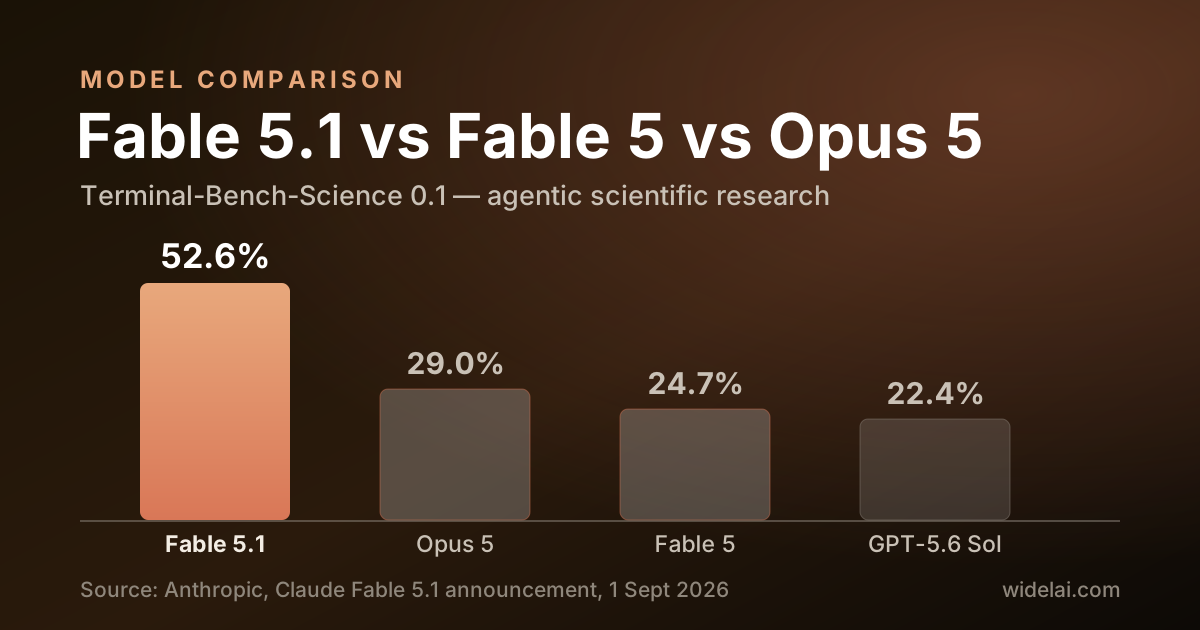
The cover chart shows Terminal-Bench-Science 0.1, the benchmark with the widest spread in the release. Figures from Anthropic's Fable 5.1 and Mythos 5.1 announcement.
The one enormous gap: agentic scientific research
On Terminal-Bench-Science 0.1, Fable 5.1 scores 52.6% against Opus 5's 29.0% and Fable 5's 24.7%. That is not an incremental gain — it is roughly double the next-best model, and it is the single largest jump in the release. Anthropic notes the standard error on this benchmark is around 3.5 to 4.5 points per model, which is nowhere near large enough to explain a 23-point lead.
Anthropic backs the number with concrete work rather than just a score. The model trained a neural network that produced a new elevation map for about a third of Venus from 30-year-old NASA Magellan radar data, resolving features down to two or three kilometres where the previous map managed 10 to 20, with heights up to 25% more accurate. Separately, on the restricted Mythos 5.1 configuration, the model wrote custom GPU kernels that sped up seven open-source genomics and protein models by up to 2.5x with identical outputs, cutting estimated GPU costs on those analyses by 30 to 60%.
If your work looks like autonomous multi-step research — long tool-using investigations where the model has to form and test hypotheses — this benchmark is the one to weight, and the gap is decisive.
The other large gap: business workflow automation
AutomationBench shows Fable 5.1 at 31.4% against Fable 5's 17.1%, nearly double. Opus 5 sits at 26.9%, much closer. Anthropic notes its safeguards intervened on some tasks and scored zero for both Fable models, which likely understates them both — so read this row as directional rather than precise.
Where the gaps are narrow: coding and knowledge work
This is where the value calculation turns against Fable 5.1 for most users.
- CursorBench 3.2.0: 73.4% vs Opus 5's 70.0%. A 3.4-point gap for 2x the price.
- Terminal-Bench 4.0: 55.8% vs Opus 5's 52.3%. A 3.5-point gap for 2x the price.
- GDPval-AA v2: 1853 vs Opus 5's 1824. Under 2% apart.
- Humanity's Last Exam with tools: 65.0% vs Opus 5's 63.6%. Within 1.5 points.
On everyday agentic coding and general knowledge work, Opus 5 delivers most of Fable 5.1's quality at half the token cost. For a team running high call volumes, that is not a close decision.
One caveat on all of these figures: Fable 5.1 was evaluated with its production safeguards active, and Anthropic states that safeguard interventions scored zero on some OSWorld and AutomationBench tasks. The published numbers are therefore a floor for the Fable models, not a ceiling.
Fable 5.1 vs Fable 5: Not Really a Choice
Fable 5 is the clearest case in this comparison, because there is no tradeoff to weigh:
- Identical per-token pricing — $10 input, $50 output per million
- Fable 5.1 wins every published benchmark, by 3 points at the narrowest and 28 at the widest
- Fable 5.1's cache reads cost a quarter as much, cutting real workload costs by 25 to 45%
- Fable 5.1's safeguards produce fewer false positives on benign requests
If you are on Fable 5 today, move to Fable 5.1. There is no dimension on which staying is the better call. We covered Fable 5's original arrival in Claude Fable 5 Is Now Available on WidelAI, and its turbulent first month in The Future of Fable 5 and the Rise of GLM-5.2 Open Weights.
Fable 5.1 vs Opus 5: The Real Decision
This is the comparison worth thinking about. Opus 5 costs half as much per token and, on the benchmarks most people's work resembles, lands within a few points.
Choose Opus 5 when:
- You are doing everyday coding, refactoring, analysis or writing
- Call volume is high enough that a 2x rate difference compounds into real money
- Your tasks are bounded — a well-specified change, a document to analyse, a bug with a clear reproduction
- You want frontier-adjacent quality as a sustainable default rather than an occasional escalation
Choose Fable 5.1 when:
- The task is autonomous, multi-step research — the Terminal-Bench-Science profile, where the gap is roughly 2x
- You are running long agentic sessions with heavy tool use, where cheaper cache reads offset much of the premium
- A cheaper model has already failed, and you want the highest available ceiling on one focused attempt
- You are chasing a root cause that has resisted ordinary effort — Anthropic's example is the investment firm Millennium, where Fable 5.1 explained an intermittent crash that had defeated the team's engineers for years
- Correctness matters more than cost per call, as in a payment path or a migration
We compared Opus 5 against its predecessor in Claude Opus 5 vs Claude Fable 5. Fable 5.1 does not change that post's conclusion for bounded work — it raises the ceiling for the unbounded kind.
How GPT-5.6 Sol Fits
GPT-5.6 Sol is the obvious cross-provider alternative: $5 input and $30 output per million, so roughly half Fable 5.1's input price.
On the benchmarks Anthropic published, Sol trails all three Claude models — 22.4% on Terminal-Bench-Science, 37.3% on Terminal-Bench 4.0, 1711 on GDPval-AA v2, 67.2% on CursorBench. Treat that with appropriate scepticism: these are a competitor's numbers, run in a harness tuned for their own models, and Sol has genuine strengths in areas this table does not cover.
The honest read is that Sol is a strong generalist at a mid-frontier price, while the Claude line currently has the edge on long-horizon agentic work specifically. We went deeper on that matchup in Claude Opus 5 vs GPT-5.6 Sol. Because all four models sit behind one credit balance on WidelAI, you can settle it on your own workload rather than trusting either vendor's chart.
What About Claude Mythos 5.1?
Worth clearing up, because the two names shipped together and the distinction is easy to miss.
Mythos 5.1 is the same model as Fable 5.1. Same weights, same price, same specification. The only difference is how permissive the safeguard layer in front of it is. Mythos 5.1 is available exclusively through Anthropic's trusted access programs — the Cyber Verification Program for defensive security work and the Life Sciences Verification Program for professional research — currently limited to a set of vetted US organisations.
For everyone else, Fable 5.1 is the model. Notably, Anthropic loosened Fable 5.1's own safeguards meaningfully: it can now be used to discover software vulnerabilities, though not to develop exploits for them, and Claude Code users should see around 60% fewer cyber safeguard interventions than on Fable 5. Penetration testing, exploit generation and binary vulnerability scanning are still redirected to Anthropic's Opus models, as are life sciences R&D queries.
No reseller can offer Mythos 5.1, WidelAI included. If your work needs it, you apply to Anthropic directly.
Summary Table
| Fable 5.1 | Fable 5 | Opus 5 | GPT-5.6 Sol | |
|---|---|---|---|---|
| Credits per 1K input | 2.00 | 2.00 | 1.00 | 1.00 |
| Credits per 1K output | 10.00 | 10.00 | 5.00 | 6.00 |
| Cache read price per 1M | $0.25 | $1.00 | — | — |
| Agentic research | Best in class | Weak | Modest | Weak |
| Agentic coding | Best | Behind Opus 5 | Near-frontier | Behind |
| Knowledge work | Best | Behind Opus 5 | Within 2% | Behind |
| Best used as | Escalation target | Superseded | Everyday default | Generalist alternative |
| WidelAI plan | Pro | Pro | Pro | Pro |
The Pattern Worth Noticing
Fable 5 now scores below Opus 5 on agentic coding, knowledge work and computer use, while costing twice as much per token. That is what a fast-moving frontier looks like: a model can go from flagship to superseded in under three months, and not by its own successor.
This is the strongest practical argument for a multi-model platform. Every model on WidelAI shares one plan and one credit balance, so acting on a shift like this is a click in the model picker — not a procurement cycle, a new API key and a second invoice. When Anthropic cut effective Fable costs by a quarter overnight, WidelAI users needed to change one dropdown.
Choose and Move On
If you want a default, use Opus 5. If you want the ceiling, escalate to Fable 5.1. If you are still on Fable 5, switch today. And if you are not sure, run the same prompt through all three — that is a one-minute experiment on WidelAI, and your own workload is better evidence than anyone's benchmark table.
Ready to compare them yourself? Open the chat and switch models mid-conversation to see the difference on your own work.
Related Reading

Do your best AI work in one place
Bring your next question, draft, file, or idea to WidelAI. Choose the model that fits the moment, keep your work together, and stay in control of privacy and usage.
Leading models, one workspace
Use powerful AI models without juggling separate tabs, accounts, or workflows.
Switch without starting over
Change models as your work evolves while keeping the conversation and context together.
The right model for every task
Choose speed for everyday work or deeper reasoning for complex questions and decisions.
Clear credits and model rates
See your balance, understand each model’s rate, and track usage from one place.
Bring your files and images
Work with documents and images alongside your prompts in the same focused experience.
Your work stays yours
Your data is encrypted in transit and at rest, and your content is never used to train AI models.