Claude Fable 5.1 Is Now Available on WidelAI
Claude Fable 5.1, Anthropic's most advanced model, is now live on WidelAI. It doubles Fable 5's agentic research score at the same token price, with cache reads 75% cheaper. Here's what it does and how to use it.
WidelAI Team
Building the future of AI accessibility
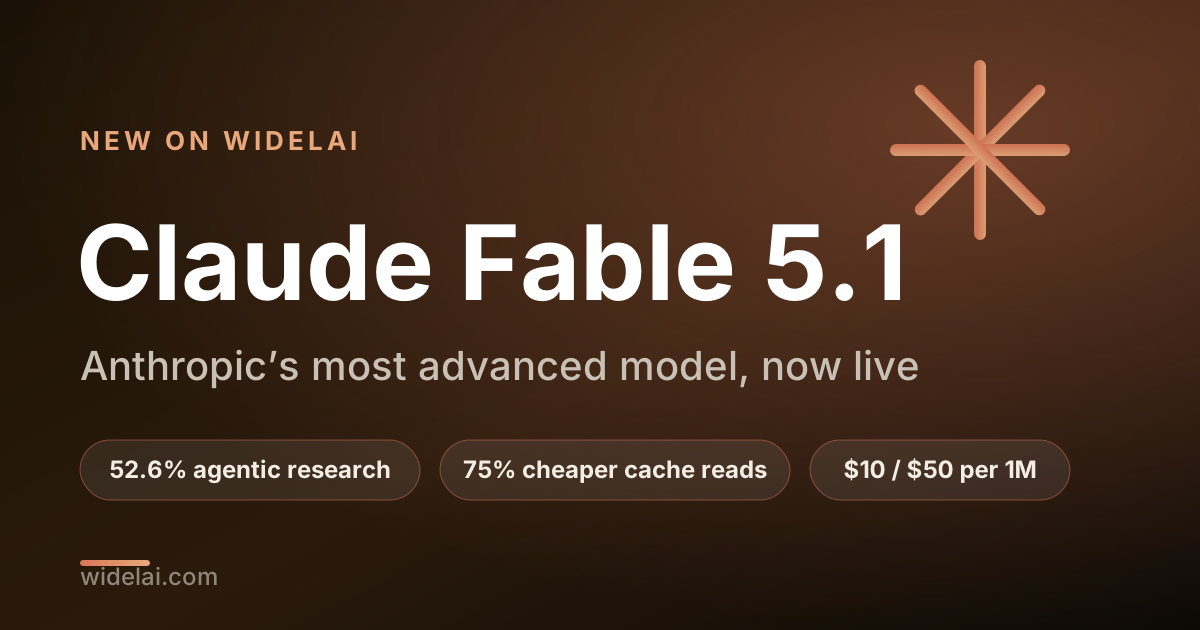
Claude Fable 5.1 is live on WidelAI, one day after Anthropic shipped it. It is in your model picker right now under the tag claude-fable-5-1 — no waitlist, no separate Anthropic subscription, and no API keys to manage.
Anthropic released Fable 5.1 on September 1, 2026, three months after the Fable 5 line first arrived. The framing is unusual for a frontier launch: the model got materially better while the cost of actually running it went down. Per-token pricing is untouched at $10 per million input tokens and $50 per million output tokens, but cache reads now cost 75% less, which pulls typical workload costs down by roughly a quarter and heavily agentic workloads by up to about 45%.
This post covers what changed in Fable 5.1, how it benchmarks against the models you already use, exactly what it costs in WidelAI credits, and when it is the right model to reach for.
Claude Fable 5.1 is built by Anthropic. See the official announcement at anthropic.com.
What Is Claude Fable 5.1?
Fable 5.1 is Anthropic's most advanced generally available model, positioned for coding, knowledge work and long-running problem-solving. It is the successor to Claude Fable 5, which shipped in June 2026 and had an eventful first month before settling into general availability.
The release has three threads worth separating:
- Capability. Large gains on agentic and long-horizon work, with the biggest jump on autonomous scientific research.
- Cost. Cache reads cut by 75%, which is where the real-world savings come from.
- Safeguards. Fewer false positives on benign requests, and vulnerability discovery now permitted.
Anthropic also shipped Claude Mythos 5.1 the same day. It is the same underlying model at the same price behind a more permissive safeguard layer, restricted to vetted organisations through Anthropic's trusted access programs. More on that distinction below.
What Changed From Fable 5
Anthropic published a benchmark comparison against Fable 5, Claude Opus 5 and OpenAI's GPT-5.6 Sol. Fable 5.1 leads every row, but the size of the lead varies a great deal.
| Benchmark | Fable 5.1 | Fable 5 | Opus 5 | GPT-5.6 Sol |
|---|---|---|---|---|
| Terminal-Bench-Science 0.1 | 52.6% | 24.7% | 29.0% | 22.4% |
| Terminal-Bench 4.0 (agentic coding) | 55.8% | 42.0% | 52.3% | 37.3% |
| GDPval-AA v2 (knowledge work) | 1853 | 1723 | 1824 | 1711 |
| OSWorld 2.0 (computer use, strict) | 41.7% | 36.1% | 39.6% | — |
| Humanity's Last Exam (with tools) | 65.0% | 63.8% | 63.6% | — |
| AutomationBench (business workflows) | 31.4% | 17.1% | 26.9% | 19.6% |
| CursorBench 3.2.0 (agentic coding) | 73.4% | 70.5% | 70.0% | 67.2% |
The standout is Terminal-Bench-Science 0.1, where Fable 5.1 more than doubles Fable 5's score and clears Opus 5 by 23 points. Anthropic notes the benchmark's standard error is around 3.5 to 4.5 points per model, so a gap that size is real rather than noise. AutomationBench shows a similar pattern, nearly doubling Fable 5's result.
On everyday agentic coding and general knowledge work the gaps are much narrower — a few points over Opus 5 on CursorBench and Terminal-Bench 4.0, and under 2% on GDPval-AA v2. That distinction matters for choosing a model, and we work through it properly in Claude Fable 5.1 vs Fable 5 vs Opus 5.
Anthropic evaluated Fable 5.1 with production safeguards enabled, and states that safeguard interventions scored zero on some OSWorld and AutomationBench tasks. The published figures are a floor for the Fable models rather than a ceiling.
Anthropic also points to results outside benchmark suites. Fable 5.1 trained a neural network that produced a new elevation map covering about a third of Venus from 30-year-old NASA Magellan radar data, resolving detail down to two or three kilometres where the existing map managed 10 to 20. At the investment firm Millennium, the model identified the cause of a rare crash in internal systems that the firm's engineers had been unable to explain over several years. Early-access partner Jane Street reported that it stays readable across long multi-step tasks, where earlier models became harder to follow the longer they ran.
The Pricing Change That Actually Matters
Fable 5.1's headline rates are identical to Fable 5's: $10 per million input tokens, $50 per million output tokens. What changed is the price of reading context the model has already processed.
Cache reads dropped 75%, from $1.00 to $0.25 per million tokens. Anthropic measured the effect across four weeks of real August 2026 usage: roughly a 25% reduction in total cost for typical workloads, and up to about 45% for context-heavy, tool-heavy agentic work where re-read context dominates the bill.
That has a practical consequence for how you use the model. Long conversations over a stable body of context — a codebase, a spec, a document set — are now considerably better value than they were on Fable 5. If you had written off long agentic runs on the Fable line purely on cost, this is the change that makes them worth retesting.
Claude Fable 5.1 Pricing on WidelAI
WidelAI prices in credits, where 1 credit equals $0.005 of real API cost. Input and output are billed separately, because generating tokens costs far more than reading them. A model's credit rate is its real per-million price multiplied by 0.2, expressed per 1,000 tokens.
| Model | Input (credits / 1K tokens) | Output (credits / 1K tokens) |
|---|---|---|
| Claude Fable 5.1 | 2.00 | 10.00 |
| Claude Fable 5 | 2.00 | 10.00 |
| Claude Opus 5 | 1.00 | 5.00 |
| Claude Sonnet 5 | 0.40 | 2.00 |
To make it concrete: a 10,000-token input with a 2,000-token response costs about 10 × 2.00 + 2 × 10.00 = 40 credits. Fable 5.1 is the highest-rated model on the platform, which is the correct signal — it is an escalation target, not a default. Every model's rate is published on our pricing transparency page.
Safeguards: More Precise, Not Just Looser
Anthropic spent much of this release on reducing false positives rather than raising limits, which is the more useful direction for ordinary technical work.
- Vulnerability discovery is now permitted. Fable 5.1 can be used to find software vulnerabilities — the defensive work that makes your own systems safer — though not to develop exploits for them. Anthropic reports around 60% fewer cyber safeguard interventions per session than on Fable 5.
- Biology false positives are down sharply. The latest biology safeguards fire about 85% less often on benign requests such as elementary biology or general medical questions, relative to those that launched with Fable 5.
- Some dual-use work is still redirected. Penetration testing, exploit generation and binary-based vulnerability scanning route to Anthropic's Opus models, as do life sciences research and development queries.
Anthropic also previewed Enterprise Frontier Safeguards, a system that keeps customer data in the customer's own cloud infrastructure to give the privacy equivalent of a zero data retention agreement while still detecting misuse. It rolls out in phases from autumn 2026.
What About Claude Mythos 5.1?
Easy to conflate, so worth stating plainly: Mythos 5.1 is the same model as Fable 5.1 — identical weights, price and specification. The only difference is how permissive the safeguard layer in front of it is.
Mythos 5.1 is available only through Anthropic's trusted access programs: the Cyber Verification Program for defensive security work, and the Life Sciences Verification Program for professional research, developed with the US government. Access is currently limited to a set of vetted US organisations.
No reseller can offer Mythos 5.1, WidelAI included. For everyone outside those programs, Fable 5.1 is the model — and its own safeguards are now meaningfully more permissive than they were at Fable 5's launch.
When to Use Claude Fable 5.1
Reach for Fable 5.1 when
- You are running autonomous, multi-step research — the profile where its benchmark lead is roughly 2x rather than a few points
- You are chasing a root cause that has resisted ordinary effort, the Millennium-style problem where a cheaper model has already failed
- You are running long agentic sessions with heavy tool use, where the cheaper cache reads offset a good part of the premium
- Correctness matters more than cost per call — a payment path, a migration, a security-sensitive change
- You need the highest available ceiling on one focused attempt
Consider a different model when
- The work is everyday coding, analysis or writing — Claude Opus 5 delivers most of the quality at half the token rate
- Call volume is high enough that a 2x rate difference compounds into real money
- The task is well-bounded and well-specified, where frontier reasoning has little to add
- You are prototyping at volume, where GLM 5.3 Flash or Gemini 3.5 Flash Lite cost a fraction as much
Tip: Because every model on WidelAI shares one credit balance, the efficient pattern is to work on a mid-tier model and escalate the same thread to Fable 5.1 when you stall. It inherits the full context, including the approaches that already failed.
How to Use Claude Fable 5.1 on WidelAI
Getting started takes about a minute:
- Sign in to your WidelAI account, or create one if you are new.
- Open the chat and click the model selector.
- Choose Claude Fable 5.1 from the Anthropic group — or use the model tag (
claude-fable-5-1) if you are calling it programmatically. - Send your prompt.
Fable 5.1 is available on the Pro plan, alongside Claude Opus 5, GPT-5.6 Sol and the rest of the frontier tier. Browse the full catalog on our models page, or see it listed with every other supported model in the models library. It is in the model picker on the Android and Mac apps too, sharing the same conversations and the same credit balance.
For a deeper walkthrough of prompting, cost control and tier routing, see How to Use Claude Fable 5.1 on WidelAI.
Why Access It Through WidelAI
You could go to Anthropic directly — but then you are managing another subscription and another billing relationship for a single provider's models. WidelAI gives you Fable 5.1 alongside the best of OpenAI, Google, Moonshot and Zhipu, under one plan and one credit balance.
That is worth more than convenience on a week like this one. Fable 5 was Anthropic's flagship three months ago; today it scores below Opus 5 on agentic coding and knowledge work while costing twice as much per token. Acting on a shift like that should be a dropdown, not a procurement cycle. Model choice is leverage, and leverage only pays if you can exercise it quickly.
Get Started Today
Claude Fable 5.1 is live on WidelAI now. If you want the strongest available model for long agentic runs, hard debugging or autonomous research, it is one click away in your model picker.
Already a member? Open the chat, pick Claude Fable 5.1, and try it on something a cheaper model could not finish.
Related Reading

Do your best AI work in one place
Bring your next question, draft, file, or idea to WidelAI. Choose the model that fits the moment, keep your work together, and stay in control of privacy and usage.
Leading models, one workspace
Use powerful AI models without juggling separate tabs, accounts, or workflows.
Switch without starting over
Change models as your work evolves while keeping the conversation and context together.
The right model for every task
Choose speed for everyday work or deeper reasoning for complex questions and decisions.
Clear credits and model rates
See your balance, understand each model’s rate, and track usage from one place.
Bring your files and images
Work with documents and images alongside your prompts in the same focused experience.
Your work stays yours
Your data is encrypted in transit and at rest, and your content is never used to train AI models.