Claude Opus 5 Is Now Available on WidelAI
Claude Opus 5, Anthropic's new flagship, is now live on WidelAI. It comes close to Fable 5's capabilities at half the price. Here's what it does, how it's priced in credits, and how to start using it in under a minute.
WidelAI Team
Building the future of AI accessibility
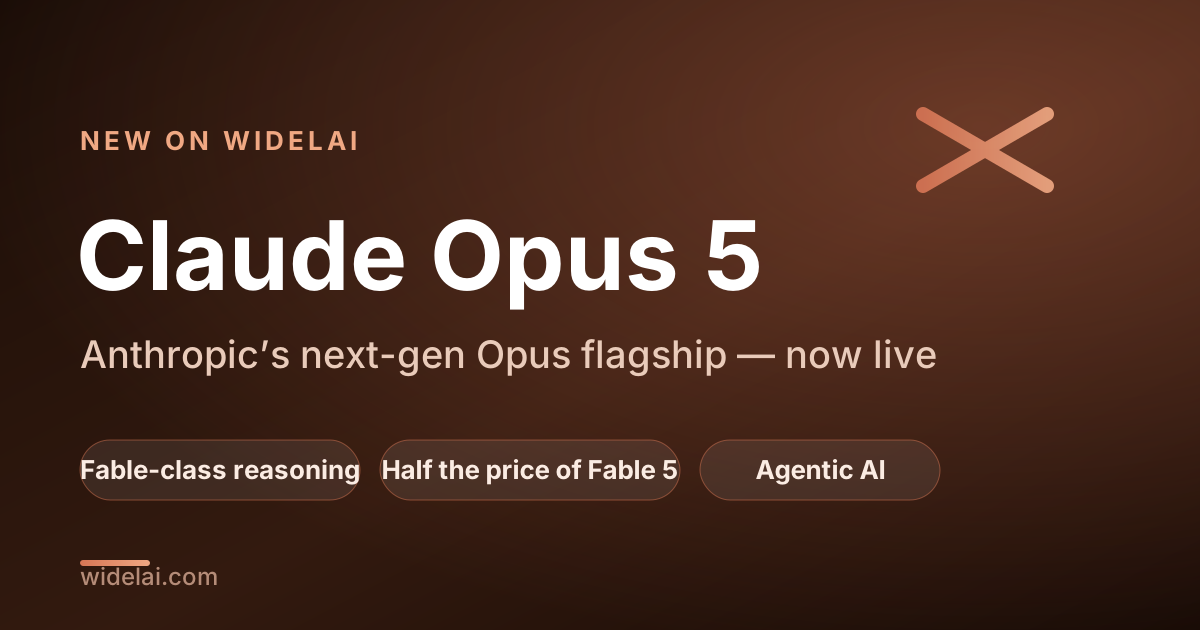
Anthropic's newest flagship is live on WidelAI today. Claude Opus 5 is in your model picker right now under the tag claude-opus-5 — no waitlist, no separate Anthropic subscription, and no API keys to manage. Announced by Anthropic on July 24, 2026, Opus 5 is positioned as the company's best-performing and most cost-effective Opus model yet, coming close to the capabilities of the Mythos-class Claude Fable 5 in many domains while costing half as much. This post covers what Opus 5 is, how it is priced in WidelAI credits, when to reach for it, and how to start using it in the next minute.
Anthropic Claude logo
Claude Opus 5 is built by Anthropic. Read the coverage from The Verge and CNBC, and the official Claude model documentation.
What Is Claude Opus 5?
Claude Opus 5 is the newest model in Anthropic's Opus line — the tier that sits above the balanced Sonnet family and below the frontier Mythos-class models. Anthropic describes Opus 5 as its best-performing and most cost-effective model across a number of industry benchmarks, and says it "comes close to the capabilities of Claude Fable 5 in many domains" while being meaningfully better at complex coding than the previous Opus generation.
The way Anthropic frames it: Opus 5 is the ideal everyday model for demanding work — especially knowledge work, coding, and scientific domains like biology — while Fable 5 remains the tool for the most ambitious, long-horizon autonomous agent projects. In other words, Opus 5 pulls frontier-adjacent quality down into a price and a footprint you can run every day.
The headline points from launch:
- Near-Fable 5 quality in many domains, with a clear step up in complex coding over Claude Opus 4.8
- Retains the Opus line's million-token context window, so large codebases and document sets fit in a single run
- The most aligned Opus model to date — Anthropic says it is the least susceptible to being tricked into misuse, with stronger cybersecurity safeguards than Opus 4.8
- New "Fast mode" (launching in research preview) that trades cost for speed — roughly double the price for higher throughput
- Optional automatic fallback to a lower-tier model when safety guardrails require Opus 5 to decline a request
Where Opus 5 Sits in the Lineup
The simplest mental model: Opus 5 slots between Anthropic's everyday Sonnet tier and its frontier Fable 5, closing much of the gap with Fable 5 at half the price.
| Model | Tier | Best for | Real API price (input / output per 1M) |
|---|---|---|---|
| Claude Fable 5 | Mythos-class frontier | Most ambitious, long-horizon agent work | $10.00 / $50.00 |
| Claude Opus 5 | Flagship Opus | Everyday knowledge work, coding, science | $5.00 / $25.00 |
| Claude Sonnet 5 | Balanced | High-volume coding, writing, analysis | $2.00 / $10.00 |
For reference, Anthropic priced Opus 5 identically to its predecessor Opus 4.8 ($5 input / $25 output per million tokens) and pointed out that this is half the per-token price of Fable 5. It is also slightly cheaper than OpenAI's GPT-5.6 on output. For context on the neighbors: Opus 4.8 posted 88.6% on SWE-bench Verified and Fable 5 reached 95.0% — Opus 5 is positioned to land between them while carrying Opus 4.8's pricing.
Claude Opus 5 Pricing on WidelAI
WidelAI uses a transparent credit system: 1 credit equals $0.005 of real API cost, and input and output tokens are priced separately because generating output costs far more than reading input. Your credit rate for any model is its real per-million price multiplied by 0.2, then expressed per 1,000 tokens:
| Model | Input (credits / 1K tokens) | Output (credits / 1K tokens) |
|---|---|---|
| Claude Opus 5 | 1.00 | 5.00 |
| Claude Fable 5 | 2.00 | 10.00 |
| Claude Sonnet 5 | 0.40 | 2.00 |
That puts Opus 5 at exactly half the credit rate of Fable 5 — the same rate the Opus line has held since Opus 4.5. You get near-frontier capability without frontier-tier credit burn. See every model side by side on our pricing transparency page.
Note: Opus 5's "Fast mode" trades cost for speed at roughly double the standard price. When it becomes available on WidelAI, standard mode remains the default so your everyday usage stays at the 1.00 / 5.00 rate unless you opt into speed.
When to Use Claude Opus 5
Opus 5 is built to be the model you reach for by default when a task needs real depth but does not demand the absolute frontier.
Reach for Claude Opus 5 when
- You want frontier-adjacent quality for daily coding, refactoring, and debugging without paying Fable 5 rates
- The work is knowledge-heavy: analysis, research synthesis, technical writing, or scientific domains like biology
- You need a large context window for codebase-scale or document-set work
- Alignment and safety matter for your use case — Opus 5 is Anthropic's most aligned Opus model to date
Consider a different model when
- You are running the most ambitious, multi-hour autonomous agent projects where Fable 5 still holds the ceiling
- The task is high-volume and latency-sensitive — a Sonnet- or Flash-class model is the smarter economic choice
Tip: Because every model on WidelAI shares one credit balance, you can make Opus 5 your everyday default, drop to Sonnet 5 for routine high-volume work, and escalate only the hardest long-horizon runs to Fable 5 — without juggling separate accounts or keys.
Safety and Alignment Built In
Opus 5 arrives with Anthropic emphasizing safety more than usual. The company says it is the most aligned Opus model yet and the least susceptible to being manipulated into misuse, with stronger cybersecurity safeguards than Opus 4.8. There is also an opt-in behavior where, when a guardrail requires Opus 5 to decline a request, the platform can automatically fall back to a lower-tier model rather than simply failing. For teams building on top of Anthropic models, that combination of higher capability and tighter alignment is a meaningful upgrade.
How to Use Claude Opus 5 on WidelAI
Getting started takes about a minute:
- Sign in to your WidelAI account, or create one if you are new.
- Open the chat and click the model selector.
- Choose Claude Opus 5 from the Anthropic group — or paste the model tag (
claude-opus-5) if you are calling it programmatically. - Send your prompt.
Opus 5 is available on the Pro plan, right next to Claude Fable 5, Claude Sonnet 5, GPT-5.6 Sol, and Gemini 3.5 Flash. Browse the full catalog on our models page.
Why Access It Through WidelAI
You could get Opus 5 directly from Anthropic — but then you are managing another subscription, another billing relationship, and another set of API keys, all locked to a single provider. WidelAI gives you Opus 5 alongside the best models from OpenAI, Google, and Moonshot, under one plan and one credit balance.
That matters for more than convenience. Model choice is leverage: the ability to pick the most cost-effective model that clears your quality bar, and to switch the moment something better or cheaper ships. We wrote more about that resilience angle in The Future of Fable 5 and the Rise of GLM-5.2 Open Weights.
Get Started Today
Claude Opus 5 is live on WidelAI right now. Whether you need it for everyday coding, deep knowledge work, or research that benefits from a million-token context, it is one click away in your model picker — at half the price of the frontier.
Already a member? Open the chat, pick Claude Opus 5, and try it on your next task.
Related Reading

Do your best AI work in one place
Bring your next question, draft, file, or idea to WidelAI. Choose the model that fits the moment, keep your work together, and stay in control of privacy and usage.
Leading models, one workspace
Use powerful AI models without juggling separate tabs, accounts, or workflows.
Switch without starting over
Change models as your work evolves while keeping the conversation and context together.
The right model for every task
Choose speed for everyday work or deeper reasoning for complex questions and decisions.
Clear credits and model rates
See your balance, understand each model’s rate, and track usage from one place.
Bring your files and images
Work with documents and images alongside your prompts in the same focused experience.
Your work stays yours
Your data is encrypted in transit and at rest, and your content is never used to train AI models.