GPT-6 Astra Is Now Available on WidelAI
GPT-6 Astra is now on WidelAI Pro, with 1.05M context, five reasoning levels, modern tool workflows, and transparent 2/10 credit rates. Here are the verified details.
WidelAI Team
Building the future of AI accessibility
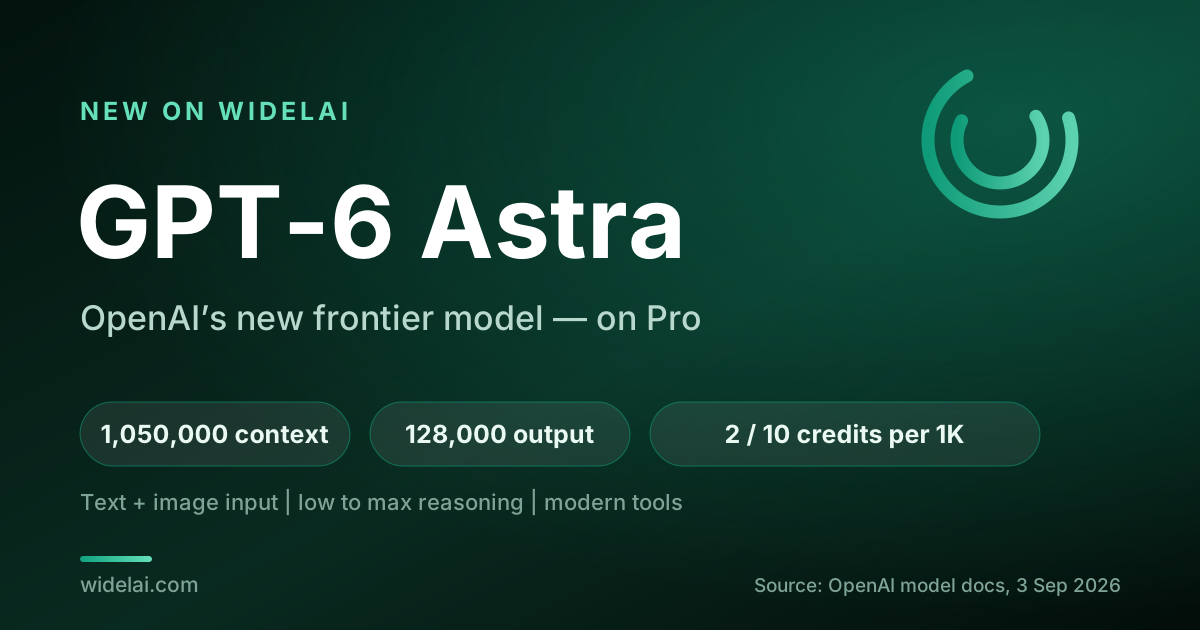
GPT-6 Astra is now available on WidelAI for Pro members. OpenAI released the model on September 3, 2026, and WidelAI now gives teams a direct way to use it alongside GPT-5.6 Sol and other leading models through one workspace and credit balance.
Astra is a substantial release rather than a naming update. It combines a 1,050,000-token context window, up to 128,000 output tokens, text and image input, configurable reasoning, and a newer generation of tool-using behavior. OpenAI says it is stronger than GPT-5.6 Sol in computer use, browsing, software engineering, science, and professional work, while potentially using fewer output tokens. This article explains the verified specifications, price, rollout, workflow changes, and safety context without inventing benchmark scores.
The official sources are OpenAI's GPT-6 Astra model page, latest-model guide, safety overview, and Path to Astra.
GPT-6 Astra at a Glance
| Specification | Verified detail |
|---|---|
| Model ID | gpt-6-astra |
| Release date | September 3, 2026 |
| Context window | 1,050,000 tokens |
| Maximum output | 128,000 tokens |
| Knowledge cutoff | April 30, 2026 |
| Input modalities | Text and images |
| Output modality | Text |
| Reasoning effort | low, medium, high, xhigh, max |
| APIs | Responses and Chat Completions |
| Core features | Streaming, function calling, structured outputs, modern tools |
| New workflow behavior | Asynchronous tools, mid-turn steering, configuration_update |
| WidelAI access | Pro plan |
| WidelAI rates | 2 input / 10 output credits per 1K tokens |
The context figure is exact: 1,050,000 tokens, not a rounded claim that should be treated as unlimited. Likewise, 128,000 is a maximum output length, not a recommended default. Good workflows still retrieve relevant material, bound the response, and verify the result.
The April 30, 2026 knowledge cutoff is newer than GPT-5.6 Sol's February 16, 2026 cutoff, but it still predates the model's release. Current research should use browsing or supplied sources. A newer cutoff reduces some gaps; it does not turn model memory into a live database.
What OpenAI Says Improved
OpenAI describes Astra as stronger than GPT-5.6 Sol across five broad areas:
- Computer use, where a model must observe an interface, choose actions, and recover when the state differs from expectation.
- Browsing, where success depends on finding, comparing, and citing useful sources rather than merely producing fluent text.
- Software engineering, including multi-step implementation, debugging, migration, and tool-driven work.
- Science, where the model needs to reason across technical evidence and expose uncertainty.
- Professional work, covering complex analysis and deliverables with real constraints.
OpenAI also says Astra can use fewer output tokens. That claim matters because output is the most expensive standard token category. It does not mean every Astra answer will be shorter, nor does it prove a lower total cost than Sol. Prompt length, reasoning effort, tools, retries, and the final output all contribute.
There are no benchmark scores in the verified source set provided for this launch package. We therefore present the official directional claims as claims, not as numerical results. Teams should evaluate Astra against their own tasks and acceptance criteria. A trustworthy model review names what is known and leaves unknown numbers blank.
One Million Tokens Is Capacity, Not a Prompting Target
Astra's 1,050,000-token context can hold large repositories, document sets, transcripts, or mixed text-and-image evidence. That makes new workflows possible, but “fits” and “helps” are different tests.
Relevant context improves a result. Irrelevant context increases cost, adds distracting instructions, and makes verification harder. For a legal-policy review, select the governing policy, cited exhibits, and the decision question rather than every document in an archive. For software engineering, include the dependency map, failing tests, relevant modules, and constraints rather than blindly uploading a repository dump.
The price schedule reinforces that discipline. Direct OpenAI API prompts above 272,000 tokens move to higher rates. A strong long-context workflow uses retrieval, progressive summaries, and evidence maps so the model can point back to the material supporting each conclusion.
Image input expands the same principle. Astra can inspect a screenshot, chart, diagram, or photographed document, but image quality and instructions matter. Ask the model to identify visible labels and uncertainty before analysis. The output is text; it does not generate an image in this configuration.
Reasoning Effort Has Five Levels
GPT-6 Astra supports low, medium, high, xhigh, and max reasoning effort. It does not support none. This is an operational control, not a score.
Use low for extraction, classification, rewriting, and simple summaries. Medium is a practical starting point for everyday coding and analysis. High suits difficult debugging, architecture, and research synthesis. Xhigh and max should be reserved for the small set of high-value problems where deeper reasoning justifies more latency and potential token use.
The best starting effort is the lowest one that consistently meets a written quality bar. If the model lacks a document, raising effort will not reconstruct it. If a tool lacks permission, max reasoning cannot authorize it. Diagnose failures before turning the control upward.
WidelAI members can focus on task instructions and model choice in the chat workspace. Developers integrating Astra directly should follow OpenAI's current request schema and evaluate effort on representative cases.
Price and WidelAI Credits
OpenAI's published direct API prices for GPT-6 Astra are:
| Category | Price per million tokens |
|---|---|
| Input | $10.00 |
| Cached input | $1.00 |
| Cache writes | $12.50 |
| Output | $50.00 |
On WidelAI, Astra uses 2 credits per 1,000 input tokens and 10 credits per 1,000 output tokens. A 10,000-token prompt with a 1,000-token answer uses approximately 20 input credits plus 10 output credits, or 30 credits at the standard WidelAI rates.
The 5:1 output-to-input credit ratio suggests two practical habits. First, supply enough relevant evidence to avoid retries; under-contexting can cost more than sending the right document. Second, ask for the smallest useful deliverable. A focused patch, decision table, or source-backed summary is usually better than a full restatement.
The WidelAI pricing transparency page publishes model credit rates for direct comparison.
Pricing above 272K prompt tokens
For direct OpenAI API requests with prompts over 272,000 tokens, input, cached input, and cache writes cost 2x, while output costs 1.5x. At those multipliers, Astra is $20 per million input tokens, $2 per million cached input tokens, $25 per million cache-write tokens, and $75 per million output tokens.
That threshold is below the maximum context window, so plan large workloads before sending them. Segment unrelated documents, retrieve the relevant passages, and keep a compact record of established decisions.
Batch, Flex, and fast mode
OpenAI lists Batch and Flex at 50% of standard pricing for eligible workloads. Those modes suit jobs that do not need an immediate interactive response. Fast mode is 2x, aimed at workloads where lower latency is worth a premium. Check the official model page for eligibility and current terms; these modes apply to direct API execution and should not be assumed to map one-to-one to WidelAI chat controls.
Responses, Chat Completions, and Tools
GPT-6 Astra works with the Responses API and Chat Completions. For tool calling, OpenAI's guidance is to use Responses. New tool-heavy integrations should follow that direction rather than defaulting to an older interface solely out of habit.
Astra supports streaming, function calling, structured outputs, and modern tools. Three workflow features are especially notable:
- Asynchronous tools support work that continues beyond a single immediate tool round trip. Applications should expose job IDs, state, retry behavior, and final results clearly.
- Mid-turn steering lets a user or application update direction during a longer run. A good steering instruction says what changed and what prior constraints remain active.
- configuration_update supports changes to configuration during a run. Treat those updates as auditable state, constrain them to allowed fields, and never let untrusted content silently change permissions.
Tool support does not make a model the security boundary. Your application must validate function arguments, enforce identity and authorization, protect secrets, confirm consequential writes, and log external side effects. Structured output improves shape; it does not prove an action is safe or correct.
Astra integrations should omit temperature, top_p, and top_logprobs. Carrying those parameters forward from a generic client is a migration bug, not a tuning strategy.
How Astra Changes a Practical Workflow
Imagine a production incident involving a failing deployment, several services, and an intermittent browser-only symptom. A productive Astra workflow would:
- receive the incident timeline, relevant logs, architecture constraints, screenshots, and known failed hypotheses;
- classify evidence and identify gaps before proposing a cause;
- use tools to inspect current state, with read and write permissions separated;
- explain competing hypotheses and the observation that would distinguish them;
- propose the smallest reversible fix;
- run or request targeted validation;
- produce a concise incident summary linked to evidence.
Mid-turn steering can add a newly discovered log without restarting the whole analysis. An asynchronous tool can wait for a build or scan with an explicit state. Configuration updates can be logged if the workflow changes an allowed setting. The model's value comes from coordinating evidence and actions, not from emitting more prose.
For simpler work—rewriting a paragraph, extracting fields, drafting routine messages—a lower-cost model may still be the right default. WidelAI's model selector makes escalation easy: use an economical model for the ordinary steps, then move the same thread to Astra when complexity or consequence rises.
Rollout and Availability
OpenAI began the Astra rollout with Trusted Access enterprises, followed by broader API and paid-plan access in the following days. WidelAI now supports GPT-6 Astra for Pro members.
Rollout language matters because availability can differ by account, product, region, and date. The official model page is the source of truth for direct API access. WidelAI members can check the model selector and plans page for platform access.
This staged release is also a sensible adoption model for teams. Start with a controlled group, measure quality and cost, inspect tool behavior, and expand when the evidence supports it. Keep GPT-5.6 Sol or another validated model as a fallback while Astra moves through production canaries.
Safety: Critical Cyber Capability Without Hype
OpenAI describes GPT-6 Astra as its first model reaching a Critical cyber-capability classification. That is a serious safety and operations fact, not a marketing superlative or an invitation to misuse the model.
For legitimate teams, the useful focus is defensive and authorized work: secure code review, configuration hardening, vulnerability triage, detection engineering, incident response, and remediation on systems they own or are explicitly permitted to assess. Surround the model with target allowlists, least-privilege credentials, approval gates for consequential actions, logging, and human review.
Do not use Astra to target systems without authorization, evade controls, or create harmful capability. The GPT-6 Astra safety overview and Path to Astra explain OpenAI's safety framing and deployment approach.
When to Choose Astra
Astra is a strong candidate when:
- a difficult software-engineering task has resisted cheaper models;
- browsing and source reconciliation are central to the result;
- an agent must use tools over several steps and adapt mid-run;
- image evidence matters alongside long text context;
- scientific or professional analysis justifies deeper reasoning;
- reviewer time or repeated failed attempts costs more than the token premium.
Choose a lower-cost model when the task is routine, high-volume, latency-sensitive without a need for deep reasoning, or already meets its acceptance criteria on another model. Frontier capability is valuable when it changes the outcome, not merely when it changes the label in the model selector.
Start With a Verifiable Task
To try Astra well, choose a task where you know what success looks like. Provide the evidence, constraints, and output format. Start with medium reasoning effort if you are working through the API, increase it only when evaluation shows a reasoning gap, and verify the result with tests, citations, or observed state.
GPT-6 Astra is available on the WidelAI Pro plan now. Open WidelAI chat, select GPT-6 Astra, and compare it with the model you use today. For a detailed decision framework, read GPT-6 Astra vs GPT-5.6 Sol. For prompting, cost control, tools, and migration steps, continue to How to Use GPT-6 Astra on WidelAI.

Do your best AI work in one place
Bring your next question, draft, file, or idea to WidelAI. Choose the model that fits the moment, keep your work together, and stay in control of privacy and usage.
Leading models, one workspace
Use powerful AI models without juggling separate tabs, accounts, or workflows.
Switch without starting over
Change models as your work evolves while keeping the conversation and context together.
The right model for every task
Choose speed for everyday work or deeper reasoning for complex questions and decisions.
Clear credits and model rates
See your balance, understand each model’s rate, and track usage from one place.
Bring your files and images
Work with documents and images alongside your prompts in the same focused experience.
Your work stays yours
Your data is encrypted in transit and at rest, and your content is never used to train AI models.