GPT-6 Sol vs GPT-6 Luna: Which Model Should You Choose?
Compare GPT-6 Sol and GPT-6 Luna on coding, high-volume work, reasoning, tools, long-context pricing, and a measured 20× cost-aware escalation strategy.
WidelAI Research
Evidence-led analysis for practical multi-model AI decisions
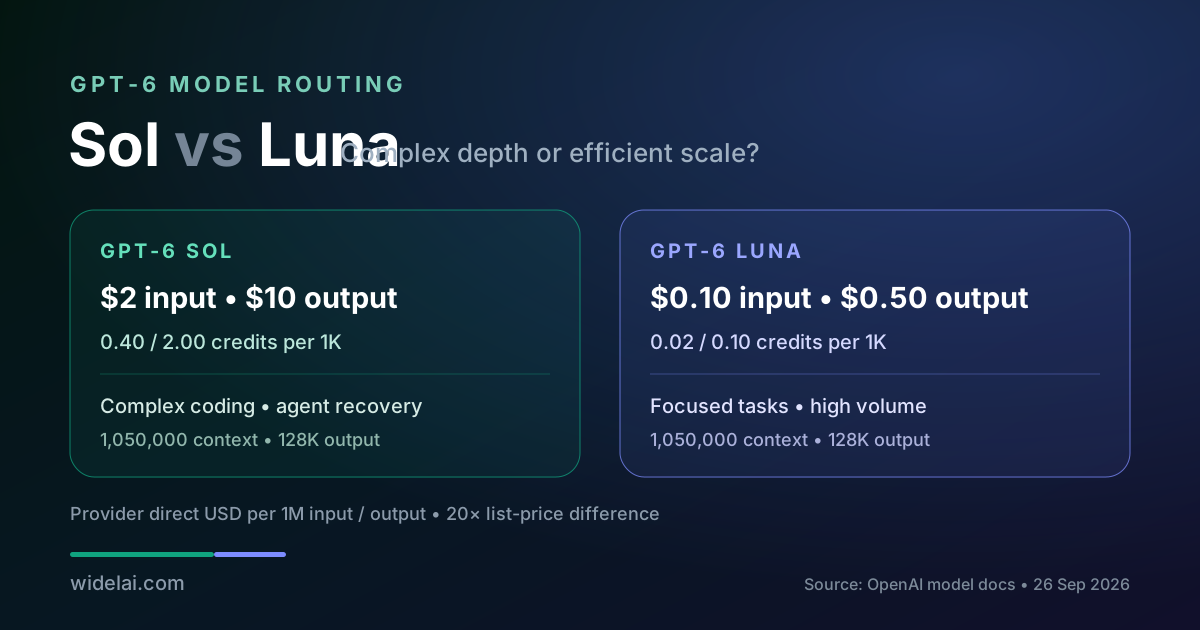
GPT-6 Sol vs GPT-6 Luna is not a choice between a “smart model” and a disposable one. OpenAI released both on September 22, 2026 with the same six reasoning levels, a represented 1,050,000-token context window, 128K maximum output, and the same modern tool-integration direction. Their intended workloads and rates are dramatically different: Sol targets complex coding and agentic workflows, while Luna is the efficient option for focused, high-volume work.
Sol costs $2 per million input tokens and $10 per million output tokens at direct Standard rates. Luna costs $0.10 and $0.50 respectively—a 20× list-price difference in both directions. That makes Luna the rational default when it can reliably meet the acceptance bar, while Sol must justify escalation through better completion, fewer loops, or lower review cost.
This comparison explains the shared foundation, the important differences, and a routing method you can evaluate in WidelAI chat. Also read the September model announcement, the cross-provider Claude Opus 5.5 vs GPT-6 Sol comparison, and the Gemini 3.8 Flash guide for alternatives outside this family.
The Short Answer
Start with GPT-6 Luna for classification, extraction, short transformation, structured drafting, high-volume support, focused tool selection, and other tasks with narrow scope and deterministic checks. Its direct rates and WidelAI credit rates are one twentieth of Sol's. Luna is also useful as a first-pass router: it can identify which cases are straightforward and send ambiguous or consequential cases to a deeper tier.
Start with GPT-6 Sol for complex multi-file coding, agent workflows with uncertain paths, difficult debugging, tool orchestration, and tasks where a failed cheap attempt costs more than the model savings. Sol's value is not a larger listed context window—it shares the same represented capacity with Luna—but the higher-capability role OpenAI assigns it.
Use a cascade when volume is high: Luna handles the common case, a deterministic validator checks the result, and Sol receives only failures or high-risk categories. Set a retry and cost ceiling so the cascade cannot loop silently.
Shared Foundation, Different Role
| Category | GPT-6 Sol | GPT-6 Luna |
|---|---|---|
| Model ID | gpt-6-sol | gpt-6-luna |
| Released | September 22, 2026 | September 22, 2026 |
| Provider position | Complex coding and agentic workflows | Most efficient focused, high-volume model |
| Context represented in catalog | 1,050,000 | 1,050,000 |
| Maximum output | 128K | 128K |
| Knowledge cutoff | Consult current model docs | May 18, 2026 |
| Reasoning | none, low, medium, high, xhigh, max | none, low, medium, high, xhigh, max |
| Default reasoning | medium | medium |
| Recommended tool API | Responses | Responses |
| Chat Completions functions | Reasoning none only | Reasoning none only |
The shared limits are useful for integration consistency. A product can preserve similar request envelopes and reasoning labels while routing between tiers. But equal context and output limits do not imply equal performance inside those limits. A million-token prompt remains a demanding reasoning environment, and a cheap model may need better retrieval or a narrower question.
Luna's May 18, 2026 cutoff is a planning boundary. Provide current data or retrieval for later events and changing facts. Sol's current model documentation should be consulted for its knowledge boundary rather than inferring one from the family name.
The 20× Price Gap
| Rate per 1M tokens | GPT-6 Sol | GPT-6 Luna | Ratio |
|---|---|---|---|
| Standard input | $2.00 | $0.10 | Sol 20× Luna |
| Cached input | $0.20 | $0.01 | Sol 20× Luna |
| Cache writes | $2.50 | $0.125 | Sol 20× Luna |
| Standard output | $10.00 | $0.50 | Sol 20× Luna |
WidelAI mirrors the direct-rate relationship through credits: Sol is 0.40 input and 2.00 output credits per thousand tokens; Luna is 0.02 input and 0.10 output credits per thousand. One credit equals $0.005, and the per-1K credit number is the direct per-1M dollar rate multiplied by 0.2.
Consider 100 routine requests, each with 8,000 uncached input tokens and 1,000 output tokens. The workload totals 800,000 input and 100,000 output tokens. At direct Standard rates:
- Sol: 0.8 × $2 + 0.1 × $10 = $2.60.
- Luna: 0.8 × $0.10 + 0.1 × $0.50 = $0.13.
The gap is $2.47 for that batch. If Luna's error rate creates hours of human review, Sol may still be the better system. If both pass the same validator, paying Sol's rate provides no economic benefit.
Direct service modes add another layer. Batch and Flex are 50% of Standard. Regional processing adds 10%. Fast mode is 2× where applicable. Compare the same service class and latency requirement rather than mixing discounted Luna processing with low-latency Sol.
Coding: When Sol Earns Escalation
Sol is built for complex coding and agentic workflows. Complexity is not the number of files alone. It includes uncertainty about the root cause, dependencies across layers, state that evolves through tool calls, and acceptance criteria that require judgment before deterministic validation can begin.
Good Sol candidates include:
- A bug whose symptom appears far from the violated invariant.
- A migration spanning API, persistence, client state, and tests.
- An agent that must inspect, edit, run commands, interpret failures, and recover.
- A refactor with compatibility constraints and a meaningful rollback plan.
- An architectural comparison requiring evidence from an unfamiliar repository.
Even for Sol, ask for investigation before editing. Require the agent to name the execution path, cite evidence, define success, and use the narrowest validation first. High or max reasoning is not a substitute for a precise task contract.
What Sol should not do by default
Routine formatting, a known one-line mapping, bulk classification, or extraction into a strict schema rarely needs the complex tier. Sol can perform those jobs, but capability without incremental value is over-routing. Start Luna on a representative set and measure whether any quality gap survives deterministic validation.
Volume Work: Where Luna Compounds Savings
Luna's intended advantage grows with repetition. Focused tasks have a stable instruction, constrained inputs, limited output, and an objective way to detect failure. Examples include document tagging, field extraction, normalization, routing, short summaries, templated replies, and simple function selection.
Design the task for the efficient tier
A narrow prompt should define:
- The allowed output schema and enum values.
- What to do when evidence is missing or ambiguous.
- A few representative edge cases.
- A maximum output length.
- A validator that rejects malformed or unsupported results.
Do not force Luna to invent certainty. An explicit needs_review result is often the most valuable category because it creates a clean handoff to Sol or a person.
Use Luna as a router
A high-volume pipeline can ask Luna to label each task as routine, ambiguous, or consequential. Routine items continue through a deterministic validator. Ambiguous items move to Sol with the original evidence and Luna's structured reason. Consequential items can require human approval before any model acts.
Evaluate router false negatives carefully. Saving credits is not worthwhile if difficult cases are incorrectly treated as routine. Tune thresholds from observed errors rather than asking the model to self-report confidence as a percentage.
Context, Caching, and the 272K Threshold
Both models are represented with 1,050,000 context and 128K maximum output, but both share a pricing threshold that can dominate large-agent economics. When the prompt exceeds 272K tokens, the entire request bills at 2× input and cache rates and 1.5× output rates.
For Sol, the adjusted Standard rates become effectively $4/M input, $0.40/M cached input, $5/M cache writes, and $15/M output for that request. For Luna, they become $0.20/M input, $0.02/M cached input, $0.25/M writes, and $0.75/M output. These figures apply the stated multipliers to illustrate the threshold; actual service-tier billing should be checked in current provider documentation.
A prompt at 271K and one at 273K can therefore have a discontinuous price relationship. Build token-budget alerts before the threshold. Retrieve only relevant files or passages, summarize resolved history, and split independent work when doing so does not remove essential relationships.
Caching preserves the 20× listed ratio: $0.20 versus $0.01 for cached input and $2.50 versus $0.125 for writes. Stable prefixes create the best reuse opportunity. If every turn rewrites the system instructions or shuffles context order, expected savings may not appear.
Long context does not remove model routing
Luna can technically receive the same context envelope as Sol, but an enormous prompt may be the wrong way to ask a focused model to work. First use retrieval or a deterministic index to select evidence. Escalate when the task requires integrating many uncertain relationships, not merely because files are available.
Reasoning Levels and API Compatibility
Sol and Luna share six reasoning levels: none, low, medium, high, xhigh, and max, with medium as the default. This shared surface simplifies a router, but effort should still be tuned independently for each tier. Luna at high is not necessarily a substitute for Sol at low, and Sol at max can waste budget on a bounded extraction.
A sensible experiment sweeps effort on a small dataset:
| Task | Luna start | Sol start | Escalate when |
|---|---|---|---|
| Exact schema extraction | none | none | Validator fails or evidence conflicts |
| Classification with nuance | low | low | Review category or unstable labels |
| Focused code change | medium | medium | Failure spans architecture |
| Multi-step agent | medium | high | Tool loops or unresolved diagnosis |
| High-impact review | Not automatic | high/xhigh | Human requests deeper analysis |
OpenAI recommends Responses for built-in tools and function calling. Chat Completions can use function calling for these models only when reasoning is none. If a production integration uses Chat Completions at medium today, simply changing the model ID is not a valid migration. Move tool workflows to Responses or deliberately use none after validating quality.
Always validate tool arguments outside the model and gate irreversible operations. For authorized defensive security tasks, keep scope, credentials, and audit logs explicit. The deeper model is not an authorization mechanism.
Build an Escalation Pipeline
Step 1: define the acceptance bar
Write deterministic checks where possible: JSON Schema validation, required citations, compiler output, unit tests, database constraints, or business-rule assertions. Where judgment is unavoidable, define a review rubric with examples.
Step 2: run Luna once
Use the lowest reasoning setting that historically meets the bar. Capture input, output, latency, tokens, tool calls, and validator results. Do not allow unbounded retries, because repeated cheap calls can erase the savings and conceal an unsuitable task.
Step 3: escalate with evidence
When Luna fails, send Sol the original source material, the task contract, the failed output, and the validator's exact error. Do not send a vague statement that “the smaller model got it wrong.” Precise failure evidence lets Sol focus on the difficult part.
Step 4: stop safely
If Sol fails or the task crosses a risk threshold, hand it to a person. Preserve logs and partial artifacts. A production router needs a terminal state other than endless model switching.
Step 5: review the routing policy
Measure how often Luna succeeds, how often escalation fixes the result, total cost per accepted item, latency percentiles, and severe false negatives. Revisit the route when prompts or tools change; yesterday's simple workload can become today's agent.
Fair Evaluation Method
Create a stratified sample rather than choosing only spectacular coding demos. Include high-volume easy cases, ambiguous edge cases, known complex tasks, and a few cases that should always require human review. Freeze fixtures and tool permissions.
For each model and reasoning level, measure first-pass acceptance, retries, invalid tool calls, output tokens, elapsed time, direct cost or WidelAI credits, and repair time. Report the distribution, not only the average: a cheap median can hide expensive failure tails.
Run threshold-specific tests around 272K tokens. Test with caching enabled and disabled. Exercise both successful and rejected function calls. Supply post-cutoff information explicitly when evaluating Luna, whose cutoff is May 18, 2026.
Avoid model-graded-model evaluation as the sole judge. Deterministic validators and qualified human review provide stronger evidence. If one provider publishes a benchmark, label it as provider-reported and do not treat it as an independent family comparison.
The pricing transparency page helps interpret WidelAI usage, while the model catalog provides the available choices. Production decisions should still be based on your accepted outcomes and measured traffic shape.
Decision Matrix
| Workload characteristic | Choose Luna | Choose Sol |
|---|---|---|
| High volume, narrow schema | Yes | Only after repeated failures |
| Objective validator | Strong default | Escalation tier |
| Ambiguous root cause | Initial triage only | Strong default |
| Multi-file agent with recovery | Possibly for bounded steps | Strong default |
| Long prompt above 272K | Reconsider prompt first | Reconsider prompt first |
| Consequential action | Assist under review | Assist under review |
| Same accepted quality | Prefer Luna | No demonstrated premium value |
| Fewer Sol retries offset price | No | Yes, if measurements prove it |
Other models can occupy the same router. Claude Opus 5.5 is a cross-provider candidate for sustained coding and knowledge work. Gemini 3.8 Flash offers a different Flash-tier approach. The broader September bundle guide places all four together.
Primary references are OpenAI's official GPT-6 Sol documentation, GPT-6 Luna documentation, and Sol and Luna announcement. The specifications and pricing rules above summarize and rephrase those sources.
Conclusion: Default Efficiently, Escalate Deliberately
GPT-6 Luna should be the first economic test for focused, high-volume work because its listed input, cache, write, output, and WidelAI credit rates are all one twentieth of Sol's. GPT-6 Sol earns its place when task complexity, agent recovery, or reduced human repair produces a better completed-work result.
The shared context limit and reasoning labels make routing technically convenient, but they do not decide quality. Build validators, cap retries, monitor the 272K pricing threshold, and pass exact failure evidence into escalation. The strongest Sol-versus-Luna policy is not a permanent winner; it is a measured pipeline that keeps routine work inexpensive and gives complex work the depth it actually needs.

Do your best AI work in one place
Bring your next question, draft, file, or idea to WidelAI. Choose the model that fits the moment, keep your work together, and stay in control of privacy and usage.
Leading models, one workspace
Use powerful AI models without juggling separate tabs, accounts, or workflows.
Switch without starting over
Change models as your work evolves while keeping the conversation and context together.
The right model for every task
Choose speed for everyday work or deeper reasoning for complex questions and decisions.
Clear credits and model rates
See your balance, understand each model’s rate, and track usage from one place.
Bring your files and images
Work with documents and images alongside your prompts in the same focused experience.
Your work stays yours
Your data is encrypted in transit and at rest, and your content is never used to train AI models.