GPT-6 Astra vs GPT-5.6 Sol: Specs, Price, and Use Cases
Compare GPT-6 Astra and GPT-5.6 Sol on verified specs, token price, reasoning, tool workflows, migration risk, and real use cases—without invented benchmark scores.
WidelAI Research
Evidence-led analysis of frontier AI models
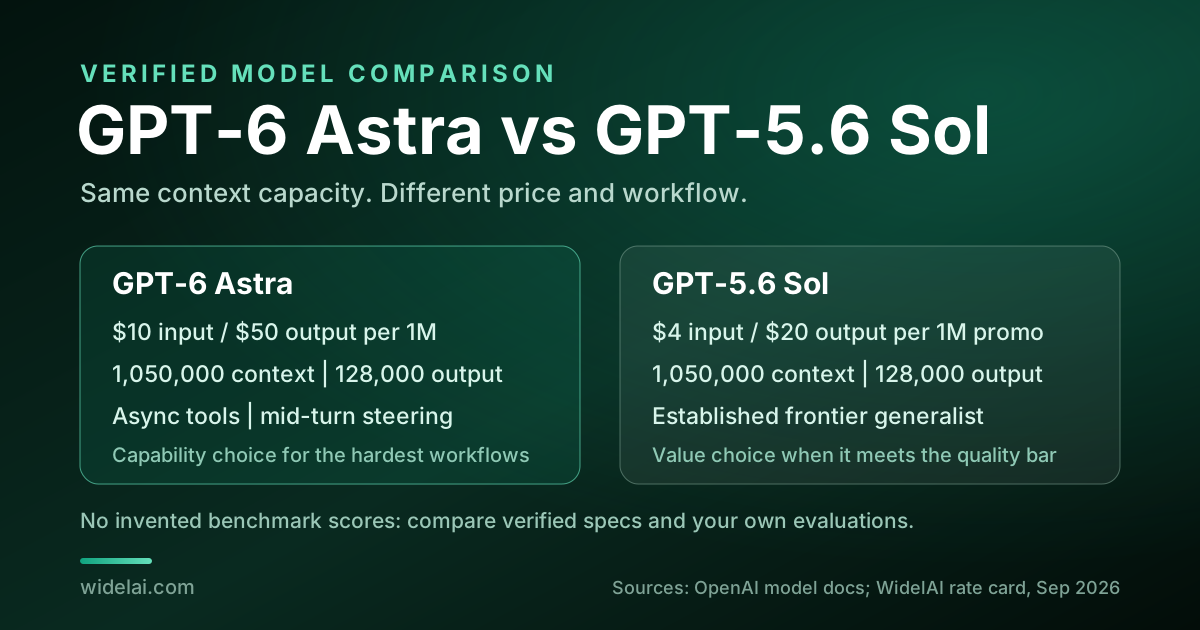
GPT-6 Astra vs GPT-5.6 Sol is not a simple new-model-wins decision. Astra brings OpenAI's latest reasoning and tool workflow, a newer knowledge cutoff, and an official claim of stronger performance across several important categories. Sol remains a capable frontier model with the same million-token-class context and a materially lower standard token price. The right choice depends on the work, the verification standard, and how often you need the newer capabilities.
This comparison focuses on verified specifications, price, workflow behavior, migration, and practical use-case selection. OpenAI has said GPT-6 Astra is stronger than GPT-5.6 Sol in computer use, browsing, software engineering, science, and professional work, and that Astra can use fewer output tokens. OpenAI has not provided benchmark numbers in the source set used for this article, so we will not invent scores or turn directional claims into fake precision.
Both models are available through WidelAI's Pro plan. For the launch overview, read GPT-6 Astra Is Now Available on WidelAI. For implementation detail, continue with How to Use GPT-6 Astra on WidelAI.
The Short Answer
Choose GPT-6 Astra when the task is difficult enough to benefit from stronger reasoning, browsing, computer use, software engineering, scientific analysis, or professional work; when you need Astra's newer tool behavior; or when output efficiency matters more than the higher per-token rate.
Choose GPT-5.6 Sol when you need a proven frontier generalist, the workload is already meeting its quality target, and standard token cost matters more than Astra's capability gains. During OpenAI's promotion available at least through November 21, 2026, Sol costs $4 per million input tokens and $20 per million output tokens—40% of Astra's standard input and output rates.
The best operational policy is not “migrate everything.” It is keep Sol for workloads it already handles, then evaluate Astra on the expensive failures, high-value decisions, and new agentic workflows.
Verified Specification Comparison
| Specification | GPT-6 Astra | GPT-5.6 Sol |
|---|---|---|
| Model ID | gpt-6-astra | gpt-5.6-sol |
| Release | September 3, 2026 | July 2026 |
| Context window | 1,050,000 tokens | 1,050,000 tokens |
| Maximum output | 128,000 tokens | 128,000 tokens |
| Knowledge cutoff | April 30, 2026 | February 16, 2026 |
| Input | Text and images | Text and images |
| Output | Text | Text |
| APIs | Responses and Chat Completions | Responses and Chat Completions |
| Astra-specific reasoning efforts | low, medium, high, xhigh, max | Not assumed in this comparison |
| Tool guidance | Use Responses for tool calling; modern and asynchronous tools, mid-turn steering, configuration_update | Keep existing verified integration; evaluate before assuming Astra workflow parity |
| Unsupported Astra controls | Omit temperature, top_p, top_logprobs | Follow Sol's own model documentation |
The equal context and output limits are important. Astra is not an upgrade because it can simply hold more tokens than Sol; both list 1,050,000 context tokens and up to 128,000 output tokens. Astra's practical differences are the newer cutoff, reasoning controls, tool workflow, capability claims, and economics.
The 73-day cutoff difference can matter for events and software changes between February 16 and April 30, 2026. It does not remove the need for retrieval. Both cutoffs predate the September launch, and neither should be trusted as a source for current facts without supplied documents or browsing.
Price: Astra Costs More Per Token
OpenAI's published standard rates are:
| Model | Input / 1M | Cached input / 1M | Cache writes / 1M | Output / 1M |
|---|---|---|---|---|
| GPT-6 Astra | $10.00 | $1.00 | $12.50 | $50.00 |
| GPT-5.6 Sol | $4.00 promotional | $0.40 promotional | $5.00 promotional | $20.00 promotional |
OpenAI states that Sol's promotional rates are available at least through November 21, 2026. At those rates, Astra input and output each cost 2.5x as much per token; Sol cache writes are 1.25x its uncached input rate.
On WidelAI, the corresponding standard credit rates are:
| Model | Input credits / 1K | Output credits / 1K |
|---|---|---|
| GPT-6 Astra | 2.00 | 10.00 |
| GPT-5.6 Sol | 0.80 | 4.00 |
Consider a workload that sends 50,000 input tokens and receives 5,000 output tokens. At WidelAI's listed rates, Astra uses about 100 input credits and 50 output credits, for 150 total. Sol uses about 40 input credits and 20 output credits, for 60 total. That is not a prediction of invoice cost for every workflow; it is a transparent standard-rate example showing why Astra should earn its place through better outcomes or fewer retries.
OpenAI says Astra can use fewer output tokens than GPT-5.6 Sol. That could offset part of the output-price difference in workloads where Astra reaches the correct result more directly. But “can” is not a guaranteed discount. Measure total tokens, tool calls, retries, and human review on your own evaluation set.
Astra's Long-Context Price Step
GPT-6 Astra prompts over 272,000 tokens use a higher pricing tier: 2x for input, cached input, and cache writes, and 1.5x for output. At that tier, the published Astra rates become $20 per million input tokens, $2 per million cached input, $25 per million cache writes, and $75 per million output.
This threshold changes model selection for large-document workflows. A prompt can fit inside Astra's 1,050,000-token window and still be economically inefficient. Before crossing 272K, ask whether retrieval, document selection, or a staged summary can preserve the evidence that actually affects the answer.
Do not project Astra's threshold onto GPT-5.6 Sol without checking Sol's current official documentation. Pricing rules are model-specific. The right comparison uses the real request shape and applicable terms for each model, not just the headline context number.
OpenAI also lists Batch and Flex at 50% and fast mode at 2x for Astra. Batch and Flex suit eligible asynchronous workloads where latency is flexible; fast mode is for cases where reduced latency justifies double price. These are Astra execution options, not evidence that the model becomes more or less intelligent.
What OpenAI Actually Claims About Capability
OpenAI's official Astra material says the model is stronger than GPT-5.6 Sol in:
- computer use;
- browsing;
- software engineering;
- science;
- professional work.
It also says Astra can use fewer output tokens. Those are meaningful claims because they span both digital action and knowledge work, but they are not a license to fabricate a leaderboard. Without published scores in the cited material, responsible selection requires an internal evaluation.
Build a test set from work your team recognizes. Include successful Sol cases, expensive Sol retries, known failures, adversarial inputs, tool errors, image inputs, long-context prompts, and tasks where a reviewer can establish the right answer. Score both models on completion quality, evidence, constraint adherence, latency, total tokens, tool success, and reviewer time.
Astra wins a workload when its total value is higher—not merely when a response sounds more polished. If it reduces a three-pass code investigation to one verified patch, the higher rate may be cheap. If it rewrites a short email no better than Sol, it is wasteful.
Reasoning and Prompt Behavior
Astra exposes five reasoning-effort levels: low, medium, high, xhigh, and max. There is no supported “none” effort. This gives you a routing control inside the model: low for bounded transformations, medium for general analysis, high for difficult multi-step problems, and xhigh or max for rare work where additional reasoning is worth the latency and cost.
Do not begin every Astra call at max. Prompt quality and evidence quality remain more important than brute-force effort. If a result misses a constraint because you never provided the policy, increasing effort only makes the model think harder about incomplete information.
For a fair Sol comparison, keep the output contract constant and select each model's documented controls. Do not send Astra-only settings to Sol or carry unsupported sampling parameters into Astra. In particular, omit temperature, top_p, and top_logprobs from Astra requests.
Tool Calling and Workflow Behavior
Both model families support modern API interaction, but new Astra integrations should favor the Responses API for tool calling. Astra supports streaming, function calling, structured outputs, modern tools, asynchronous tools, mid-turn steering, and configuration_update.
These capabilities affect application architecture:
- Asynchronous tools let a run wait on a job that has an explicit lifecycle rather than pretending every operation is immediate.
- Mid-turn steering lets you update direction during a longer workflow without discarding all progress.
- configuration_update lets supported configuration change during the run; applications should log and constrain those updates.
- Structured outputs make downstream parsing more reliable, but authorization and semantic validation still belong in your code.
Sol remains the lower-risk choice for an established production flow that already passes its evaluations. Astra is attractive when you are building a new tool-intensive workflow or when Sol's current tool use is the source of failures. Do not infer that every Astra behavior applies to Sol. Check each model's official documentation and test the exact event stream, function schema, retry path, and cancellation behavior you depend on.
Migration: Change More Than the Name, Less Than Everything
A good migration isolates variables. Start with the same prompts, tools, and evaluation cases, then change the model ID. Once you have a baseline, introduce Astra-specific reasoning or workflow features one at a time.
Required review points
- Replace the model identifier with gpt-6-astra in a canary environment.
- Remove temperature, top_p, and top_logprobs from Astra requests.
- Select low, medium, high, xhigh, or max rather than none.
- For tool calls, move new work toward Responses and verify streaming events.
- Recalculate standard and over-272K budgets.
- Test image inputs and the 128K output ceiling only where the product genuinely needs them.
- Re-run safety, refusal, authorization, and tool-permission tests.
- Compare total workflow cost, including retries and review—not only token rates.
- Roll out gradually with a clear fallback to Sol.
What can stay stable
Your business rules, authorization layer, tool-side validation, logging, user consent, and acceptance criteria should not depend on a model. Preserve them. The model proposes structured actions; your application checks whether they are allowed.
Likewise, do not rewrite every prompt before measuring the model switch. If Astra improves or regresses, you need a stable baseline. Prompt optimization comes after the first controlled comparison.
Use-Case Selection
Choose Astra for hard software engineering
OpenAI specifically claims improvement over Sol in software engineering. Astra is the candidate for cross-repository diagnosis, architecture trade-offs, difficult migrations, and agentic coding where tool reliability matters. Provide tests and require the model to explain the root cause before proposing a minimal change.
Keep Sol for routine implementation, boilerplate, straightforward refactors, and mature coding flows that already pass. The higher Astra rate is hard to justify when the task is mechanically clear.
Choose Astra for research with browsing
Astra is the stronger candidate when the work depends on browsing, reconciling sources, or synthesizing technical and professional evidence. Require citations, publication dates, and a section for unresolved conflicts. The model's April 30, 2026 cutoff still means retrieval is essential for later facts.
Sol remains a sensible choice for summarizing a supplied, bounded set of documents when it already meets the accuracy bar.
Choose Astra for computer use
Computer use demands observation, planning, and recovery from interface changes. OpenAI says Astra is stronger here. Use it for workflows where the model must inspect state and adapt, while requiring confirmation before destructive or financial actions.
For stable, deterministic UI automation, ordinary software remains preferable to either model. A model should not replace a reliable script without a clear reason.
Choose Astra for science and professional work
Astra is the evaluation target for complex scientific synthesis and high-value professional analysis. Ask for evidence mapping, assumptions, and limitations. In regulated or consequential settings, retain qualified human review; model capability does not transfer accountability.
Sol can remain the value choice for drafts, routine summaries, and high-volume document handling.
Route mixed workflows
Many workflows should use both. Sol can classify, extract, and condense large volumes. Astra can then reason over the selected evidence, resolve difficult conflicts, or operate tools. This routing pattern controls cost while preserving Astra for the part where OpenAI claims a meaningful advantage.
Safety and Authorized Use
GPT-6 Astra is OpenAI's first model classified at a Critical cyber-capability level. That fact should be discussed without hype. It means teams need stronger operational boundaries, not that every user should pursue offensive capability.
Keep cyber use defensive and authorized: review code you own, harden configurations, triage vulnerabilities, improve detections, analyze incidents, and validate remediation. Enforce target scope and credentials outside the model. Read OpenAI's safety overview and Path to Astra for the official rollout and safeguards.
Decision Table
| If your priority is… | Start with… | Why |
|---|---|---|
| Lowest cost for an existing frontier workflow | GPT-5.6 Sol | Promotional $4/$20 per million standard input/output vs Astra's $10/$50 |
| Difficult coding or tool-driven engineering | GPT-6 Astra | OpenAI claims stronger software engineering; newer tool workflow |
| Browsing and source synthesis | GPT-6 Astra | OpenAI claims stronger browsing and professional work |
| Routine bounded summarization | GPT-5.6 Sol | Lower rate when quality is already sufficient |
| Computer-use adaptation | GPT-6 Astra | OpenAI claims stronger computer use |
| Very large prompts | Evaluate both carefully | Same listed context capacity, but Astra crosses a price step above 272K |
| High-volume mixed work | Route between both | Use Sol for routine stages and Astra for hard decisions |
The Bottom Line
GPT-6 Astra is the capability choice; GPT-5.6 Sol is often the value choice. Astra offers a newer cutoff, configurable reasoning effort, newer tool behavior, and official directional gains in computer use, browsing, software engineering, science, and professional work. Sol offers the same listed context and output limits at lower standard input and output rates.
Do not migrate by reputation. Test representative work, count complete workflow cost, and route each task to the least expensive model that meets its quality and safety bar. On WidelAI, both models share one workspace and credit balance, making that policy practical.
Open WidelAI chat, compare the models on a task you can verify, then read the practical Astra guide before moving a production workflow.

Do your best AI work in one place
Bring your next question, draft, file, or idea to WidelAI. Choose the model that fits the moment, keep your work together, and stay in control of privacy and usage.
Leading models, one workspace
Use powerful AI models without juggling separate tabs, accounts, or workflows.
Switch without starting over
Change models as your work evolves while keeping the conversation and context together.
The right model for every task
Choose speed for everyday work or deeper reasoning for complex questions and decisions.
Clear credits and model rates
See your balance, understand each model’s rate, and track usage from one place.
Bring your files and images
Work with documents and images alongside your prompts in the same focused experience.
Your work stays yours
Your data is encrypted in transit and at rest, and your content is never used to train AI models.